
Dark Wood Floors: A Practical Guide to Designing With Them
Light, contrast, texture and the way the color is made: what decides whether a dark floor works.
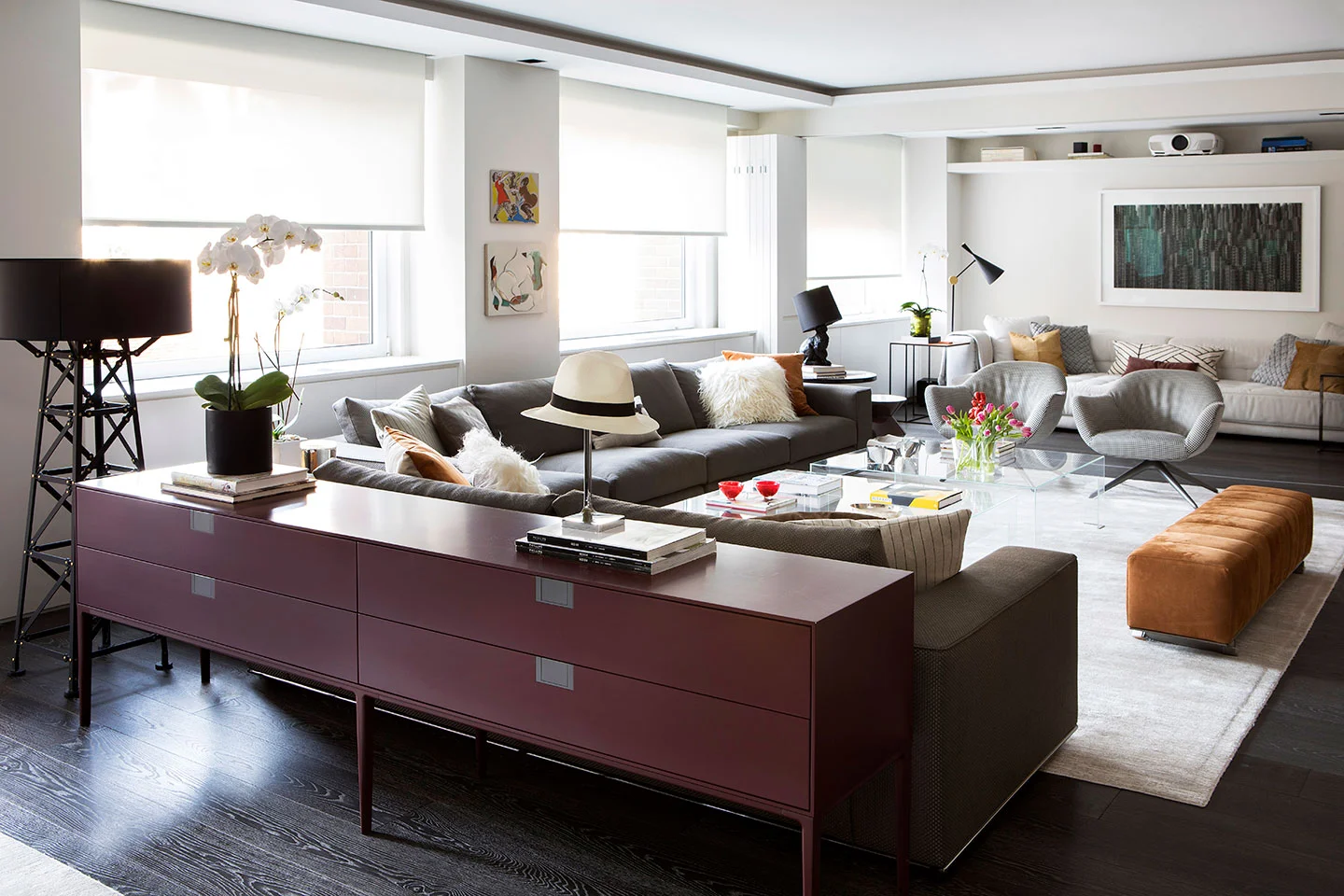
Dark wood floors work when the rest of the room gives them light and contrast. A deep floor absorbs light rather than reflecting it, so it anchors a room and makes pale walls and furniture stand out, but it needs light from the walls and ceiling, matte surfaces and some texture to avoid feeling heavy. How the color is made matters as much as the shade: color that runs through the wood wears far better than a dark stain on the surface.
Do dark wood floors make a room look smaller?
Not by themselves. A dark floor reads as a firm base, and the eye measures a room more by its walls and ceiling than by the floor. What shrinks a room is dark on every surface: dark floor, dark walls, heavy furniture and little daylight. Keep the walls light, let daylight and lamps reach the upper half of the room, and a dark floor tends to make the space feel more defined rather than smaller.
In small rooms the edges matter. Skirting boards painted the wall color, rather than the floor color, keep the floor from creeping up the walls. Furniture on slender legs lets the floor run underneath and keeps the room from looking crowded.
How do you light a room with a dark floor?
A dark floor returns little of the light that falls on it, so the room depends on light bounced off the walls and ceiling. Three habits help:
- Light the walls, not the floor. Wall lights, uplighters and floor lamps that wash the walls keep the room bright without throwing hard pools of light onto the floor, where they would pick out every footprint.
- Diffuse the daylight. Sheer curtains or linen blinds soften low sun and spread it across the room instead of striking one patch of floor.
- Choose a matte floor. A gloss finish on a dark floor acts like a mirror: it doubles every window and shows every scratch. A matte surface scatters light and lets the grain show.
Raking light, low morning or evening sun across the floor, is where a dark floor looks its best. It brings out the grain and texture that a flat, overhead light hides.
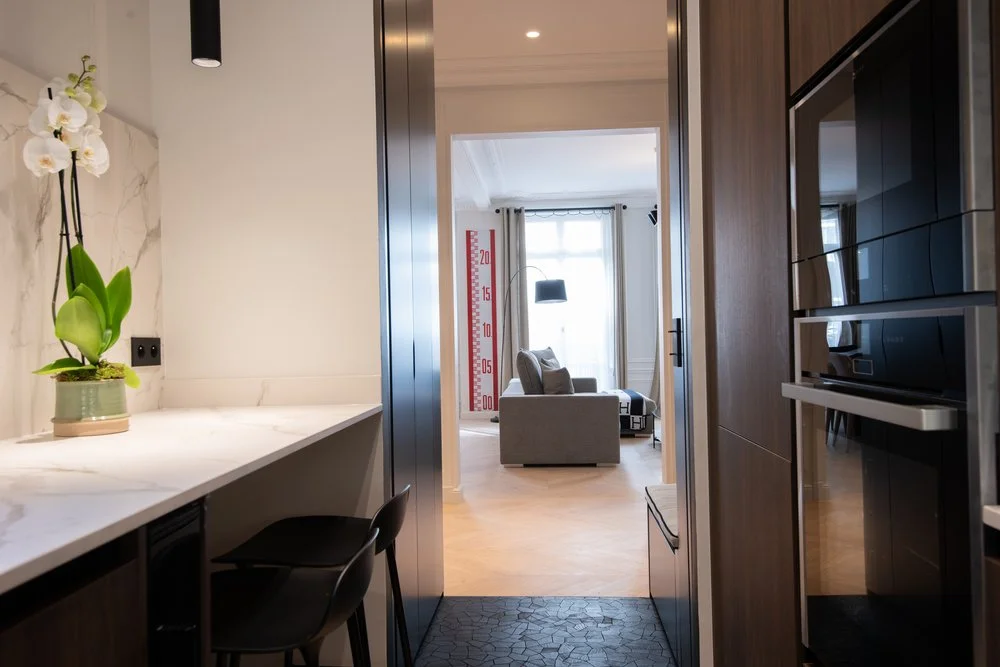
In this private apartment in Paris, Opus Black runs through the kitchen passage, set against white stone and a pale oak floor in the room beyond: the contrast is what makes the dark floor read.
What goes with dark wood floors?
Contrast in tone and in texture. A dark floor next to pale, matte, slightly rough materials looks rich; next to more dark, smooth surfaces it can look flat. Pairings that work well:
| Material | What it does | Where to use it |
|---|---|---|
| Lime plaster, travertine | Warm, pale contrast with a soft texture | Walls, fireplace surrounds, low tables |
| Linen, wool, bouclé | Softens the floor and diffuses light | Curtains, upholstery, rugs |
| Raw concrete, black granite | Tone on tone, quieter and more graphic | Kitchen counters, hearths, plinths |
| Brass, bronze | Small warm highlights against the dark ground | Lighting, hardware, frames |
For walls, warm off-whites, sand and greige usually sit better on a dark floor than a cold, bright white, which can make the contrast harsh. Rugs in pale wool or jute break up a large dark area and help with dust in the places people walk most.
Do dark wood floors show dust and scratches?
More than mid-tone floors, yes. Pale dust, pet hair and the light-colored fibers of a fresh scratch all stand out on a dark surface, and a gloss finish makes it worse. Four things reduce the problem:
- A matte finish, which scatters light and hides fine marks.
- Visible grain or texture, which breaks up the surface so small marks blend in. Endgrain is particularly forgiving because marks disappear into the growth rings and the variation between blocks.
- A slightly lighter dark: deep brown or charcoal forgives more than pure black.
- Color that runs through the wood, so a scratch does not uncover a pale layer underneath.
Day to day, a dry microfiber mop and doormats at the entrances do most of the work. Felt pads under chairs and table legs prevent the scratches dark floors show most.
Stained, smoked or charred: how is a dark floor made?
A stain is a pigment applied to the surface. It is the most common way to darken a floor and the least forgiving: a scratch deep enough to cut through it shows the paler wood beneath as a light line, and sanding the floor removes the color.
Smoking, also called fuming, exposes oak to ammonia, which reacts with the tannins in the wood and darkens it from within. There is no pigment, and the result varies from board to board because each piece of oak holds a different amount of tannin. OscarOno Paris's Smoke finish is smoked through the full depth of the oak, so a scratch shows the same color as the surface.
Charring, the Japanese shou sugi ban tradition, burns the surface of the wood to a deep black. OscarOno Paris's Black finish is charred this way. Neither Smoke nor Black uses a stain.
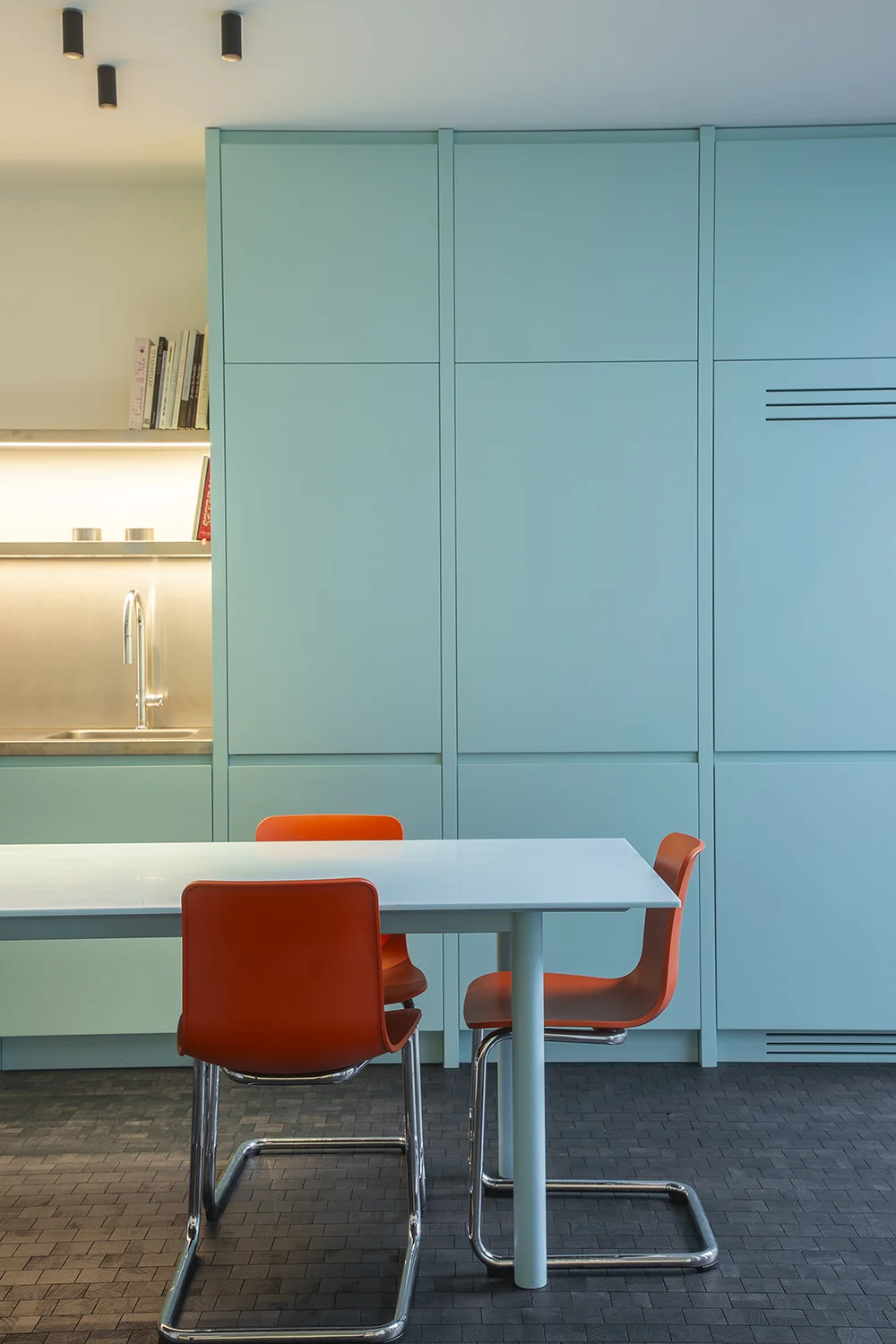
At the Galerie d'Art Carole Lambert in Paris, Cube, a grid of endgrain oak blocks, is laid in Black. Pale cabinetry and bright chairs stand out against it, and the block texture keeps a black floor from looking flat.
Which dark wood floor suits which room?
Pattern changes how a dark floor reads. Straight boards in a dark color give a calm, continuous surface that suits living rooms and bedrooms. Endgrain makes a dark floor more textured and less uniform, which hides wear in halls, shops and restaurants. A rule of thumb: the busier the room, the more grain and texture you want in a dark floor, and the less you want a smooth, uniform black.
OscarOno Paris makes dark floors three ways. Droit, the straight oak plank, comes in twelve lacquered colors, including dark ones; the Braise project in Paris, for example, uses a charcoal color called Rocher Charbon. Opus, an endgrain oak floor in an organic pattern, and Cube come in Natural, Smoke and Black, with no stain.
Frequently asked questions
Do dark wood floors make a room look smaller?
Not on their own. A dark floor reads as a firm base; what makes a room feel small is dark walls, heavy furniture and little light on top of it. Keep the walls light and light them well, and a dark floor makes a room feel defined rather than cramped.
Do dark wood floors show dust and scratches?
More than mid-tone floors. Pale dust and the light fibers of a scratch stand out on a dark surface, especially a glossy one. A matte finish, visible grain or endgrain texture, and color that runs through the wood rather than a surface stain all make marks much less visible.
What color walls go with dark wood floors?
Warm off-whites, sand, greige and lime plaster usually work best. They give clear contrast without the harshness of a cold, bright white, and they reflect the light a dark floor absorbs.
What is the difference between stained and smoked oak?
A stain is pigment on the surface, so a deep scratch shows paler wood beneath. Smoked oak is darkened by ammonia reacting with the tannins inside the wood, with no pigment, so the color is part of the wood itself and varies naturally from board to board.
Dark floors by OscarOno Paris
Droit is flatgrain select oak, 12 mm with a 4 mm top layer, 150 mm or 190 mm wide, in twelve lacquered colors, rated usage class 33 for heavy commercial traffic. Opus and Cube are endgrain oak in Natural, Smoke (smoked through the full depth) or Black (charred, in the shou sugi ban tradition), rated usage class 34 for very heavy commercial traffic. All three carry a Cfl-s1 fire rating and are FSC and PEFC certified.
Dark colors change more with light than pale ones, so judge them in the room itself. Order samples, and find spec sheets, CAD and 3D files in the library.
More from the Atelier
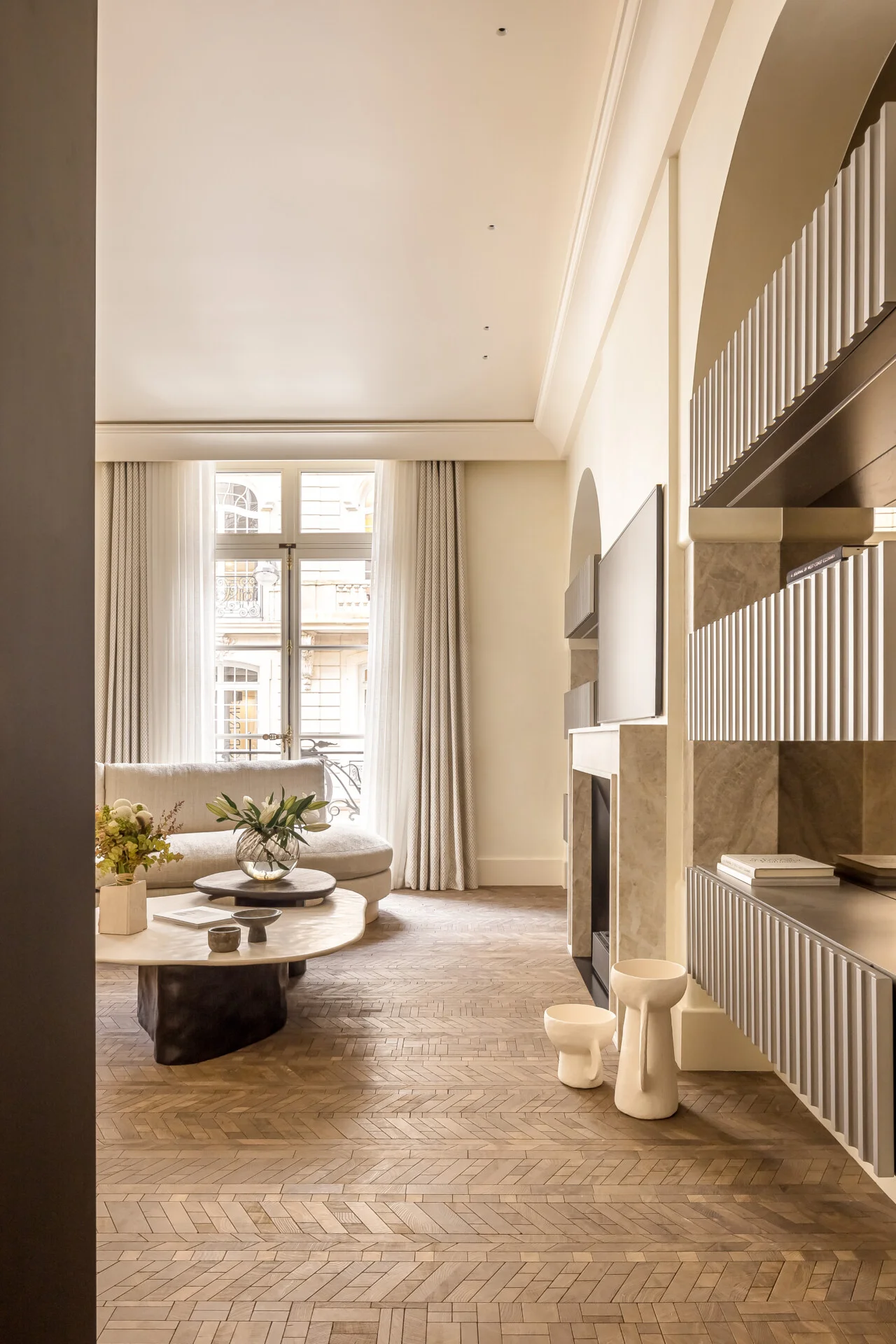
What Is Wood Terrazzo Flooring? An Architectural Guide
Wood terrazzo flooring unites reclaimed endgrain oak offcuts and mineral ground, creating continuous, tactile surfaces designed for circular luxury interiors.

Modern Versailles Parquet: The Classic Panel in Today's Interiors
The woven oak panel first laid in a palace still works in a contemporary room. What changes is the color, the construction and how freely the weave is drawn.
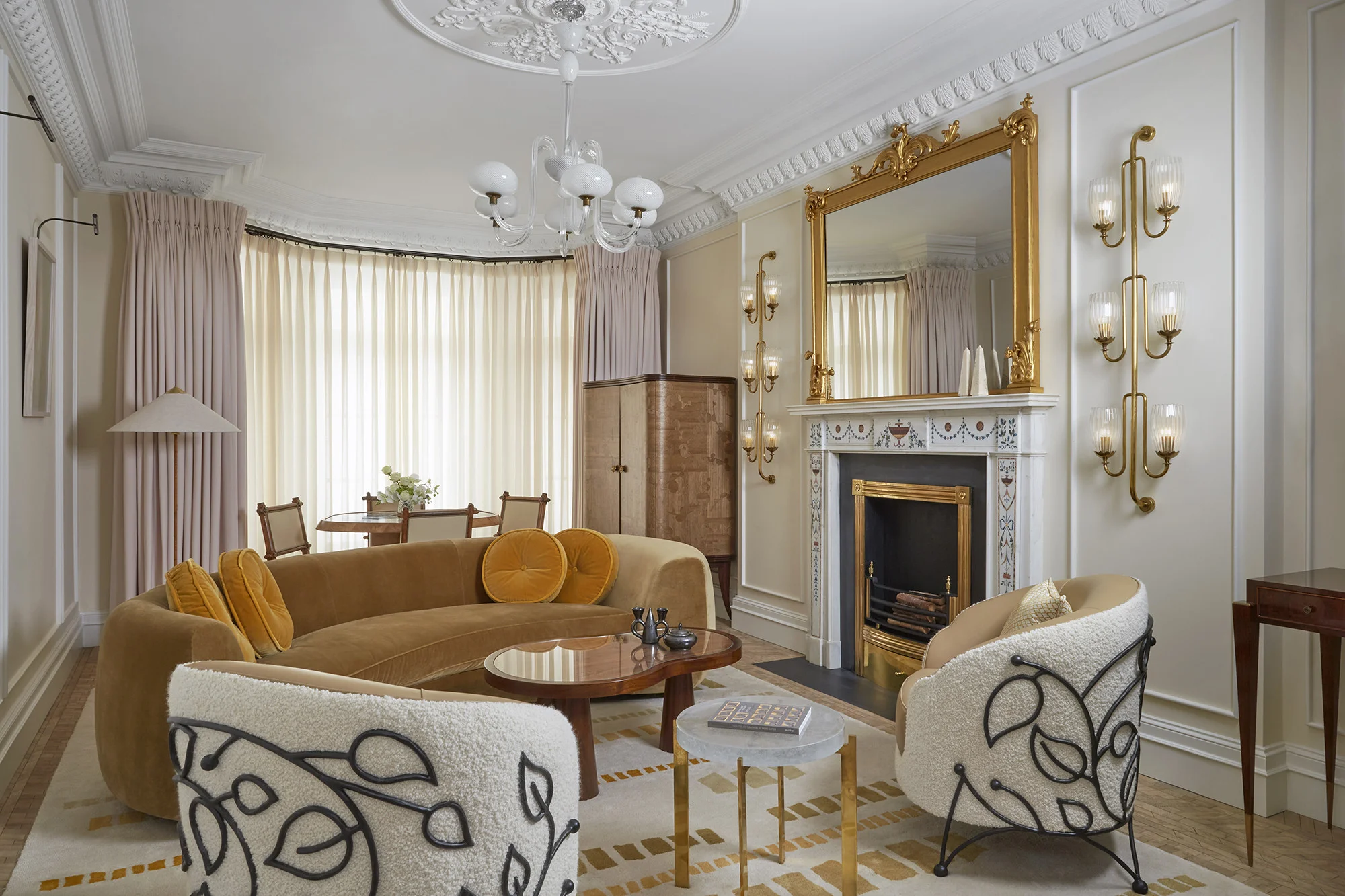
Wood Floor Interior Design: Pairing Oak with Linen, Stone and Brass
Start with the floor, then balance it: stone for weight, linen for softness, brass for light. A practical guide to designing a room around wood.