
Curved Wood Flooring in Architecture: Designing Non-Linear Oak
How non-linear geometries and interlocking curves redefine interior flow.
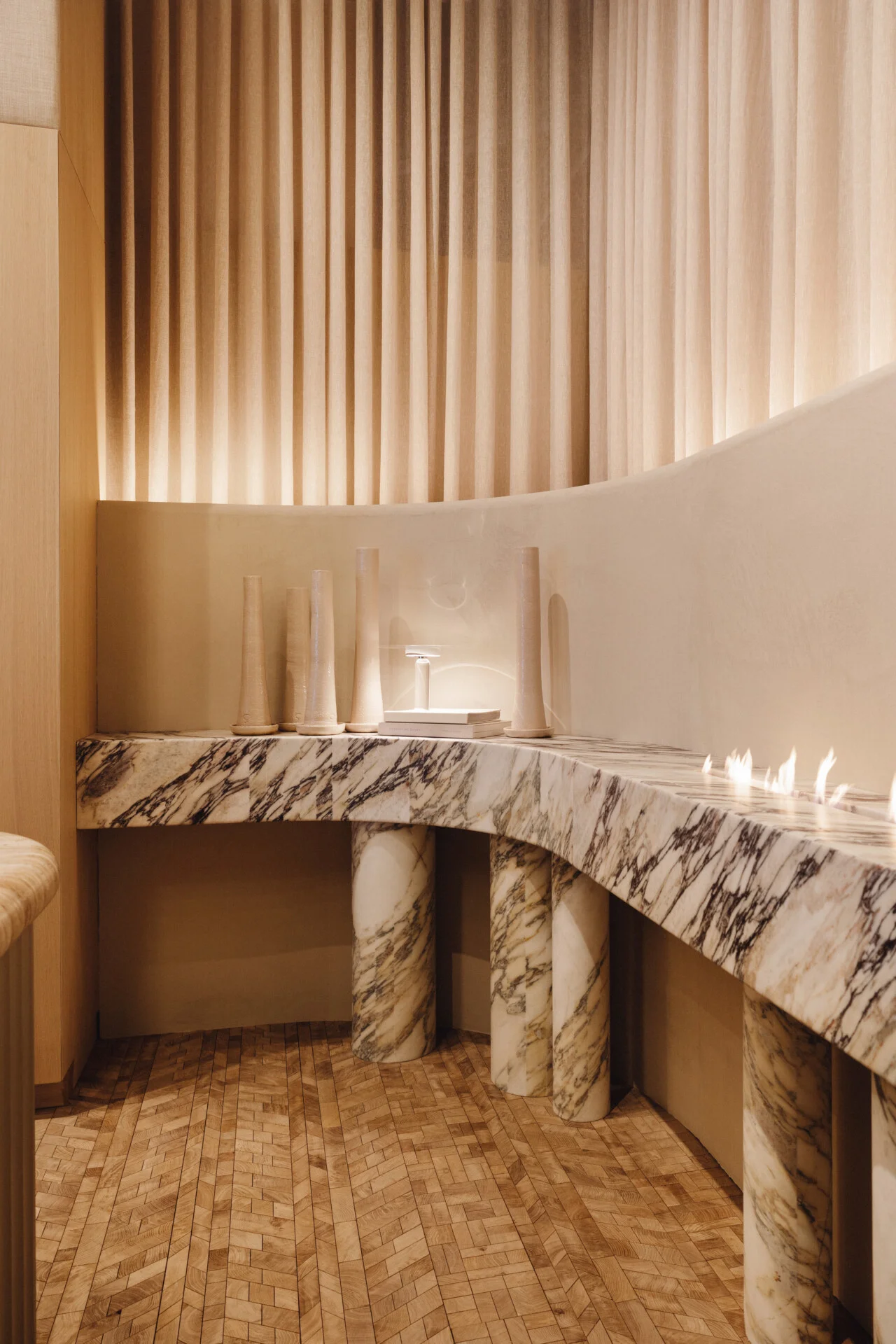
Curved wood flooring introduces fluid motion into interior architecture by replacing rigid rectilinear planks with soft radii and interlocking arcs. By releasing the floor plane from right angles, non-linear oak surfaces guide circulation naturally and soften spatial transitions across large open layouts. Achieving this organic continuity requires engineered multi-layer construction, calibrated subfloor preparation, and deliberate perimeter allowance for seasonal expansion.
What is curved wood flooring and how does it reshape room circulation?
Curved wood flooring is an architectural timber installation that employs curved profiles, softened radii, or interlocking serpentine shapes instead of standard parallel boards. This approach breaks the longitudinal visual axis typical of straight plank floors, allowing the floor plane to direct sightlines and footsteps along curvilinear paths.
In contemporary open-plan spaces, rectilinear floor boards can create visual tension against curved partitions, rounded joinery, or organic stone islands. When the flooring itself adopts soft contours, it eliminates hard intersections and establishes harmony between horizontal surfaces and three-dimensional millwork. Movement through the space feels unforced, as the eye follows sweeping contours rather than stepped breaks.
Specifying non-linear surfaces does not mean abandoning structural discipline. Precision tongue-and-groove milling ensures that adjacent modules fit together flush, preserving structural integrity across the entire surface while creating an unbroken visual rhythm.
Why choose curved oak parquet over straight rectilinear boards?
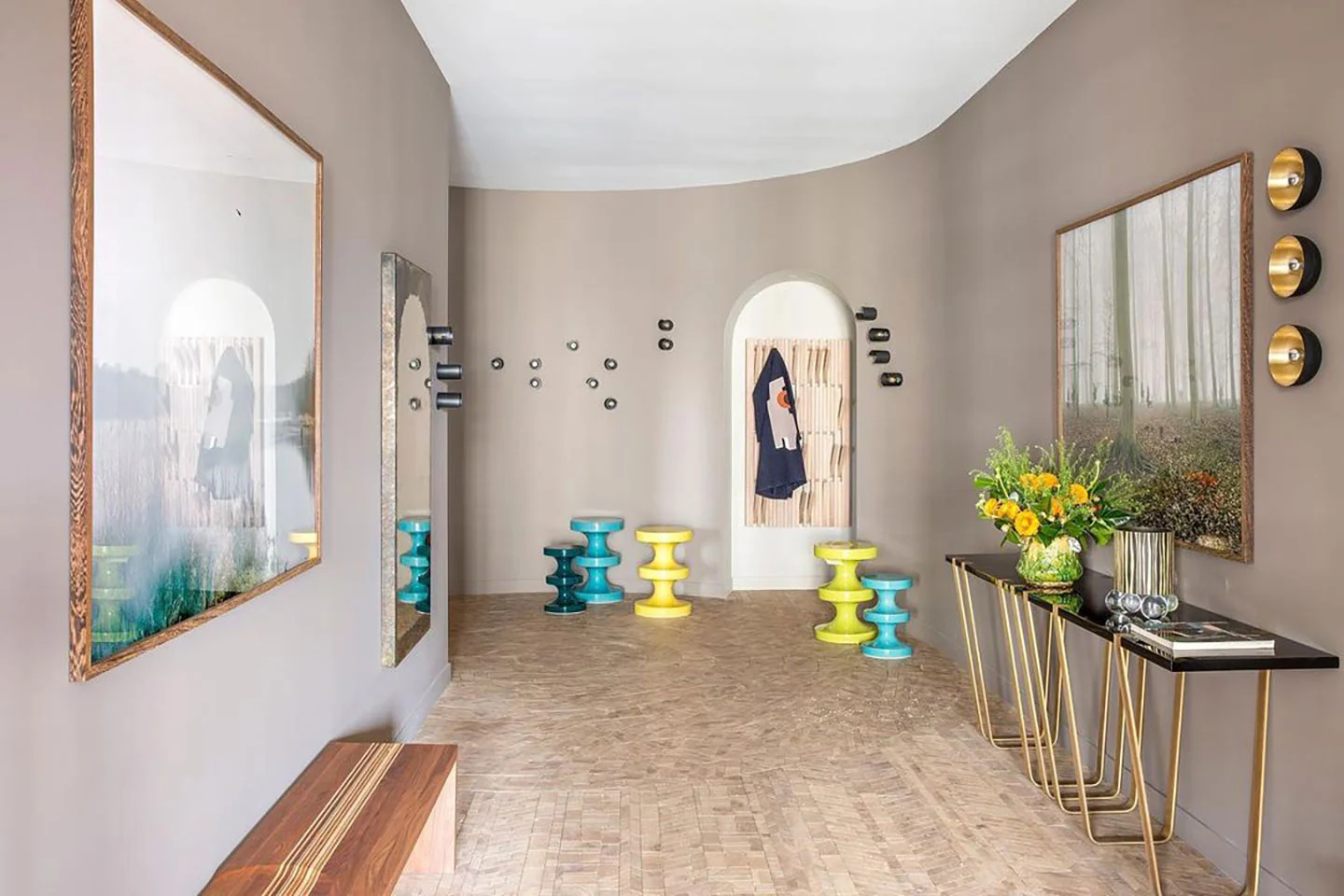
Curved oak parquet offers a sculptural quality that straight boards cannot replicate, turning the floor into a deliberate focal point rather than a quiet background. European oak provides the ideal balance of dimensional stability and surface resilience for these demanding geometries, resisting surface wear under sustained foot traffic.
From an aesthetic perspective, non-linear boards evoke artisanal craftsmanship while complementing modernist and mid-century design vocabularies. In broad spaces where straight planks can feel repetitive, subtle curvatures introduce shadow play and texture as light sweeps across the grain at varying angles. The natural medullary rays and growth rings of oak respond dynamically to these curved contours.
Furthermore, non-linear layouts allow architects to define functional zones without physical partitions. A shift from straight planks to a sinuous weave can demarcate a reception zone from an adjoining corridor without requiring metal threshold profiles or abrupt material transitions.
How does interlocking curved flooring manage movement and expansion?
Interlocking curved flooring manages hygroscopic movement by utilizing balanced engineered substrates that stabilize multi-directional stress vectors. In standard linear flooring, wood expands and contracts predominantly across its width, but curved and interlocking geometries disperse seasonal movement along varied radial vectors.
Solid wood planks cut into curved shapes are vulnerable to twisting and cupping because cross-grain tension varies along the curve. To prevent this, architectural non-linear floors rely on a multi-layer engineered base, typically bonded to a high-grade oak top layer. This cross-laminated substrate restrains the oak face, keeping the surface flat across seasonal humidity fluctuations.
Glue-down installation is essential for interlocking systems. Full-spread elastic adhesives adhere the planks directly to the subfloor, absorbing minor shear stresses between adjoining blocks while allowing controlled expansion at the room perimeter. Specifiers must maintain an expansion gap along all walls, concealed beneath skirting boards or recessed reveals, to accommodate the cumulative movement of the floor.
What subfloor tolerances does geometric wood parquet require?
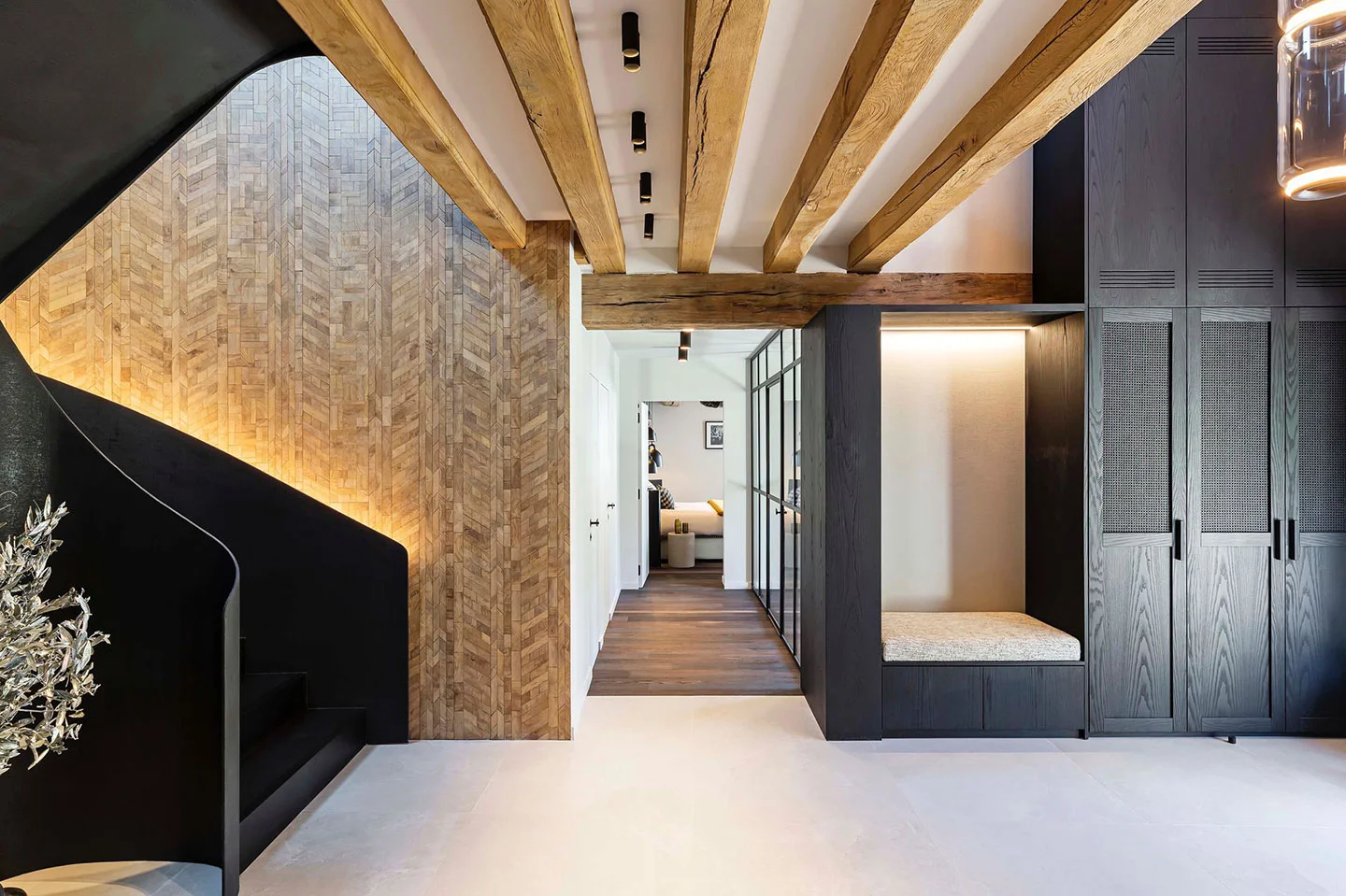
Geometric wood parquet with curved edges requires exceptionally flat subfloors to prevent joint lippage and edge chipping along curved joins. The acceptable subfloor flatness tolerance for precision curved timber is under 2 millimeters measured across a 2-meter straightedge.
Because the joining edges of curved planks follow arcs rather than straight lines, any vertical deflection in the subfloor creates visible height discrepancies between adjacent boards. Installers must prime the substrate and apply self-leveling compounds to eliminate dips or ridges before dry-laying modules to verify joinery tolerances.
Moisture testing of the subfloor is equally critical prior to laying timber. Mineral screeds must be tested for residual moisture, and proper vapor barriers must be established to ensure the engineered substrate remains in an equilibrium state throughout the lifespan of the building.
Comparing linear, curved, and interlocking parquet formats
Architects choosing between traditional straight planks and non-linear patterns must balance visual impact against installation complexity and movement dynamics.
| Floor Configuration | Board Geometry | Expansion Vectors | Visual Rhythm | Ideal Architectural Setting |
|---|---|---|---|---|
| Straight Planks | Rectilinear boards | Unidirectional, lateral across plank width | Directional, elongates sightlines down room length | Minimalist galleries, linear corridors, expansive open lofts |
| Rounded Planks | Curved edges with softened corners | Primarily lateral with minor corner radial stress | Soft, rhythmic, playful mid-century geometry | Hospitality lounges, dynamic retail suites, residential salons |
| Interlocking Weave | Serpentine strips locking diagonally | Multi-directional, distributed across locking joints | Continuous, flowing gesture that dissolves boundaries | Flagship boutiques, private residences, gallery rotundas |
Curved oak collections from OscarOno Paris
OscarOno Paris manufactures two distinctive non-linear oak collections designed specifically for high-performance architectural applications. Both collections are engineered with a 12 mm total thickness featuring a robust 4 mm select-grade oak top layer, achieving usage class 33 for heavy commercial traffic, a Cfl-s1 fire rating, and FSC and PEFC certification.
The Néon collection reinterprets the straight board by letting go of right angles: broad oak planks feature corners rounded into soft, sweeping curves that slide into one another, creating a graphic rhythm inspired by twentieth-century design. For spaces demanding continuous organic flow, the Entrelacs collection undoes the traditional parquet grid entirely: curved strips of flatgrain oak interlock and travel on the diagonal, forming a continuous weave that never straightens.
Both collections are offered in Natural, Smoke, and Black finishes. Smoke is core-smoked through the full depth of the timber rather than stained, while Black is charred in the Japanese shou sugi ban tradition. To explore circular geometry in endgrain oak, designers can study the spiral installations at AD Intérieurs, Monnaie de Paris or spatial layouts at Montfort L'Amaury. You can Order samples to examine the finishes in person or visit the Library to download complete CAD blocks, 3D files, and technical spec sheets.
Frequently asked questions
Can curved wood flooring be installed in high-traffic commercial spaces?
Yes. When engineered with a high-grade oak top layer and rated to usage class 33, curved wood flooring withstands heavy commercial traffic in boutiques, hotels, and office reception areas.
How does interlocking curved flooring handle seasonal humidity shifts?
Multi-layer engineered construction restricts the lateral swelling and shrinking of the oak surface. Multi-directional expansion is absorbed across elastic glue-down adhesive lines and perimeter expansion gaps.
What subfloor preparation is required for non-linear oak flooring?
Subfloors must be flat within 2 millimeters over a 2-meter radius, fully cured, and thoroughly tested for moisture. Self-leveling screeds are recommended to prevent joint lippage along curved joins.
How do curved oak patterns affect room boundaries and transitions?
Curved patterns eliminate rigid visual boundaries, allowing open spaces to flow into connecting corridors or adjacent rooms without harsh perpendicular transitions or disruptive threshold strips.
More from the Atelier
What Is Wood Terrazzo Flooring? An Architectural Guide
Wood terrazzo flooring unites reclaimed endgrain oak offcuts and mineral ground, creating continuous, tactile surfaces designed for circular luxury interiors.
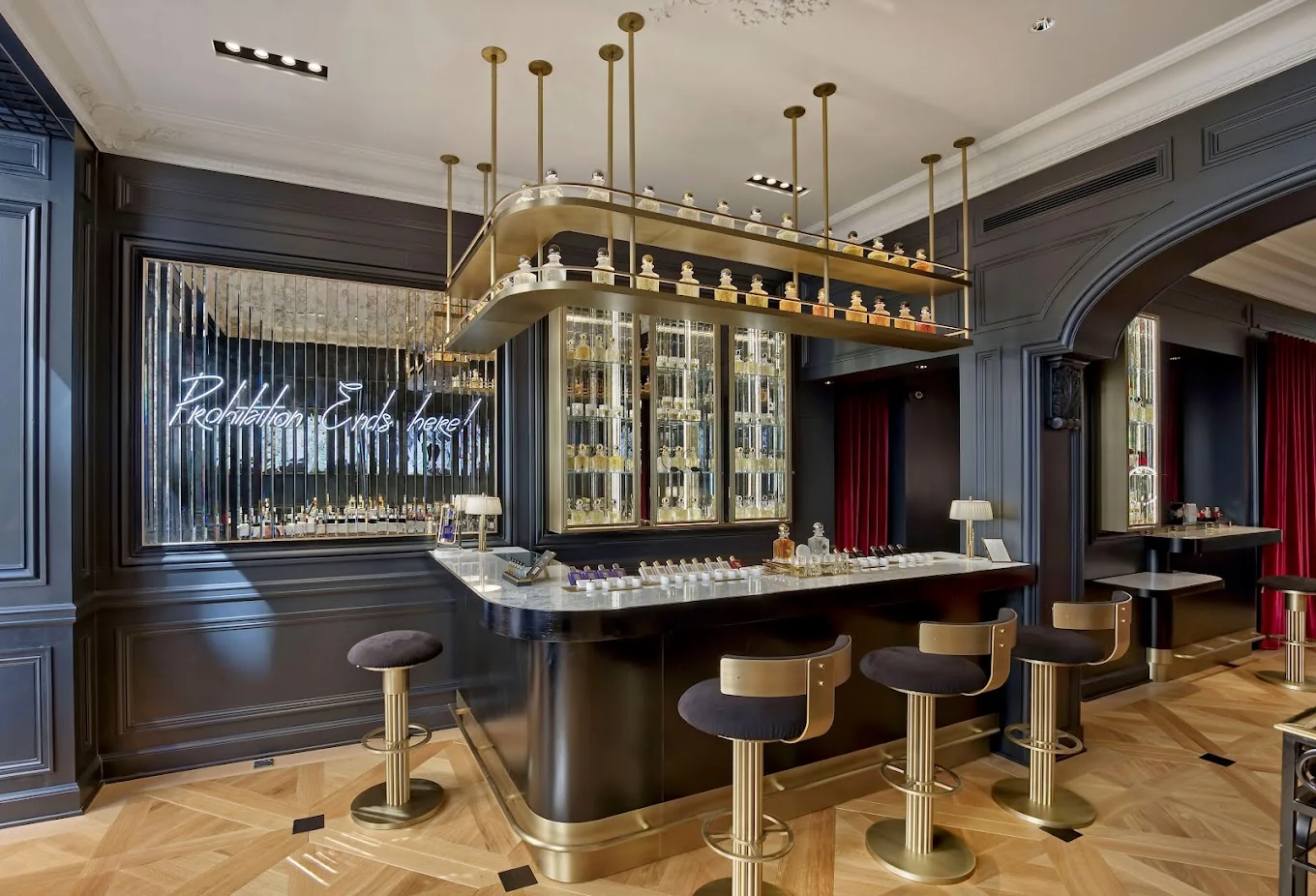
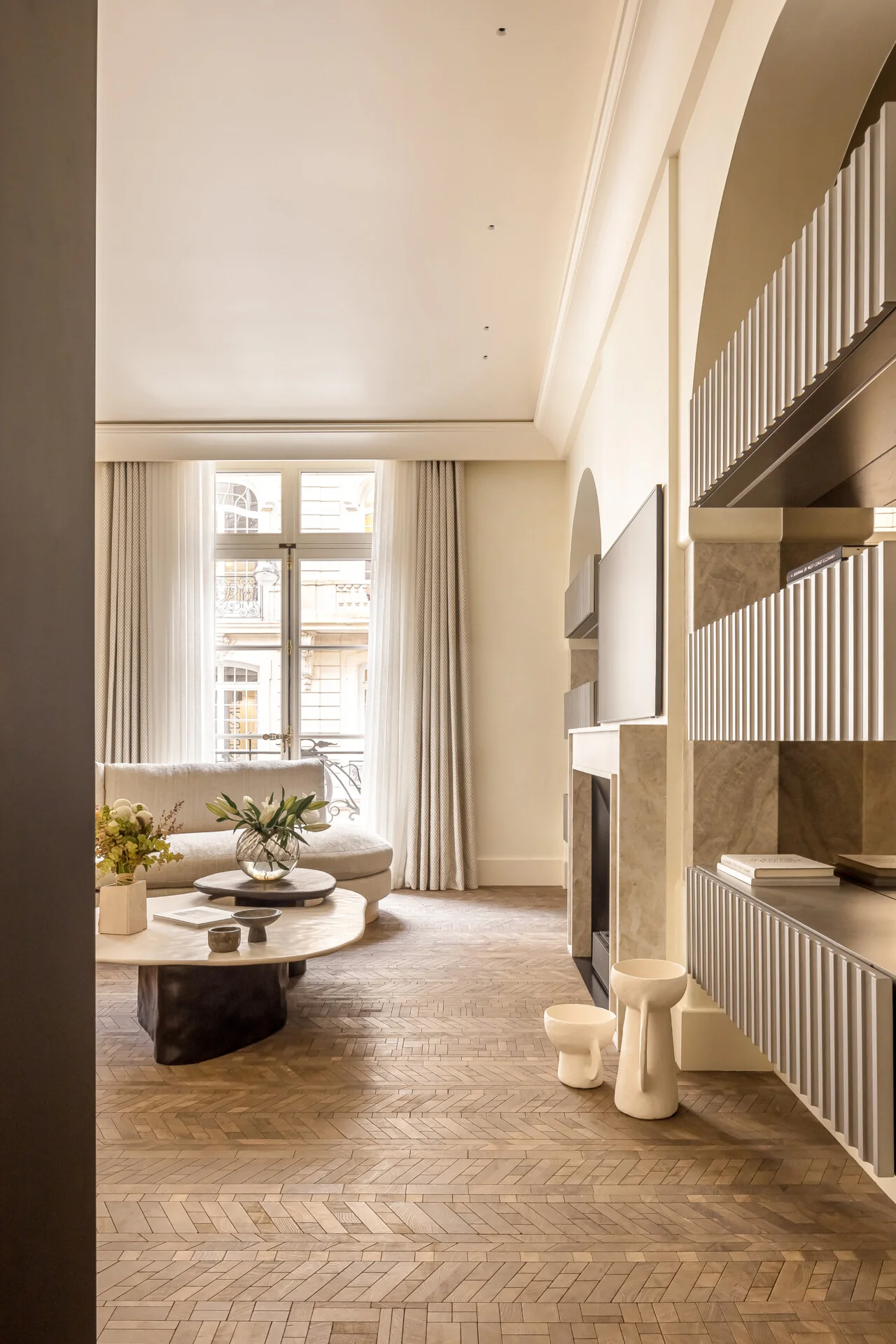
Modern Versailles Parquet: The Classic Panel in Today's Interiors
The woven oak panel first laid in a palace still works in a contemporary room. What changes is the color, the construction and how freely the weave is drawn.
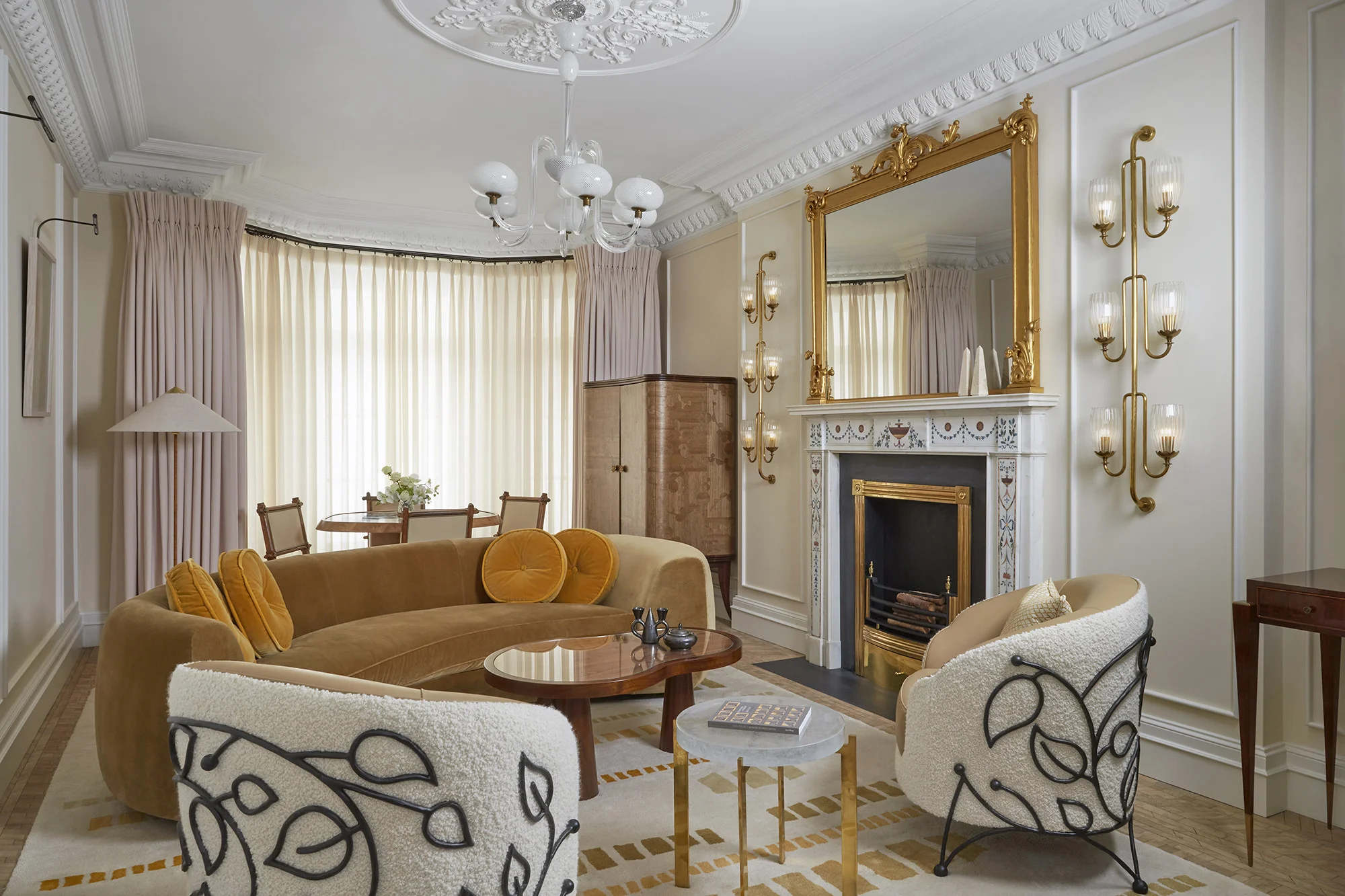
Wood Floor Interior Design: Pairing Oak with Linen, Stone and Brass
Start with the floor, then balance it: stone for weight, linen for softness, brass for light. A practical guide to designing a room around wood.