
Modern Versailles Parquet: The Classic Panel in Today's Interiors
The same woven square, in new colors and a looser hand.
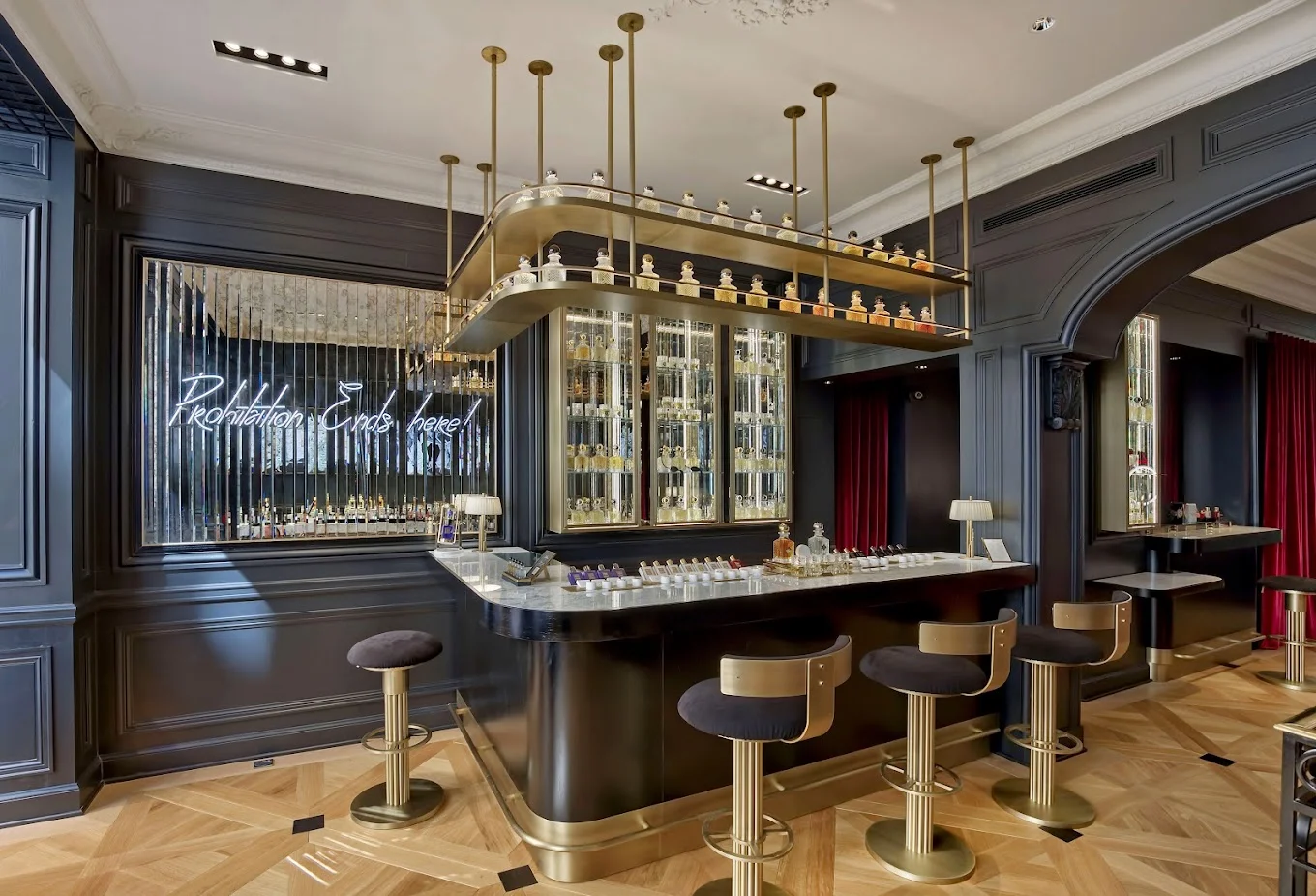
Versailles parquet is a floor of square oak panels, each one a lattice of strips woven on the diagonal inside a frame, laid edge to edge across the room. In modern interiors the pattern stays the same, but it is made in contemporary colors, built for today's subfloors and traffic, and sometimes loosened into a freer weave that keeps the idea without the formality.
If you want the pattern's history and anatomy in full, start with our guide to what parquet de Versailles is. This post is about how it is used now.
What is Versailles parquet?
The panel takes its name from the palace of Versailles, where oak panels replaced marble floors in the late seventeenth century under Louis XIV. Each panel is assembled before it is laid: a square frame, with strips inside that cross over and under one another on the diagonal to form a woven grid. Set side by side, the panels make a floor with a strong, regular rhythm that reads well from across a large room.
Because it is made in panels rather than board by board, Versailles belongs to marquetry, or marqueterie in French: oak composed into a design before it ever reaches the floor.
What makes Versailles parquet look modern?
Three things change the character of the same pattern far more than any change to its geometry.
- Color. The classic image is golden oak under a high shine. In a pale natural tone, a soft gray or a deep brown, the weave reads as texture rather than as period decoration, and it sits comfortably with plain walls and contemporary furniture.
- Sheen. A low-sheen finish lets the woven grain show; a mirror polish turns the floor into a reflection of the room.
- Scale and context. Panels laid wall to wall in a plain, sparsely furnished room look very different from panels in a gilded salon. The pattern is strong enough to carry a room on its own.
Dalle, OscarOno Paris's oak panel floor, works this way: oak composed into 800 x 800 mm panels, in the craft of the great Parisian floors, and offered in the twelve Essentiel colors, all lacquered.
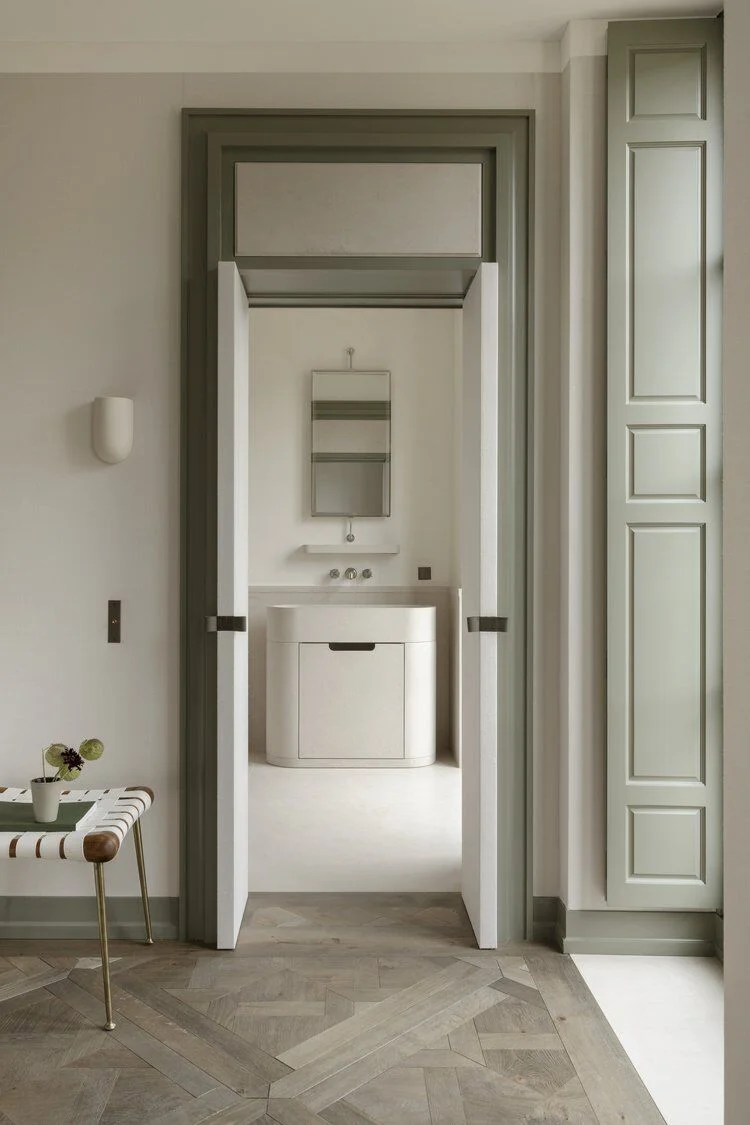
In the Private Residence by After Bach in Paris, Dalle in a natural finish gives a contemporary apartment the depth of a panel floor without any period styling around it.
How has the construction changed?
Historic Versailles panels were solid oak, assembled and fitted by hand on site. They were beautiful and also sensitive: a solid panel moves with the seasons, and the frames could open or lift over time.
Today's panels are made in the workshop to tight tolerances and laid as finished units. Dalle panels, for example, are flatgrain select oak, 12 mm thick with a 4 mm oak top layer. A thinner panel is easier to bring level with stone or tile in the next room, which matters in renovations where every millimeter of floor build-up counts. The top layer is still real oak, so the floor looks and wears like oak.
That construction also opens the pattern to commercial interiors. Dalle is rated usage class 33 for heavy commercial traffic and carries a Cfl-s1 fire rating, so the same floor can run from an apartment into a boutique or a hotel.
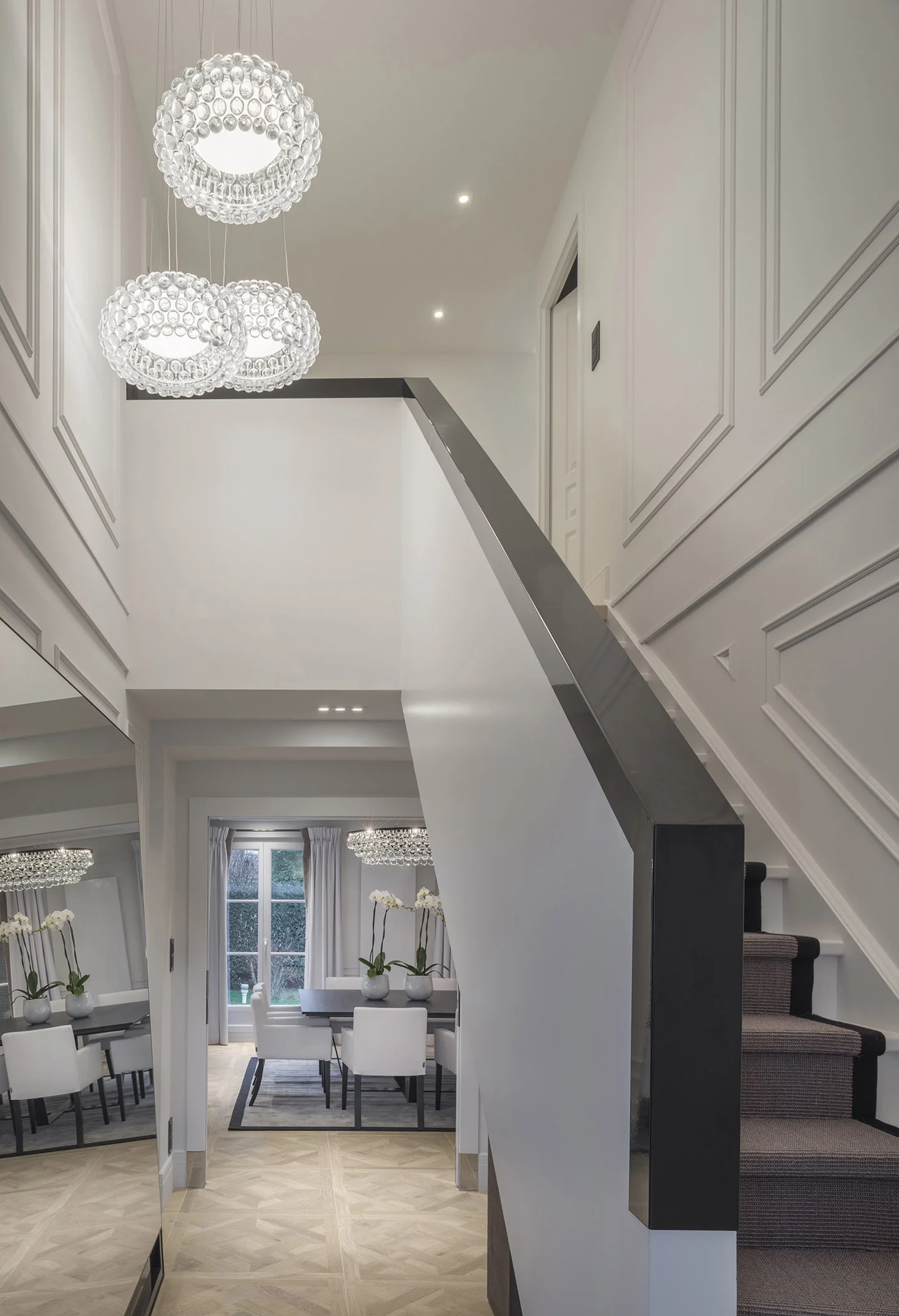
In a private villa in Bussy-Saint-George, near Paris, the panels run in a natural finish through a family home, which is where a hard-wearing classic earns its keep.
What if the classic panel feels too formal?
Some rooms want the warmth of a woven oak floor without the strict grid of framed squares. The answer is to keep the weave and drop the frame. Tresse, OscarOno Paris's loosened Versailles weave, does exactly that: strips of oak cross over and under one another like a basket and run on across the floor, so the pattern reads as handwork before it reads as geometry.
Tresse is cut from the same flatgrain select oak, 12 mm thick with a 4 mm oak top layer, and comes in three finishes: Natural, Smoke, which is smoked through the full depth of the oak, and Black, charred in the shou sugi ban tradition. None of them is a stain.
| Classic Versailles panel | Dalle | Tresse | |
|---|---|---|---|
| Pattern | Woven diagonal strips inside a square frame | Oak composed into square panels | A loosened weave, strips crossing over and under, no frame |
| Format | Panels of varying size, historically solid oak | 800 x 800 mm panels | Strips laid as a running weave |
| Finishes | Traditionally waxed or polished | Twelve colors, lacquered | Natural, Smoke, Black, no stain |
| Feel | Formal, ordered | Ordered, with color doing the modern work | Relaxed, handmade |
How should Versailles parquet be laid out?
A panel floor is planned, not just laid. Center the panels on the room or on its main axis, such as a fireplace, a window or the line of a doorway, so the cut panels at the edges are equal on opposite walls. Panels can run square to the walls or on the diagonal; square looks calmer, the diagonal more dynamic. In rooms that are far from square, a plain border around the panel field absorbs the difference so the pattern itself stays true.
Expect a panel floor to take longer to lay and to cost more than straight boards. The care goes into the layout, and it is what makes the floor look right.
Frequently asked questions
What is Versailles parquet?
A floor of square oak panels, each made of strips woven on the diagonal inside a frame, laid edge to edge. It takes its name from the palace of Versailles, where such panels replaced marble floors in the late seventeenth century.
Does Versailles parquet suit a modern interior?
Yes. In a pale natural tone, a gray or a deep brown, with a low sheen and plain surroundings, the weave reads as texture rather than period decoration. If the framed grid still feels too formal, a loosened weave keeps the idea in a freer form.
What is the difference between Dalle and Tresse?
Dalle composes oak into 800 x 800 mm panels and comes in the twelve lacquered Essentiel colors. Tresse drops the frame of the Versailles panel and lets the strips cross over and under like a basket, and comes in Natural, Smoke and Black.
Can Versailles parquet go over underfloor heating?
The pattern makes no difference; the construction and the installation do. Panels for heated floors are normally fully glued to a dry, flat screed. Check the product's spec sheet for heating compatibility before you commit.
Is Versailles parquet suitable for shops and hotels?
It can be, if the floor is rated for it. Dalle and Tresse are both rated usage class 33 for heavy commercial traffic, carry a Cfl-s1 fire rating and are FSC and PEFC certified.
Versailles parquet by OscarOno Paris
OscarOno Paris makes the panel floor in two ways. Dalle composes oak into 800 x 800 mm panels in the twelve lacquered Essentiel colors. Tresse loosens the Versailles panel into a running basket weave in Natural, Smoke or Black. Both are flatgrain select oak, 12 mm thick with a 4 mm oak top layer, rated usage class 33, Cfl-s1, and FSC and PEFC certified.
A woven floor is best judged at full scale and in your own light. Order samples, and find spec sheets, CAD and 3D files in the library.
More from the Atelier
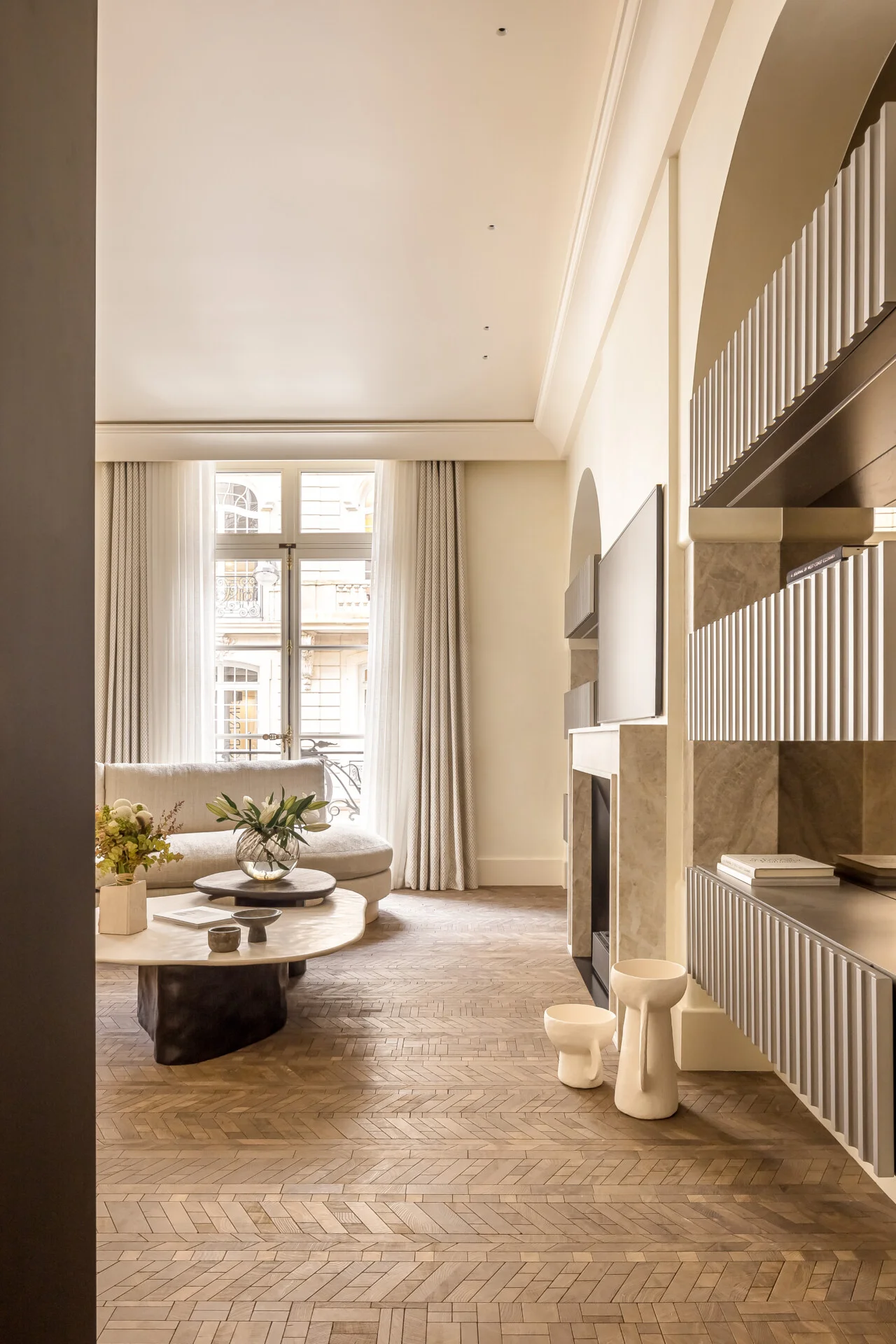
What Is Wood Terrazzo Flooring? An Architectural Guide
Wood terrazzo flooring unites reclaimed endgrain oak offcuts and mineral ground, creating continuous, tactile surfaces designed for circular luxury interiors.
Wood Floor Interior Design: Pairing Oak with Linen, Stone and Brass
Start with the floor, then balance it: stone for weight, linen for softness, brass for light. A practical guide to designing a room around wood.
Wood Floor Direction: Which Way Should Boards Run?
Along the long wall and toward the light, in most rooms. How light, the entrance, room shape and structure decide which way wood floor boards run.