
What Is Versailles Parquet? The Famous French Panel Explained
The square oak panel with a woven lattice, first laid in the palace that gave it its name.
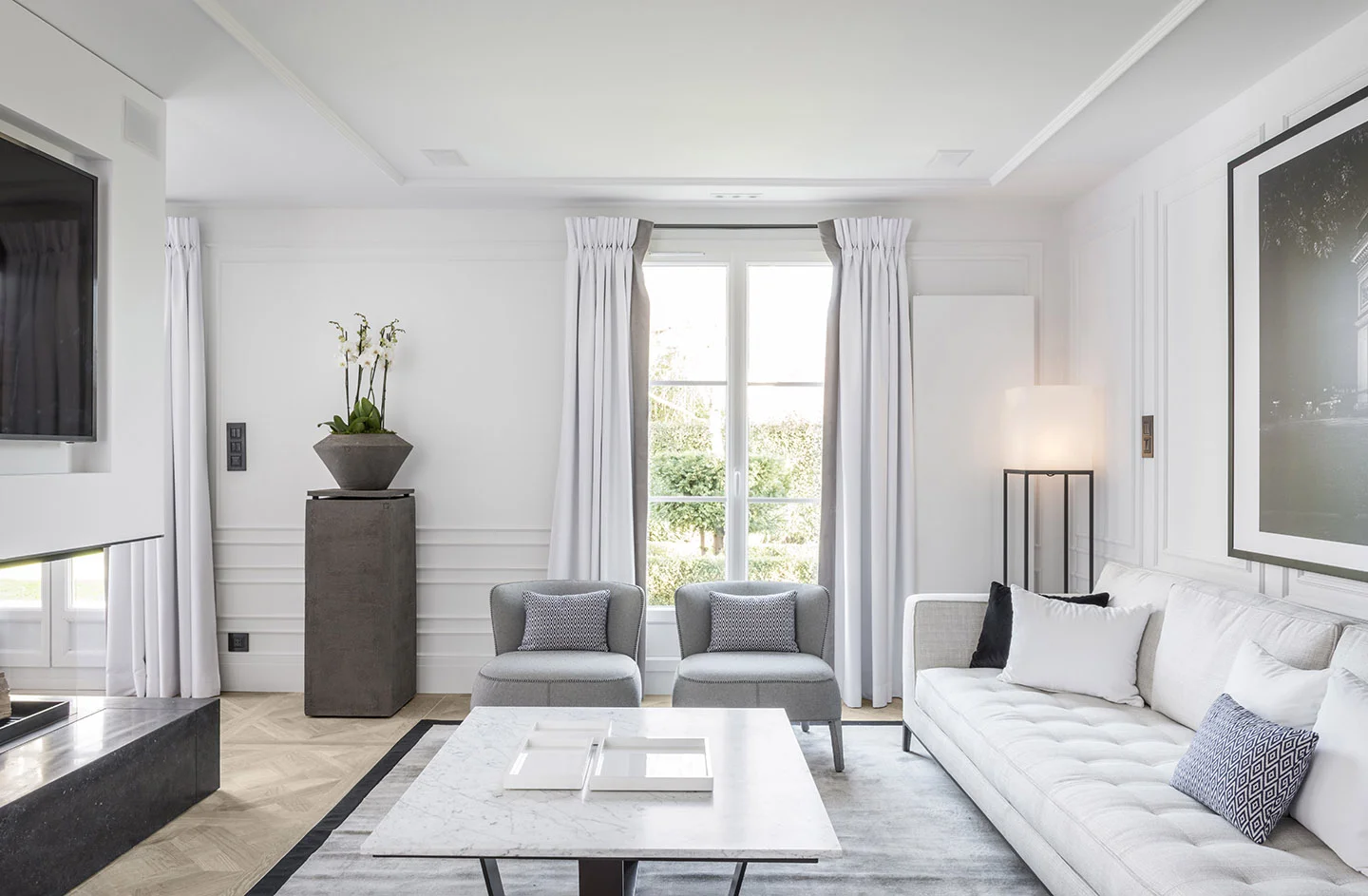
Versailles parquet, or parquet de Versailles, is a floor made of large square wooden panels, each one a square frame filled with a lattice of strips that cross on the diagonal and appear to weave over and under one another. The panels are made in the workshop and laid side by side, often on the diagonal of the room. The pattern takes its name from the Palace of Versailles, where it replaced marble floors in the late seventeenth century.
What does a Versailles panel look like?
Each panel has three parts: an outer square frame, a set of strips running corner to corner on the diagonal, and a second set crossing them, so the inside of the panel becomes a grid of small squares or lozenges. Where strips cross, one appears to pass over the other, which gives the panel its woven look.
Because the grain of each strip follows its own direction, the panel never looks one color. In raking light, the strips running one way look pale and those running the other way look darker, and the effect changes as you cross the room. Laid edge to edge, the frames join into a larger grid and the lattices into a continuous diagonal weave.
Where does parquet de Versailles come from?
The pattern was developed for the royal apartments at Versailles under Louis XIV, in the late seventeenth century, when wooden floors replaced the marble that had been laid there. Wood was warmer underfoot and easier to look after, and the panel format let large rooms be floored in a disciplined, repeating geometry that suited the architecture.
From the palace it spread to the grand houses of Paris and across Europe, and it became the floor of the Parisian hôtel particulier. Its French name for the general type, parquet à panneaux, panel parquet, covers several related designs; Versailles is the best known.
How is a Versailles panel made?
Traditionally, every panel was made by hand in solid oak, its pieces joined with tongues, grooves and wooden pegs rather than nails, then laid on a timber subfloor. The joinery let the pieces move a little with the seasons without opening or splitting. Antique panels recovered from old buildings still come up for sale, and the best of them are hundreds of years old.
Today most Versailles panels are made in two ways:
| Solid panels | Layered (engineered) panels | |
|---|---|---|
| Construction | Solid hardwood throughout | A hardwood top layer bonded to a stable base |
| Stability | Moves more with humidity | Moves less, so stays flatter |
| Underfloor heating | Usually a poor match | Commonly used over it, glued down; check the spec sheet |
| Refinishing | Can be sanded many times | Depends on the thickness of the top layer |
| Fitting | Nailed or glued to a subfloor | Usually glued to the screed |
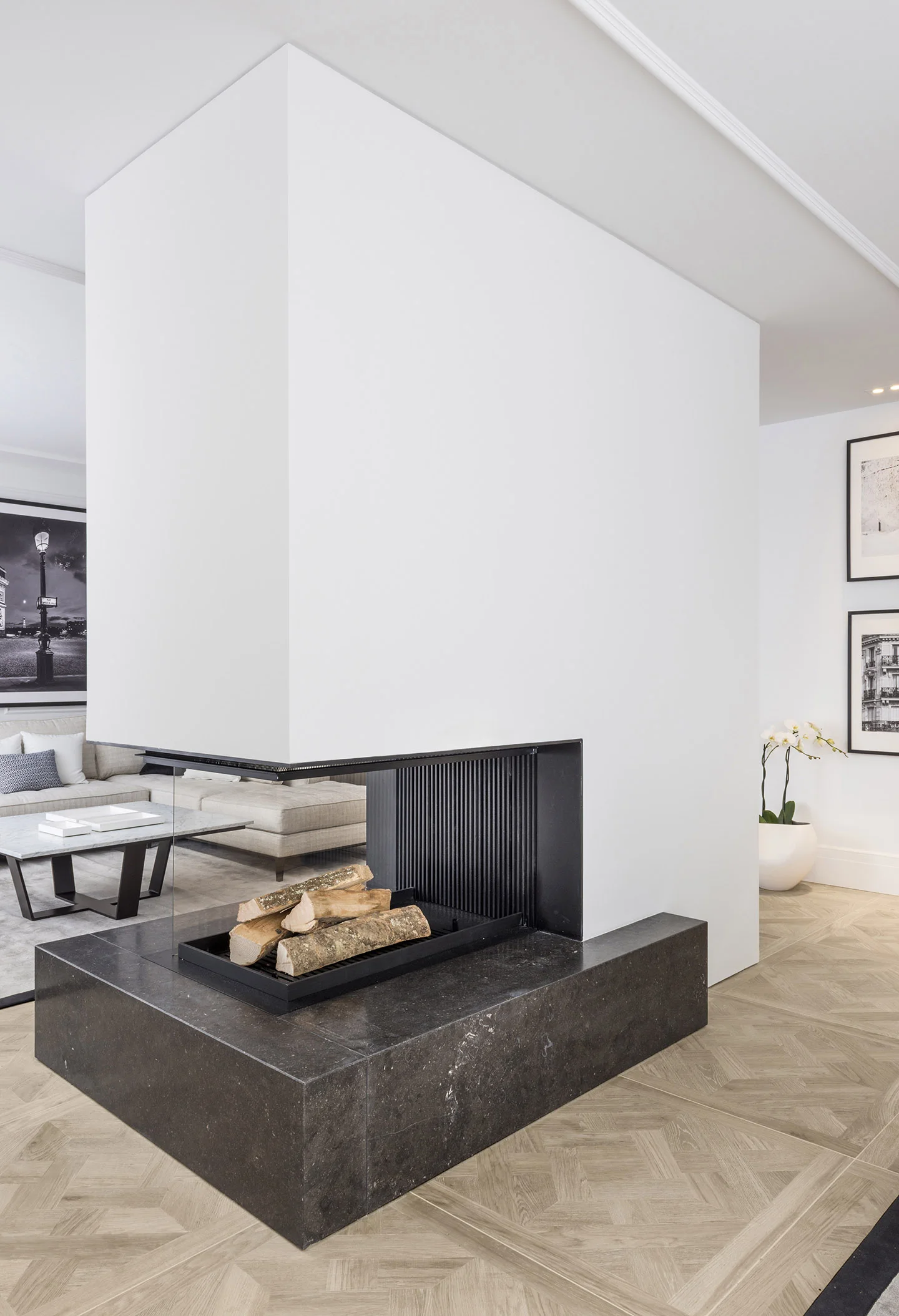
In this private villa near Paris, laid in Dalle, OscarOno Paris's oak panel parquet, the lattice of each panel runs across the living room in a pale natural oak.
How should Versailles parquet be laid in a room?
- Diagonal or square. Panels laid on the diagonal of the room are the classic French choice and suit large, formal rooms. Laid square to the walls, the grid reads calmer and more architectural.
- Center the layout. Start from the middle of the room, or from its main axis such as a fireplace or a doorway, so the cut panels at the walls are equal on each side.
- Border or no border. Traditionally the field of panels stops at a band of straight boards around the room, which hides the cuts. Leaving the border out lets the pattern run to the walls, which looks more contemporary but makes the cuts visible.
- Allow for waste. Large panels cut at the walls leave more offcuts than plain boards, especially on the diagonal. Plan the order with your fitter.
Versailles parquet in a contemporary interior
The pattern is busy enough to be the main ornament of a room, so it tends to work best with plain walls and few competing patterns. The finish changes its character more than anything else: a pale, matte natural oak makes it quiet and almost textile, a mid tone gives the classic Parisian look, and a dark smoked or black finish turns the lattice graphic.
A looser version of the same idea is a basket weave, where the strips seem to pass over and under one another without the strict frame. Tresse does exactly that: it takes the historic Versailles panel and lets it loosen and run, strips of oak crossing like a basket, in Natural, Smoke or Black.
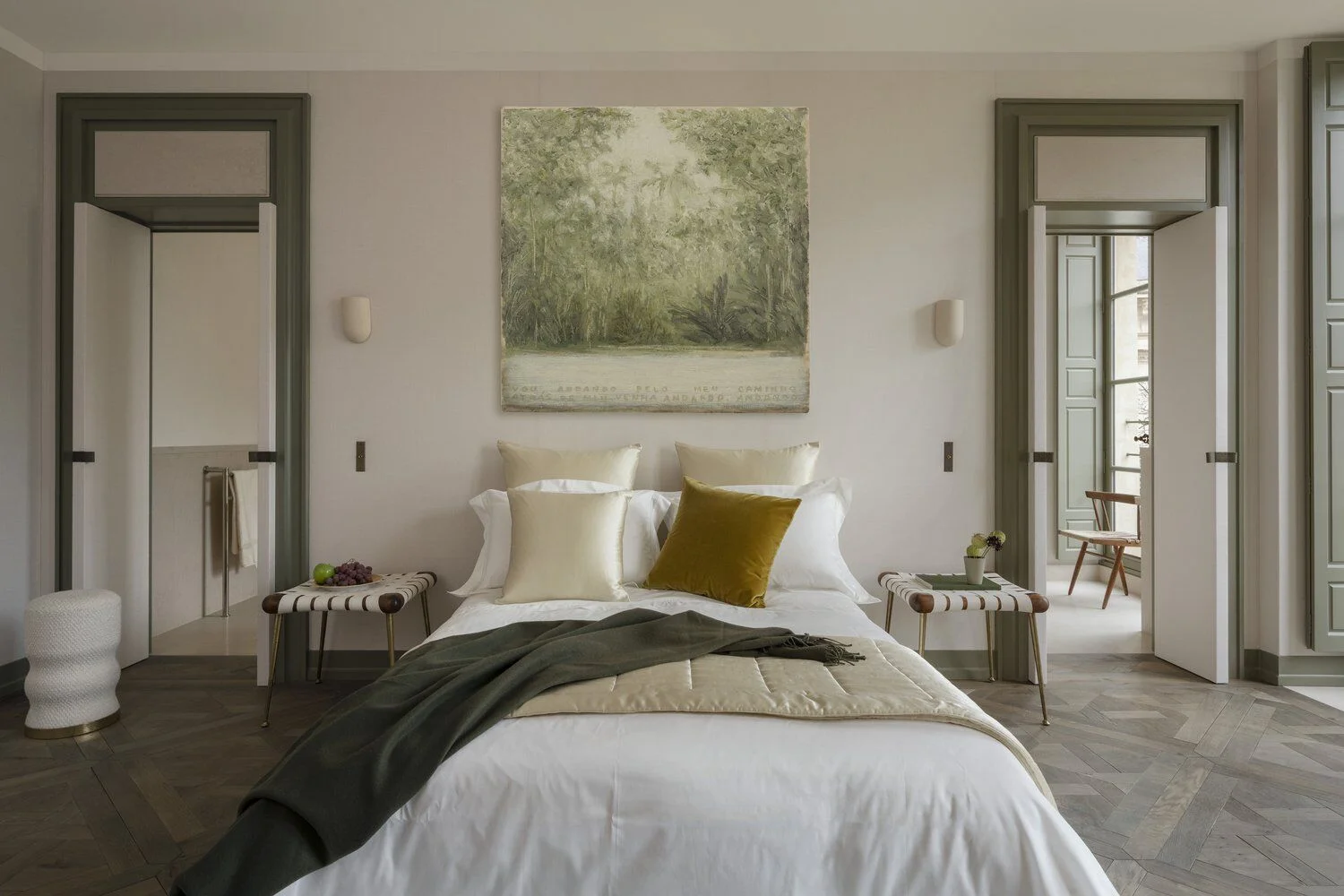
In this private residence in Paris, Dalle panels run through a bedroom with plain walls and painted door frames.
Frequently asked questions
What is Versailles parquet?
A floor of large square wooden panels, each made of a square frame filled with a lattice of strips crossing on the diagonal, so they appear to weave over and under one another. It is named after the Palace of Versailles, where it was first laid.
When was parquet de Versailles first used?
In the late seventeenth century, under Louis XIV, when wooden floors replaced marble in the royal apartments at Versailles. The pattern then spread to the grand houses of Paris and across Europe.
How big is a Versailles panel?
Traditional panels are roughly a meter square, and makers today use a range of sizes around that. Smaller panels give a finer, busier lattice; larger ones a calmer floor. OscarOno Paris's Dalle panels are 800 x 800 mm.
Is Versailles parquet more expensive than herringbone?
Usually, yes. Each panel contains many more pieces and much more assembly than a herringbone board, and laying large panels, especially on the diagonal, takes more care and leaves more offcuts at the walls.
Can Versailles parquet go over underfloor heating?
Layered panels, with a hardwood top layer on a stable base and glued to the screed, are commonly used over underfloor heating. Solid panels move more and are usually a poorer match. Check the product's spec sheet before you commit.
Panel parquet by OscarOno Paris
Dalle composes oak into 800 x 800 mm panels in the craft of the great Parisian floors, and comes in the twelve lacquered Essentiel colors. Tresse loosens the Versailles panel into crossing strips, in Natural, Smoke (smoked through the full depth of the oak) or Black (charred, in the shou sugi ban tradition), never stained. Both are flatgrain select oak, 12 mm with a 4 mm top layer, rated usage class 33 for heavy commercial traffic, Cfl-s1 for fire, and FSC and PEFC certified.
A panel is best judged at full size and in your own light. Order samples, and find spec sheets, CAD and 3D files in the library.
More from the Atelier
Reclaimed Teak Flooring: End-Grain Strength and Resilience
Explore how reclaimed teak flooring and end-grain timber provide extraordinary durability, natural silica protection, and stability for demanding spaces.
How to Prevent Fading on Hardwood Floors: Design Guide
An architectural approach to managing sun exposure on wood floors, from spectrally selective glazing to finish choices and uniform patina development.
The Craft of Marquetry Parquet Flooring and Panels
Marquetry parquet flooring bridges historical French palace geometry with contemporary minimalism, bringing architectural structure to luxury interiors.