
European Oak Flooring vs American White Oak: The Real Differences
Two close cousins, one important outsider, and the things that matter more than where the tree grew.

European oak and American white oak are close relatives, and as flooring they behave much the same: both are hard, durable, take finishes well and are among the most widely used floor woods in the world. The differences are mostly of tone and character, and they are often smaller than the differences between two logs of the same species. The oak to watch out for is American red oak, which is a different wood altogether.
What is European oak?
European oak is mainly two species, Quercus robur (pedunculate or English oak) and Quercus petraea (sessile oak), grown across Europe. French oak is European oak from French forests; the name tells you where the tree grew, not a separate species. American white oak is Quercus alba and its close relatives, grown in the eastern United States and Canada. All of them belong to the white oak group.
European oak vs American white oak: what actually differs?
| European oak | American white oak | |
|---|---|---|
| Species | Q. robur, Q. petraea | Q. alba and related white oaks |
| Typical color | Warm, light to mid brown, often slightly golden | Light tan to pale brown, sometimes a cooler, olive cast |
| Grain and figure | Open grain, visible rays when quartersawn | Open grain, often long, pronounced ray fleck when quartersawn |
| Hardness | Hard; usually tested a little below American white oak | Hard; usually tested a little above European oak |
| Pores | Sealed by tyloses, so fairly water resistant | Sealed by tyloses, so fairly water resistant |
| Smoking and fuming | Reacts well; color varies with tannin content | Reacts well; color varies with tannin content |
The two columns look alike because the woods are alike. On a finished floor, most people could not tell them apart without a label. Color is the most visible difference, and even that varies widely within each species depending on where and how fast the tree grew.
Is European oak harder than American oak?
No, it is usually tested slightly softer than American white oak, but the gap is small. Published Janka figures for both sit roughly between 1,100 and 1,400 lbf depending on the source and the sample, and oak is often quoted at around 1,300 lbf. In daily use the difference does not show. Dent resistance on a real floor depends far more on the finish, the construction of the board and whether the wood is laid as plank or as endgrain.
Which oak is more stable for flooring?
Origin makes little difference here. What controls movement is how the wood is sawn, how well it is dried and how the board is built. Quartersawn and rift-sawn boards move less across their width than flatgrain (plain-sawn) boards. A board made of a thinner oak top layer bonded to a stable base moves less than a solid plank of the same width. And a floor laid in a room that is kept at steady humidity will stay flatter than any wood in a room that swings from damp to dry.

This Boutiques Caroll shop in Paris is laid in Droit, a straight plank in select oak, in a natural color that keeps the oak pale and lets the grain carry the floor.
Can both oaks be smoked or fumed?
Yes. Smoking, or fuming, darkens oak by exposing it to ammonia, which reacts with the tannins in the wood. Both European and American white oak are rich in tannin and both have been fumed for well over a century. Because tannin content varies from tree to tree, a smoked floor always shows some variation between boards, whichever oak it is made from. Red oak holds less tannin and reacts less evenly.
What about red oak?
American red oak (Quercus rubra and relatives) is a different matter. Its pores are open, without the tyloses that plug the pores of white oaks, so it takes up water and dirt more readily and is a poorer choice near kitchens and entrances. It also has a pinkish undertone that shows through pale, white or grey finishes. When a floor is described simply as "oak", it is worth asking which one.
Softwoods such as pine and fir are further away again. They are much softer than any oak, dent easily under furniture and heels, and darken toward amber with light. They suit people who like a floor that marks and ages visibly; anyone who wants a floor that stays crisp will be better served by oak.
What matters more than European or American?
For the look and life of a floor, three choices outweigh the origin of the oak:
- Grade. It sets how many knots, color changes and sapwood are allowed. Select grade, used for Droit and Rompu, keeps knots small and color fairly even; rustic grades allow more of both.
- Cut. Flatgrain boards show the arched "cathedral" figure; quartersawn and rift boards show straight lines and ray fleck. Endgrain shows the growth rings themselves.
- Finish. A natural finish keeps the wood's own color, a lacquered color changes it, smoking darkens it from within. The same oak can look pale, honey or nearly black.
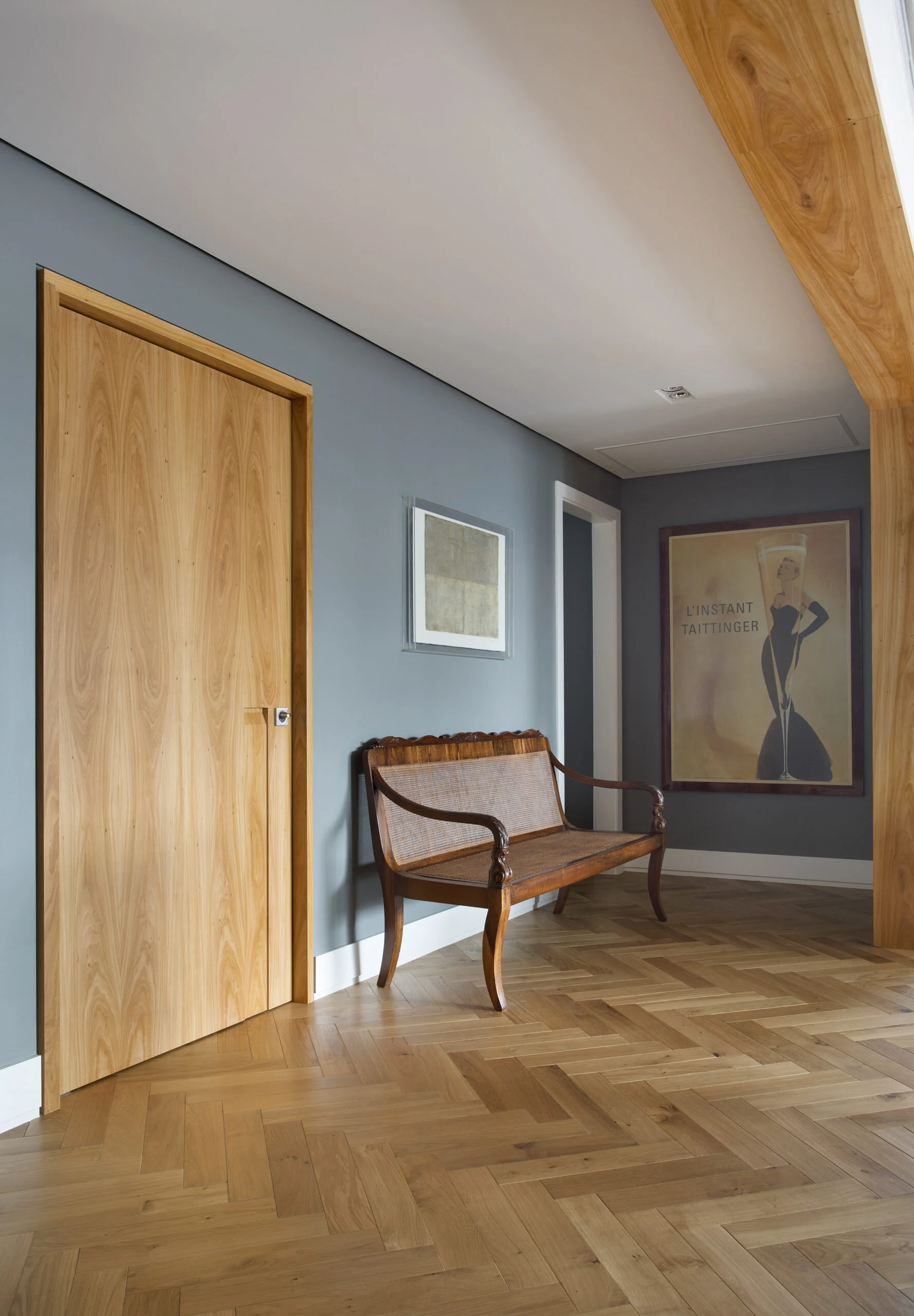
Pattern changes the oak too. In this private residence in Rio de Janeiro, the same select oak is laid as Rompu, OscarOno Paris's herringbone, in a warm honey color, and the grain changes direction with every board.
Frequently asked questions
Is European oak better than American white oak for flooring?
Neither is better in general. They are closely related white oaks with similar hardness, durability and water resistance. European oak tends to be a little warmer in color and American white oak a little paler, but grade, cut and finish change a floor far more than origin does.
Is European oak harder than American white oak?
Usually slightly softer. Published Janka figures for both fall roughly between 1,100 and 1,400 lbf depending on the source, and the difference is not noticeable underfoot. The finish and the construction of the board matter more for dents.
Can American white oak be smoked or fumed?
Yes. Like European oak, it is rich in tannin and darkens when exposed to ammonia. In both woods the depth of color varies from board to board with the tannin content. Red oak, which holds less tannin, reacts less evenly.
What is the difference between white oak and red oak flooring?
White oak pores are plugged by tyloses, which makes the wood more water resistant; red oak pores are open. Red oak also has a pinkish undertone that can show through pale or grey finishes. Both European oak and American white oak belong to the white oak group.
Is French oak the same as European oak?
Yes. French oak is European oak grown in France, the same species as oak from the rest of Europe. The name describes where the tree grew.
Oak floors by OscarOno Paris
OscarOno Paris works in oak. Droit, the straight plank, and Rompu, the herringbone, share one specification: flatgrain oak in select grade, 12 mm with a 4 mm oak top layer, 150 mm or 190 mm wide, in twelve lacquered colors. Both are rated usage class 33 for heavy commercial traffic, carry a Cfl-s1 fire rating and are FSC and PEFC certified.
Color and grain are easier to judge in your own light than on a screen. Order samples, and find spec sheets, CAD and 3D files in the library.
More from the Atelier

Reclaimed Teak Flooring: End-Grain Strength and Resilience
Explore how reclaimed teak flooring and end-grain timber provide extraordinary durability, natural silica protection, and stability for demanding spaces.
How to Prevent Fading on Hardwood Floors: Design Guide
An architectural approach to managing sun exposure on wood floors, from spectrally selective glazing to finish choices and uniform patina development.

The Craft of Marquetry Parquet Flooring and Panels
Marquetry parquet flooring bridges historical French palace geometry with contemporary minimalism, bringing architectural structure to luxury interiors.