
Smoked Oak Flooring: How Fuming Darkens Oak Naturally
No pigment, no fire: how ammonia and the tannins already in oak turn it brown, grey and nearly black.

Smoked oak flooring is oak darkened by ammonia rather than by stain. The wood is closed in a chamber with ammonia vapor, which reacts with the tannins naturally present in oak and turns them brown, so the color forms inside the wood instead of sitting on its surface. Fumed oak and smoked oak are two names for the same process; there is no fire or smoke involved.
How does smoking oak work?
Oak is rich in tannins, natural compounds the tree makes to protect itself against insects and decay. Ammonia is alkaline, and when its vapor reaches those tannins it changes them chemically into darker compounds. The longer the exposure and the more tannin a board holds, the darker it gets, from a light caramel to deep brown and smoky grey.
In practice, the boards or blocks are stacked in a sealed chamber, ammonia is introduced, and the wood is left for hours or days depending on the depth of color wanted. The wood is then aired before it is finished. How deep the color goes depends on the time in the chamber and on how easily the vapor travels into the wood: on some smoked floors it is a few millimeters, on others it runs right through.
Endgrain takes the vapor readily, because its open fiber ends face the surface. OscarOno Paris's Smoke finish, offered on its endgrain floors, is smoked through the full depth of the oak.
Is fumed oak the same as smoked oak?
Yes. Both terms describe oak darkened by ammonia vapor. "Fumed" is the older term, linked to the Arts and Crafts furniture makers, Gustav Stickley among them, who fumed white oak to darken it without stain. "Smoked" is more common in flooring today, especially in Europe. Neither should be confused with charred wood, which is actually burned.
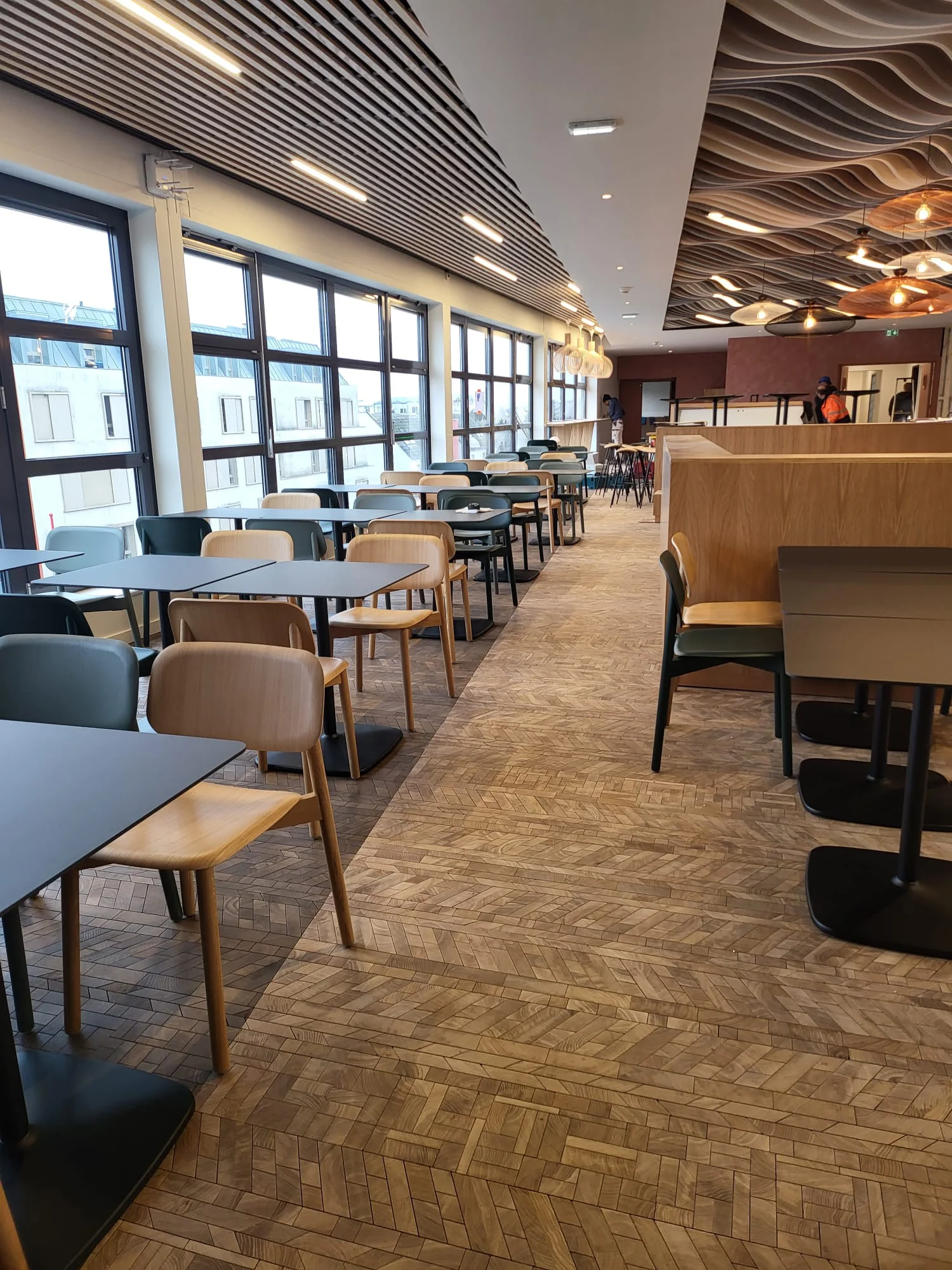
In the Octapharma company restaurant in Strasbourg, Forêt, a composed endgrain oak floor, is laid in Smoke: the blocks range from honey to deep brown, which is what gives the floor its depth.
Why does smoked oak vary from board to board?
Because tannin content varies. It differs from tree to tree, with the soil and the speed of growth, and even within one log. Heartwood is rich in tannin and darkens strongly; sapwood, the younger outer wood, has little and stays much paler. The same exposure therefore produces a range of tones across a floor, from honey to near black in the most marked cases.
This variation is the character of a smoked floor rather than a flaw. Anyone who wants a perfectly even color should look at a lacquered or stained color instead. Anyone choosing smoked oak should look at a sample large enough to show the range, ideally several pieces side by side.
Smoked oak vs stained oak vs charred oak
| Smoked (fumed) | Stained | Charred (shou sugi ban) | |
|---|---|---|---|
| How the color is made | Ammonia reacts with the oak's own tannins | Pigment or dye applied to the surface | The surface is burned |
| Where the color sits | Inside the wood, depth depends on the process | At or near the surface | At the surface |
| Look | Varied, grain stays clear | Even, can cloud the grain | Deep black, matte |
| When scratched | Shows the same color if the smoke runs deep enough | Can show pale wood beneath | Depends on the finish over it |
| Works on | Tannin-rich woods, above all oak | Almost any wood | Almost any wood |
OscarOno Paris's endgrain collections use two of these: Smoke, smoked through the full depth of the oak, and Black, charred in the shou sugi ban tradition. Neither uses a stain.
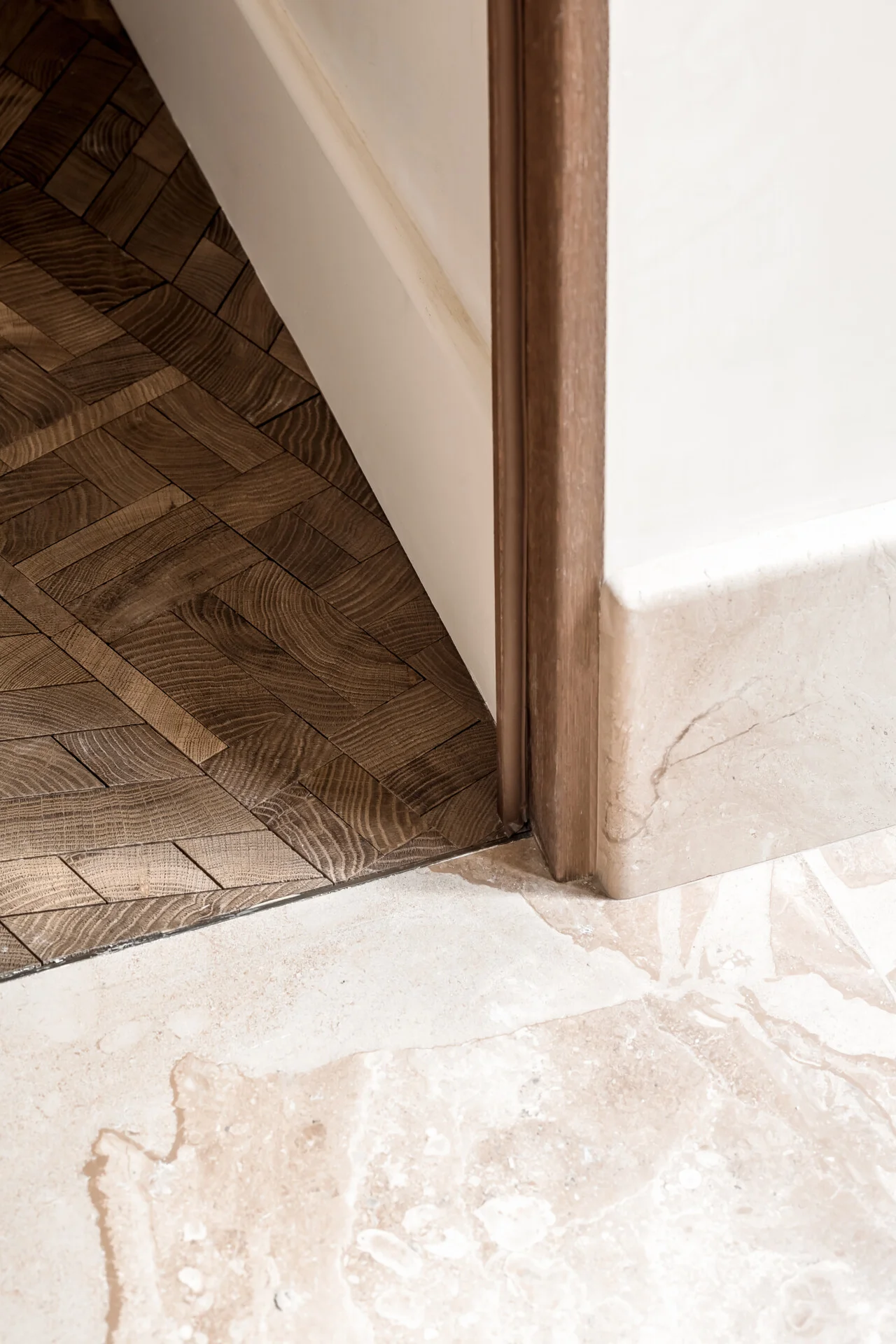
Up close, in Project Galilée in Paris, the growth rings of every smoked block stay visible through the color, and the tone shifts from block to block. The same Smoke finish is offered on Opus, an endgrain oak floor in an organic pattern.
How does smoked oak age?
All oak changes with light, and smoked oak is no exception: over years of strong sun it tends to soften and warm slightly. Rugs and furniture that never move will leave lighter or darker shadows, as on any wood floor, so it helps to move them now and then in the first months. Because the color is in the wood rather than in a coating, wear does not reveal a sharp pale line the way it can on a stained floor.
Smoking does not seal the wood, so a smoked floor always receives a protective finish afterwards. Care then depends on that finish; follow the maintenance guidance on the product's spec sheet.
Frequently asked questions
Is fumed oak the same as smoked oak?
Yes. Both names describe oak darkened by ammonia vapor reacting with the tannins in the wood. No fire or smoke is involved. Charred oak, which is actually burned, is a different finish.
Why are some boards in a smoked oak floor lighter than others?
Tannin content varies between trees and within a single log. Heartwood is rich in tannin and darkens strongly, while sapwood has little and stays paler, so the same treatment gives a range of tones across the floor.
Does smoked oak fade in sunlight?
Like all oak, it changes slowly with light and tends to soften and warm a little over years of strong sun. Because the color is in the wood rather than in a coating, it does not wear through to a pale layer the way a stain can.
Can other woods be fumed?
Only woods rich in tannin react strongly, oak above all, and chestnut too. Woods low in tannin, such as maple or pine, barely change color with ammonia.
Does smoked oak smell of ammonia?
No. The wood is aired after smoking and then finished, and a finished smoked oak floor has no ammonia smell.
Smoked oak by OscarOno Paris
Smoke is one of the three finishes of OscarOno Paris's endgrain oak floors, alongside Natural and Black: Forêt, Opus and Cube, a simple grid of endgrain blocks. In each, Smoke is smoked through the full depth of the oak, with no stain. Forêt and Opus have an 8 mm endgrain oak top layer on 12 mm birch plywood; Cube has a 6 mm top layer on 10 mm birch plywood. All three are rated usage class 34 for very heavy commercial traffic, carry a Cfl-s1 fire rating and are FSC and PEFC certified, and plain boards in the same finish are available for adjoining rooms.
Because smoked oak varies by nature, judge it from real pieces. Order samples, and find spec sheets, CAD and 3D files in the library.
More from the Atelier
Protecting End Grain Wood Block Flooring from UV Fading
Discover the science of oak photodegradation and how to protect end-grain wood floors from UV fading using advanced varnishes and architectural design.
Parquet Floor Restoration: Is an Old Parquet Floor Worth Saving?
Loose blocks, gaps, stains and a worn finish can all be put right. How to tell whether an old parquet floor is worth restoring, what the work involves, and when it is not.
Squeaky Wood Floors: Why They Squeak and How to Fix Them
A squeak is friction: wood on wood, wood on a nail, or a subfloor moving on its joists. Find which one it is and the fix follows.