
How Hard Is Oak? Oak Janka Hardness Explained
What the Janka number measures, where oak sits on the chart, and what the chart leaves out.
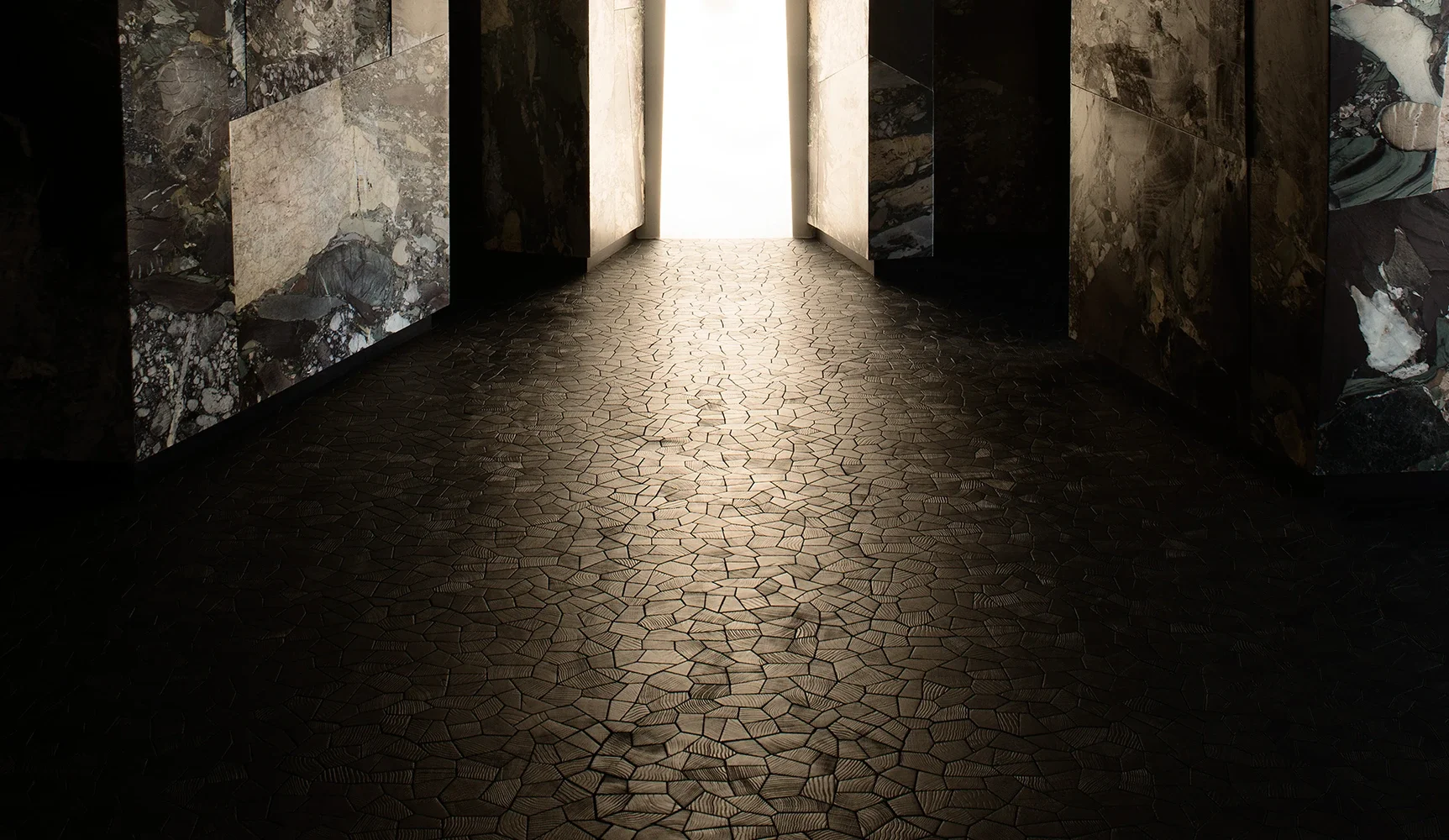
Oak scores roughly 1,300 lbf on the Janka hardness scale. American white oak is usually listed at about 1,360 lbf and red oak at about 1,290 lbf, with European oak often a little lower. That puts oak in the middle of the range for flooring woods: hard enough for busy homes and commercial spaces, and the reference most other floor woods are compared against.
What is the Janka hardness scale?
The Janka test measures how hard a wood is to dent. A steel ball 0.444 inch (11.28 mm) across is pressed into a sample until it is sunk to half its diameter, and the force needed is recorded. In the United States it is given in pounds-force (lbf); in Europe it is often given in newtons (N). The test was devised in the early twentieth century by the Austrian researcher Gabriel Janka.
The standard figures are for side grain, the face of a normal floorboard, on wood dried to a set moisture content. They are averages: two boards of the same species can differ noticeably depending on how fast the tree grew and how dense its wood is, and different sources publish slightly different numbers.
How hard is oak compared with other floor woods?
Approximate published Janka ratings, side grain:
| Wood | Janka hardness (approx.) | What it means on a floor |
|---|---|---|
| Eastern white pine | 380 lbf | Soft; dents easily under furniture and heels |
| Douglas fir | 660 lbf | Soft; marks quickly and ages visibly |
| Black walnut | 1,010 lbf | Moderately hard; shows dents more than oak |
| Red oak | 1,290 lbf | Hard; open pores, less water resistant than white oak |
| White oak | 1,360 lbf | Hard; the common benchmark for floors |
| Hard maple | 1,450 lbf | Harder than oak; tight, pale grain |
| Hickory | 1,820 lbf | Very hard; strong color variation |
| Zambezi teak | 2,990 lbf | Far harder than oak; a dense African hardwood |
The gaps that matter on a floor are the big ones. Pine against oak, or oak against a dense tropical hardwood, is a difference you can feel and see over the years. Red oak against white oak, a difference of about five percent, is not.
Is white oak harder than red oak?
Slightly, but that is not the main difference between them. White oak's pores are plugged by tyloses, which makes it more resistant to water and staining; red oak's pores are open. Red oak also has a pinkish undertone that can show through pale finishes. For a floor, those differences matter more than the few dozen pounds-force between their Janka figures. European oak belongs to the white oak group and behaves much like American white oak.
What does the Janka rating not tell you?
Janka measures resistance to denting, nothing else. It does not measure:
- Scratching. Most everyday scratches are in the finish, not the wood. A hard wood with a soft finish will scratch; grit under shoes scratches any floor.
- Stability. How much a wood moves with humidity has little to do with its hardness, and depends more on the cut and the construction of the board.
- How a floor ages. A matte surface, visible grain and a color that runs through the wood hide wear better than a smooth, glossy, uniform one, whatever the species.
Very hard woods have their own drawbacks: they are harder to cut, sand and fit, and some are oily enough to make finishing difficult. Hardness is one reason to choose a wood, not the only one.
Is end grain harder than side grain?
For resisting dents, yes. Janka figures are measured on side grain, where the fibers lie flat and a point load crushes them sideways. On end grain you stand on the ends of the fibers, and the load runs down their length, the direction in which wood is strongest. The same oak laid as end grain therefore resists denting from heels and furniture legs better than it does as a plank, and the marks it does take blend into the rings and the variation between blocks.
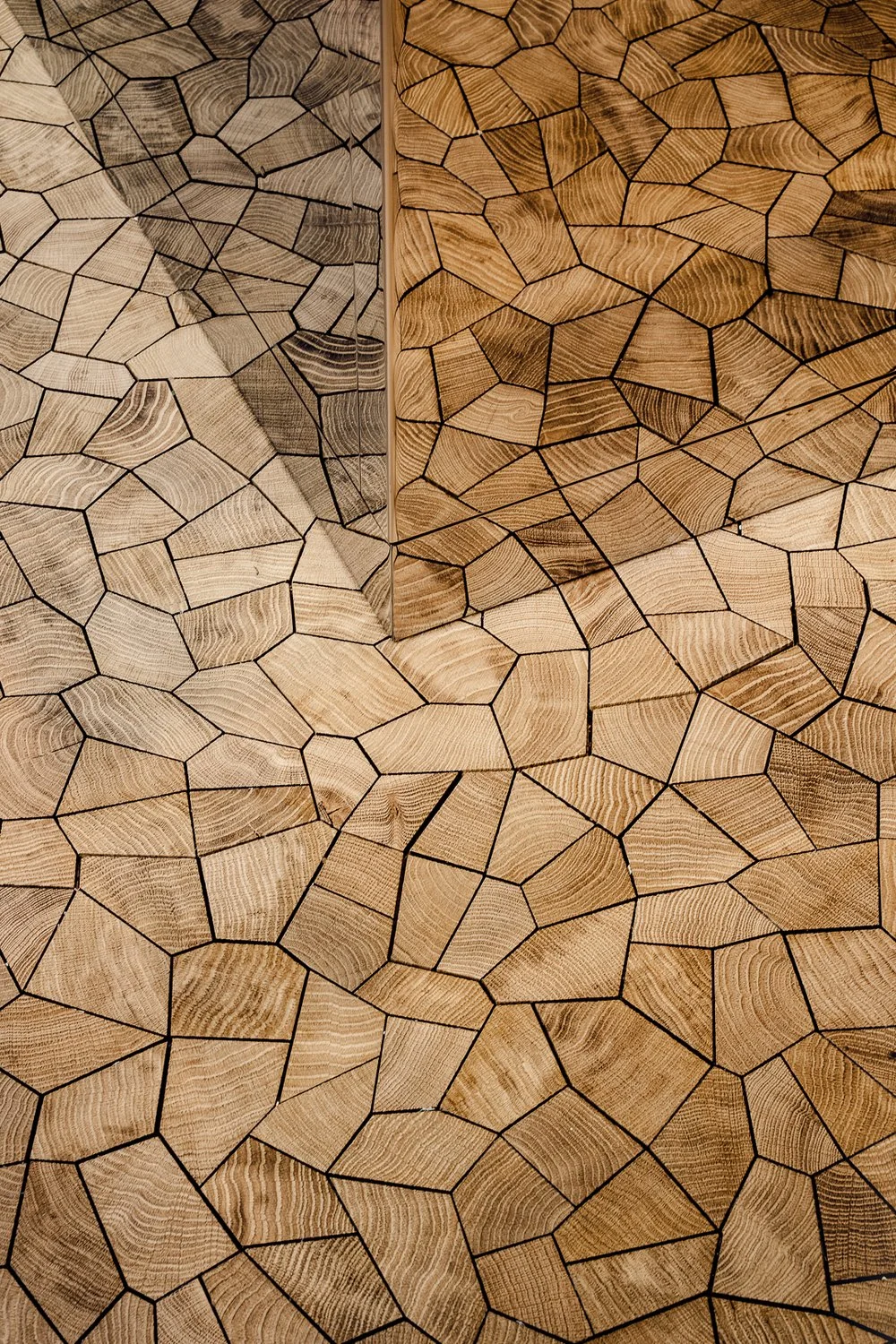
At the Butterfly Pâtisserie of the Hôtel de Crillon in Paris, the floor is Opus, an endgrain oak floor in an organic pattern. Every piece shows its growth rings because the surface you walk on is the end of the fibers.
OscarOno Paris's endgrain oak floors, Opus and Cube, a grid of endgrain blocks, are rated usage class 34, the European class for very heavy commercial traffic, one step above the class 33 of its plank and pattern floors.
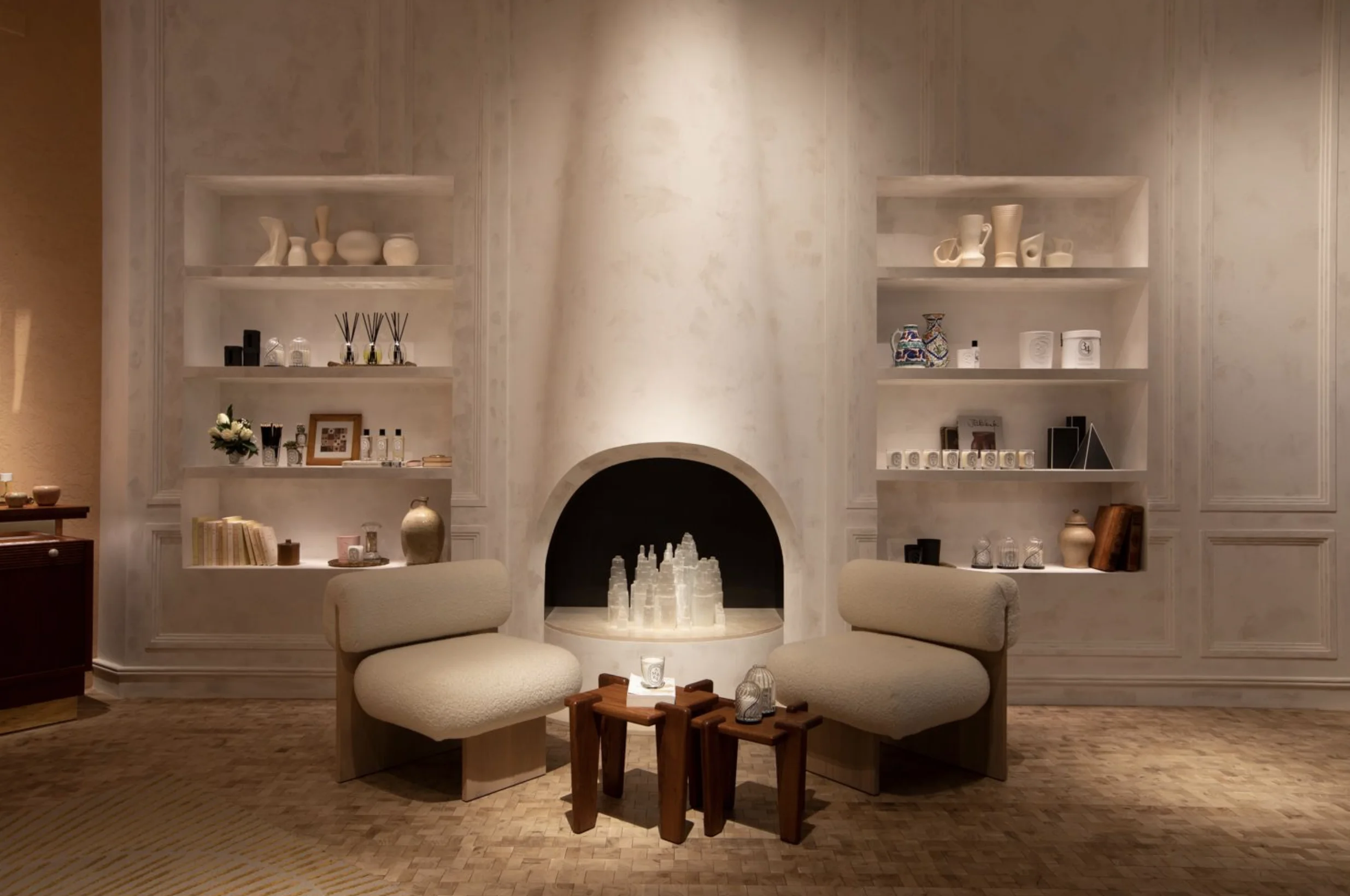
Shops test a floor's hardness every day. In the Diptyque Worldwide project, the brand's boutiques are laid in Cube in Natural.
Does smoking or charring change oak's hardness?
Smoking, or fuming, changes the color of oak by a reaction between ammonia and the tannins in the wood. It is not used to harden the wood, and the hardness of a smoked floor is still essentially that of oak. Charring, the shou sugi ban technique, works on the surface. For a floor's resistance to wear, the cut, the construction and the protective finish matter far more than the color treatment.
Frequently asked questions
How hard is oak on the Janka scale?
About 1,300 lbf. American white oak is usually listed at about 1,360 lbf and red oak at about 1,290 lbf, with European oak often a little lower. Published figures vary slightly by source and by sample.
Is white oak harder than red oak?
Slightly, by about five percent, which you will not notice on a floor. The more useful difference is that white oak's pores are sealed by tyloses, making it more water resistant, while red oak's are open.
Does a higher Janka rating mean a floor will not scratch?
No. Janka measures resistance to dents, not scratches. Most everyday scratches are in the finish, so the finish, doormats and felt pads under furniture matter more than the species.
Is end grain flooring harder than plank flooring?
It resists dents better. Janka figures are measured on side grain; on end grain the load runs down the length of the fibers, the direction in which wood is strongest, so the same oak dents less as end grain than as a plank.
What is the hardest wood used for flooring?
Some dense tropical hardwoods are rated well above 3,000 lbf. Among common North American floor woods, hickory is one of the hardest at about 1,820 lbf. Zambezi teak, at about 2,990 lbf, is more than twice as hard as oak.
Hard floors by OscarOno Paris
Opus and Cube are endgrain oak, rated usage class 34 for very heavy commercial traffic, with a Cfl-s1 fire rating and FSC and PEFC certification. Opus has an 8 mm endgrain top layer on 12 mm birch plywood; Cube, made from solid offcuts, a 6 mm top layer on 10 mm birch plywood. Both come in Natural, Smoke and Black.
For more hardness than oak can give, Réserve cuts the Opus pattern in Zambezi teak (Baikiaea plurijuga), approx. 2,990 lbf on the Janka scale against approx. 1,300 lbf for oak. It comes only from fallen trees in southern Africa, each one geolocated, documented and certified, and is finished in Smoke.
Order samples to feel the difference, and find spec sheets, CAD and 3D files in the library.
More from the Atelier
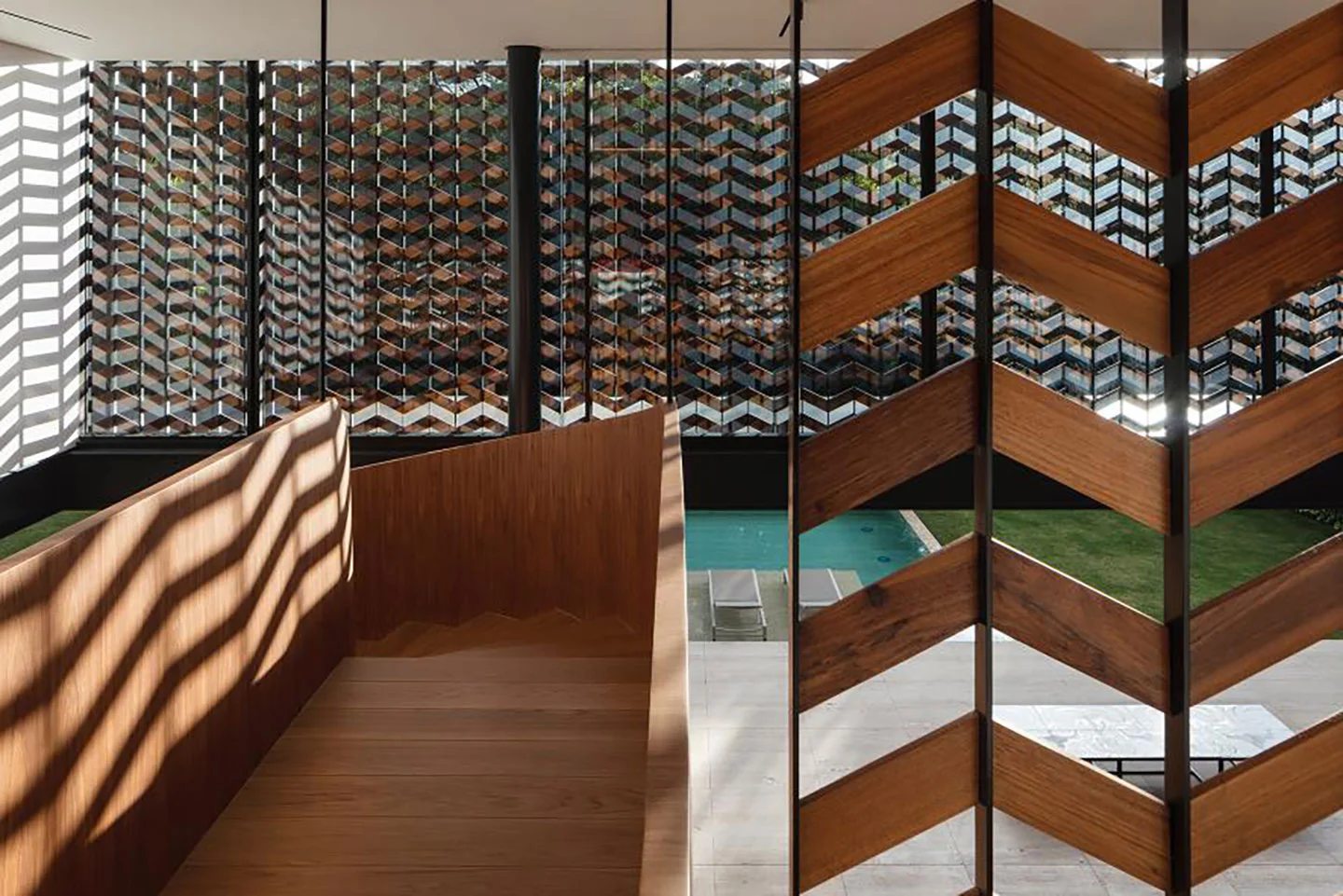
Protecting End Grain Wood Block Flooring from UV Fading
Discover the science of oak photodegradation and how to protect end-grain wood floors from UV fading using advanced varnishes and architectural design.
Parquet Floor Restoration: Is an Old Parquet Floor Worth Saving?
Loose blocks, gaps, stains and a worn finish can all be put right. How to tell whether an old parquet floor is worth restoring, what the work involves, and when it is not.
Squeaky Wood Floors: Why They Squeak and How to Fix Them
A squeak is friction: wood on wood, wood on a nail, or a subfloor moving on its joists. Find which one it is and the fix follows.