
Parquet Flooring Installation: Glue-Down vs Floating Floors
The method decides how the floor sounds, which patterns are possible and how it behaves over heating.
Parquet flooring is installed in one of three ways: glued to the subfloor, floated over an underlay, or nailed to a timber subfloor. Gluing is the standard for patterned parquet such as herringbone, chevron and end grain blocks, because every small piece has to stay exactly where it was laid. Floating suits straight click boards, where speed and the option to lift the floor later matter more than the feel underfoot.
What is the difference between glue-down and floating parquet?
In a glue-down installation, adhesive is spread over the whole subfloor with a notched trowel and each board or block is pressed into it. The floor becomes part of the building: it cannot slide, it does not need transition strips at every doorway, and it can be laid in any pattern.
In a floating installation, the boards are joined to each other, usually with a click profile, and rest on an underlay without being fixed to the subfloor. The whole floor moves as one sheet as the wood takes up and gives off moisture. It goes down quickly and can be lifted again, but it needs room to move at walls and doorways, and it only works with formats designed for it.
Nailing or secret nailing is the third, older method: solid boards are fixed through the tongue to joists, battens or a timber subfloor. It is still used on wooden structures, but rarely on the concrete slabs most rooms have today.
Glue-down vs floating floor: how do they compare?
| Glue-down | Floating | |
|---|---|---|
| How it is held | Bonded to the subfloor over its whole area | Boards joined to each other, resting on an underlay |
| Sound underfoot | Solid, quiet footfall | Can sound hollow; depends on the underlay |
| Patterns | Any: straight, herringbone, chevron, panels, end grain | Straight boards and formats made to float |
| Underfloor heating | Usually preferred: no layer of air or underlay between heat and wood | Possible with a suitable underlay, within the maker's limits |
| Subfloor | Must be flat, dry, clean and sound | Must be flat and dry; small defects are bridged by the underlay |
| Doorways | Can run continuously from room to room | Often needs breaks or profiles over long runs |
| Removal | Permanent | Can be lifted |
Which parquet patterns have to be glued down?
Herringbone and chevron are made of many short boards, each locked to its neighbors at an angle, and they come in left and right boards so the tongue and groove meet on both sides of the zigzag. Laid the traditional way, board by board, they are glued. Some herringbone products are made with click joints so they can float, but that is a property of the product, not of the pattern. Rompu, OscarOno Paris's herringbone in oak, is a traditional herringbone: 12 mm oak with a 4 mm top layer, in boards 150 mm or 190 mm wide.
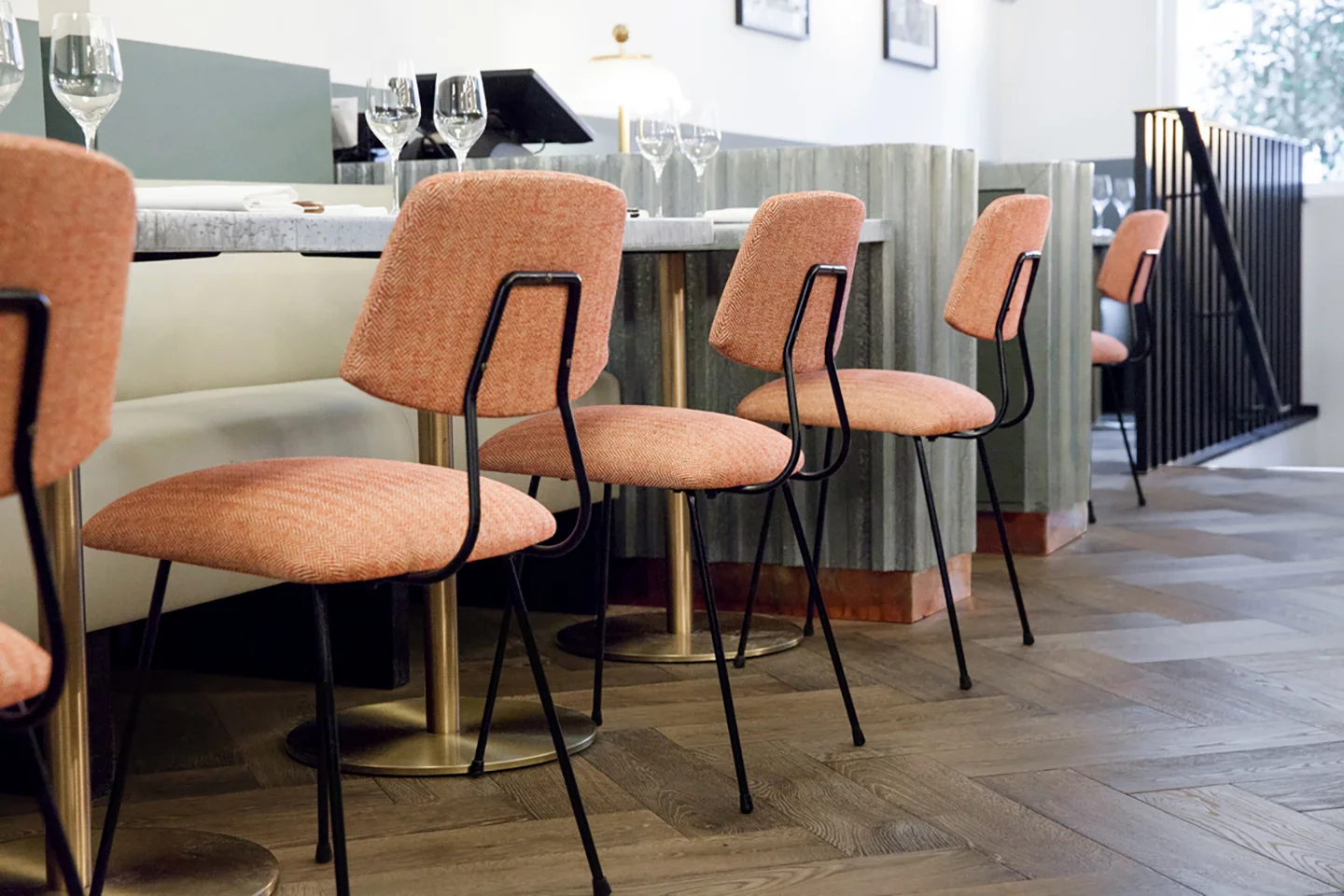
At Frenchie in London, Rompu runs under the tables and chairs of a restaurant, where the joints take traffic from every direction. That is the job a glued floor does well.
End grain floors are always glued. The blocks are cut across the trunk, so they react to moisture faster than a plank, and they are sanded and finished in place after laying. Opus, an endgrain oak floor, has an 8 mm endgrain top layer on 12 mm birch plywood; its joints are under 1 mm and can be left open or filled with LignoFusion in brown or black, which the professional video tutorial shows step by step.
Straight boards are the one format where the choice is genuinely open, and it depends on the board's profile and the maker's instructions. Droit, a straight oak board comes in 150 mm or 190 mm widths; for the installation methods it allows, read its spec sheet before choosing.
How does the installation method change sound and feel underfoot?
A glued floor sits directly on the mass of the slab, so footsteps land on something solid. A floating floor has a thin layer of underlay and air beneath it, and that space can make footsteps sound hollow inside the room. A dense, good-quality underlay reduces the effect; a cheap one makes it worse.
In apartment buildings, the rules on impact sound for the neighbors below often decide the method. They can be met either way: with an acoustic underlay under a floating floor, or with an acoustic membrane under a glued one. Ask what the building requires before choosing the floor.
Is glue-down or floating better for underfloor heating?
Glue-down is usually the better match. With the wood bonded to the screed, heat passes straight into the floor, and the bond keeps boards from moving as the floor warms and cools. A floating floor works over heating too, but the underlay has to be one made for it, because underlay slows the heat down.
Whatever the method, three rules apply: the screed must be fully dry before laying, the heating should be run in and then turned down before the wood goes down, and the surface temperature has to stay within the limit the flooring maker sets. The pattern itself makes no difference.
What does a professional parquet installation involve?
- Check the subfloor. It must be flat, sound, clean and dry. The fitter measures the moisture in the screed and levels any hollows before anything else.
- Let the wood settle. The flooring is brought into the room and left to adjust to its normal temperature and humidity, with the windows in and the heating working.
- Set out the layout. Patterned floors start from a line, usually the center or the main axis of the room, so the pattern is balanced at the walls and lines up through doorways.
- Glue and lay. The adhesive is the one the flooring maker specifies, spread at the rate it specifies, and each piece is pressed into it.
- Leave a gap at the walls. Wood keeps moving with the seasons even when glued, so a small expansion gap is left around the edges and hidden under the skirting.
- Cure, sand and finish. Nobody walks on the floor until the adhesive has cured. Floors that are finished in place, such as end grain, are then sanded and finished.
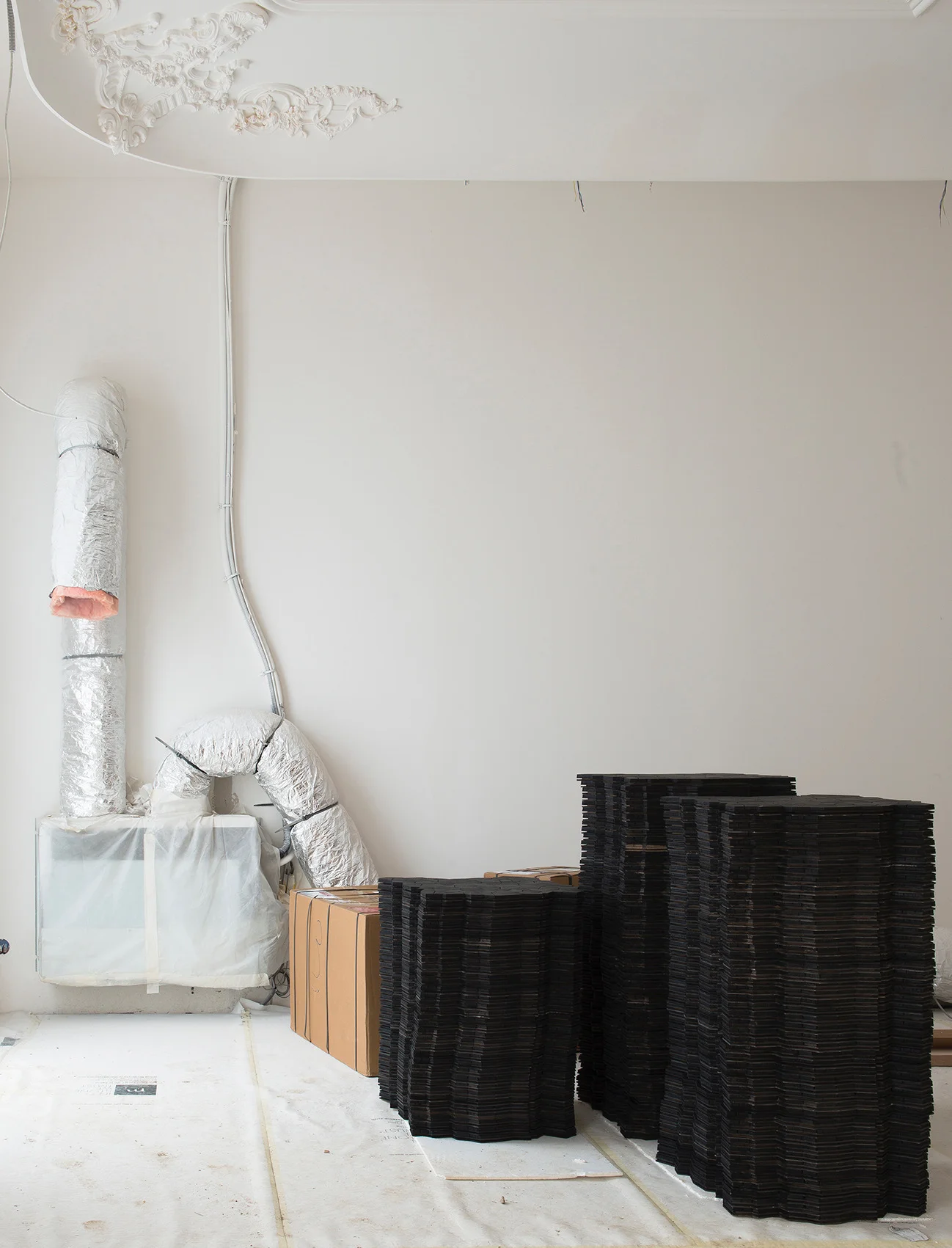
In this private apartment in Paris laid in Opus Black, the endgrain pieces wait in the room on a protected floor before laying, so the wood has adjusted to the space it will live in.
Frequently asked questions
Can you float a herringbone floor?
Only if the boards are made for it. Some herringbone products have click joints designed to float. Traditional herringbone and chevron parquet, laid board by board with left and right boards, is glued to the subfloor, because its many short joints need to be held in place.
Do you need an expansion gap with glued parquet?
Yes. A glued floor moves far less than a floating one, but the wood still swells and shrinks a little with the seasons. A small gap is left at the walls and around fixed objects, then hidden under the skirting. The flooring maker's instructions give the size.
Can parquet be laid over old tiles?
Often, yes, if the tiles are firmly bonded, flat and clean. The fitter usually primes them so the adhesive grips, and checks the new floor height at doors and thresholds. Loose or hollow tiles have to come up first.
How long before you can walk on a new parquet floor?
It depends on the adhesive, so follow the curing time its maker gives. Floors that are sanded and finished in place, such as end grain, then need the finish to dry and harden, so the room is out of use for longer than with prefinished boards.
Installing an OscarOno Paris floor
Every OscarOno Paris collection has a spec sheet, with CAD and 3D files, in the library. Read it with your fitter before choosing the installation method. The plank and pattern floors, Droit and Rompu, are 12 mm oak with a 4 mm top layer and rated usage class 33 for heavy commercial traffic. The endgrain floors such as Opus are rated usage class 34, for very heavy commercial traffic. All carry a Cfl-s1 fire rating and are FSC and PEFC certified.
To see the boards and the finish in the room where they will go, order samples.
More from the Atelier
Protecting End Grain Wood Block Flooring from UV Fading
Discover the science of oak photodegradation and how to protect end-grain wood floors from UV fading using advanced varnishes and architectural design.

Parquet Floor Restoration: Is an Old Parquet Floor Worth Saving?
Loose blocks, gaps, stains and a worn finish can all be put right. How to tell whether an old parquet floor is worth restoring, what the work involves, and when it is not.
Squeaky Wood Floors: Why They Squeak and How to Fix Them
A squeak is friction: wood on wood, wood on a nail, or a subfloor moving on its joists. Find which one it is and the fix follows.