
Wood Flooring and Allergies: Is a Wood Floor Better Than Carpet?
A hard floor gives dust mites nowhere to live. The finish, the glue and your cleaning routine decide the rest.

For most people with allergies, yes: a wood floor is a better choice than carpet. Dust mites live in textiles, and carpet also holds pet dander, pollen and fine dust deep in its pile, where every step lifts some of it back into the air. A wood floor gives mites nowhere to live and leaves dust on the surface, where it can be removed. Two caveats: rugs, curtains and upholstery still hold allergens, and the finish and adhesive, not the wood, are what can affect indoor air.
Why is a wood floor better for allergies than carpet?
Carpet is a reservoir. Dust, skin flakes, dander and pollen sink into the fibers, mites feed on them, and vacuuming only removes part of it. Walking on the carpet and sitting down on it releases fine particles back into the air you breathe.
A sealed wood floor has no pile. Dust and dander settle on top, you can see them, and a vacuum and a damp mop take them away. Dust mites need fibers and trapped moisture to live in, and a hard floor offers neither. That is why allergy and asthma advice so often starts with replacing wall-to-wall carpet in bedrooms.
| Floor | Holds allergens? | Cleaning | Emissions to watch |
|---|---|---|---|
| Wood, sealed | On the surface only | Vacuum and damp mop | The finish and the adhesive |
| Wall-to-wall carpet | Deep in the pile | Hard to clean fully | Fibers, backing and glues |
| Ceramic tile | On the surface and in grout lines | Wash and scrub grout | Very few from the tile itself |
Tile is just as easy for allergy sufferers, but it is cold and loud underfoot; wood gives the same easy cleaning with more warmth and quiet.
Do gaps between the boards matter?
They can. Wide, open joints collect fine dust that a mop cannot reach. Boards laid tight, with a sealed surface, leave less room for it. Droit straight oak boards are lacquered, so the top is a closed surface that takes a damp mop, and wide boards, 150 mm or 190 mm in Droit's case, mean fewer joints across a room than narrow strips.

At the Family Office in São Paulo, pale Droit boards run unbroken through an office: a hard, sealed floor with long boards and few joints, where dust stays on top.
Can a wood floor affect indoor air quality?
Solid oak itself gives off very little. What can release volatile organic compounds (VOCs) is everything around it: the finish while it cures, the adhesive used to glue the floor down, and, in some engineered floors, the glue in the core boards. Most of this is released in the first days and weeks, which is why fresh air during and after installation matters.
If emissions matter to you, ask for the labels rather than relying on words like "natural". In France, every floor covering carries an indoor-air emission class from A+ (lowest) to C; elsewhere, GREENGUARD Gold and FloorScore are common. For boards with glued layers, E1, E0 or CARB Phase 2 compliance covers formaldehyde. Ask the same question about the adhesive, which covers the whole floor area.
Do rugs undo the benefit?
Partly. A rug on a wood floor holds dust like a small carpet, but it can be taken outside, shaken, beaten or washed, which wall-to-wall carpet cannot. Flat-woven and washable rugs are the easiest to keep clean.

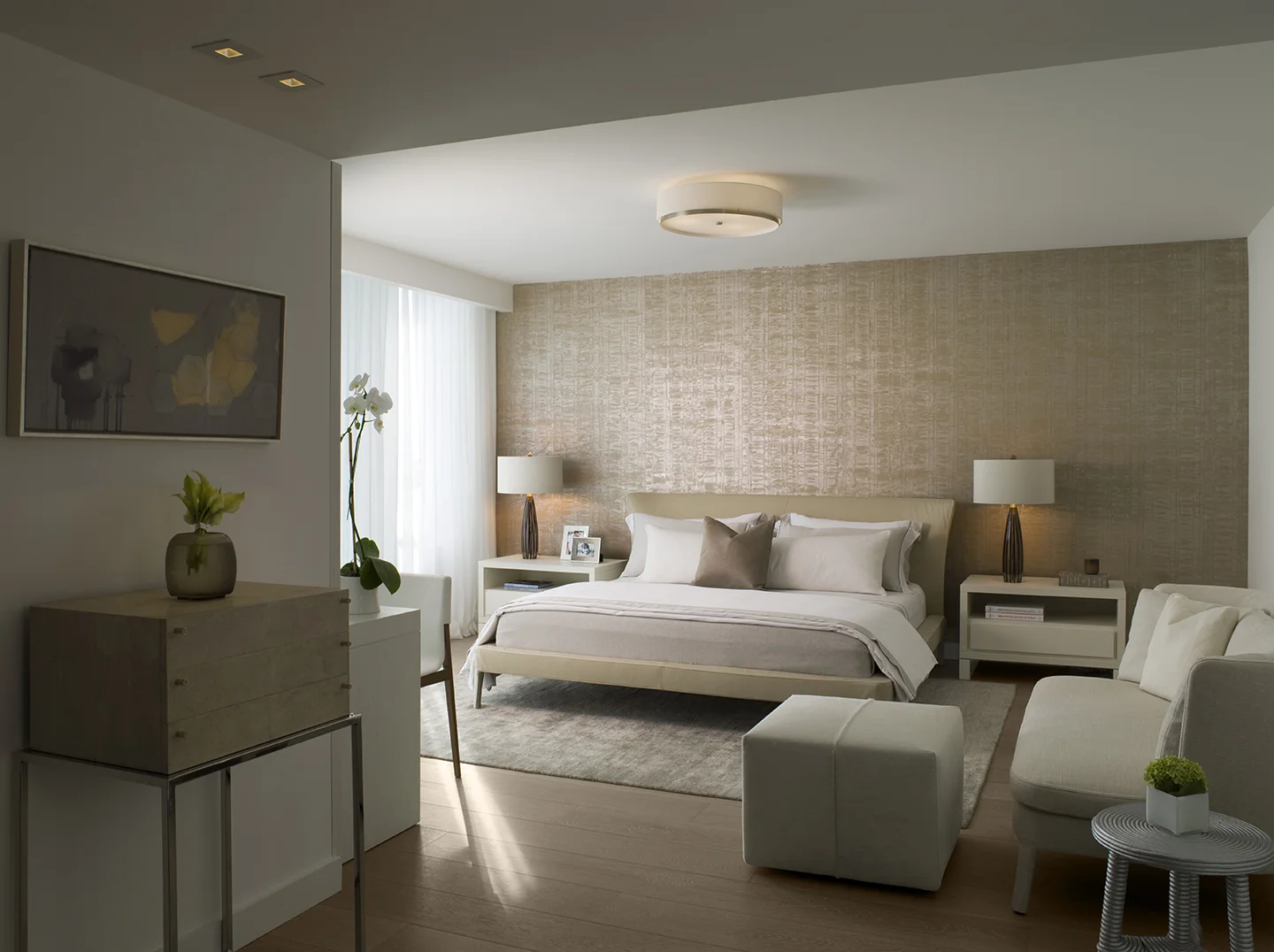
In this private apartment in Miami, a rug sits only under the bed on Droit boards: the floor around it stays bare and quick to clean.
How should you clean a wood floor if you have allergies?
Little and often. Vacuum with a soft-brush head and a HEPA filter, so fine dust is caught rather than blown back into the room, then go over the floor with a well-wrung microfiber mop and a pH-neutral cleaner. Avoid soaking the floor and avoid strongly scented products, which add their own irritants. A good doormat at each entrance stops a surprising amount of pollen and grit before it reaches the floor.
Frequently asked questions
Is wood flooring good for allergies?
For most people, yes. Unlike carpet, a sealed wood floor gives dust mites nowhere to live and keeps dust, dander and pollen on the surface, where a vacuum and damp mop remove them. Rugs, curtains and upholstery still hold allergens, so keep them washable where you can.
Do wood floors have dust mites?
Dust mites need textiles and trapped moisture, so a hard wood floor is a poor place for them. They can still live in rugs, mattresses and sofas in the same room, so a wood floor reduces mites but does not remove them from the home.
Can a wood floor give off VOCs?
The oak itself gives off very little. Emissions come mainly from the finish while it cures, from the adhesive used to lay the floor, and from glues in some engineered cores. Most is released in the first days and weeks, so ventilate well after installation.
What certifications should I look for in a low-emission floor?
The French indoor-air label, where A+ is the lowest emission class, GREENGUARD Gold and FloorScore are the common ones. For boards with glued layers, E1, E0 or CARB Phase 2 compliance covers formaldehyde. Ask for the adhesive's label too.
How should I clean a wood floor if I have allergies?
Vacuum with a soft-brush head and a HEPA filter, then use a well-wrung microfiber mop with a pH-neutral cleaner. Avoid soaking the floor and avoid strongly scented products. Doormats at the entrances keep a lot of pollen and grit off the floor.
An easy-to-clean wood floor from OscarOno Paris
Droit is the straight board in its simplest form: flatgrain select oak, 12 mm with a 4 mm oak top layer, 150 mm or 190 mm wide, lacquered in twelve colors. It is rated usage class 33 for heavy commercial traffic, carries a Cfl-s1 fire rating and is FSC and PEFC certified. For emission data and installation guidance, check the spec sheet.
Order samples, and find spec sheets, CAD and 3D files in the library.
More from the Atelier
Protecting End Grain Wood Block Flooring from UV Fading
Discover the science of oak photodegradation and how to protect end-grain wood floors from UV fading using advanced varnishes and architectural design.

Parquet Floor Restoration: Is an Old Parquet Floor Worth Saving?
Loose blocks, gaps, stains and a worn finish can all be put right. How to tell whether an old parquet floor is worth restoring, what the work involves, and when it is not.
Squeaky Wood Floors: Why They Squeak and How to Fix Them
A squeak is friction: wood on wood, wood on a nail, or a subfloor moving on its joists. Find which one it is and the fix follows.