
Superyacht Wood Flooring: Marine Tolerances and Teak
How engineered French oak and fallen Zambezi teak withstand interior marine climates
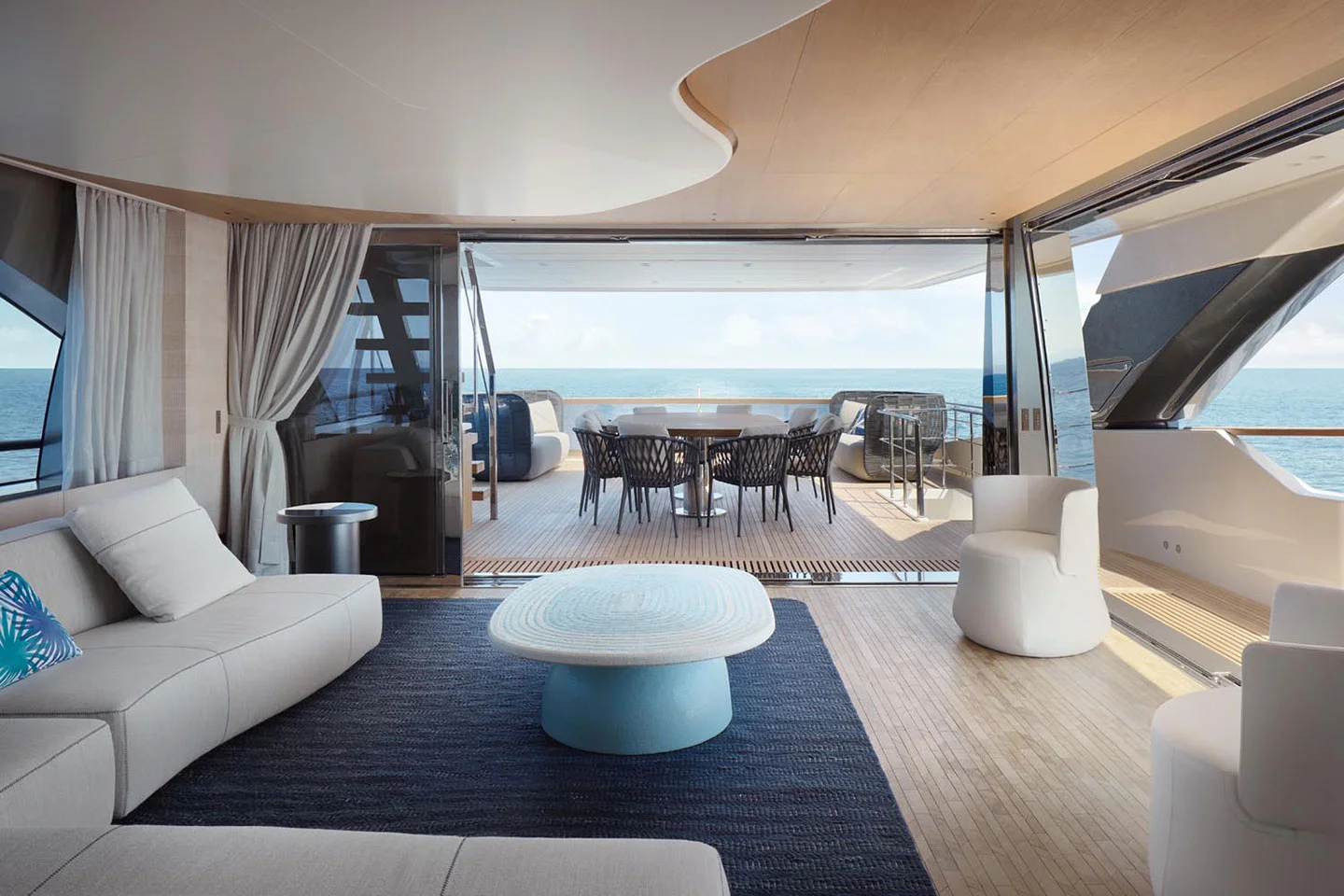
Specifying superyacht wood flooring requires solving three conflicting physical forces: severe humidity cycling between conditioned salons and open sea air, structural hull torsion, and strict weight budgets. Solid timber planks risk cupping and opening wide gaps when subjected to these maritime swings. Engineered cross-ply constructions and ultra-dense, stable timber species provide naval architects with stable surfaces that preserve architectural intent without compromising safety or naval performance.
How does superyacht wood flooring handle marine humidity cycles?
Marine cabins experience rapid shifts in relative humidity whenever sliding glass doors open to saline coastal air. Solid timber reacts hydroscopically across its width, absorbing airborne moisture and swelling against bulkheads, or shrinking and checking under dry air conditioning. Engineered timber mitigates these lateral forces by bonding a solid hardwood wear layer to a cross-laminated plywood core, reducing seasonal movement across the floor plate.
Birch multi-ply cores balance the tension of the surface veneer. Each alternating veneer layer arrests the dimensional expansion of the grain above and below it. In naval architecture, this structural symmetry prevents surface crowning and preserves tight joints across long open-plan salons.
Why specify marine teak surfaces interior over raw timber?
Specifying marine teak surfaces interior for staterooms and bridge decks introduces exceptional natural density and resistance without the ethical concerns of newly felled wood. Reclaimed Zambezi teak, botanically known as Baikiaea plurijuga, offers a Janka hardness of approximately 2,990 lbf, compared to European oak at approximately 1,300 lbf. Sourced solely from fallen trees in southern Africa, this timber yields extraordinary dimensional density and deep mineral color without contributing to tropical deforestation.
Unlike raw exterior decking teak, which relies on heavy caulked seams and constant maintenance to endure direct salt wash, interior marine surfaces demand fine furniture-grade tolerances. Cross-cut endgrain blocks and precision-milled tongue-and-groove profiles in dense teak provide quiet acoustic dampening underfoot while standing up to high guest traffic and luggage impact.
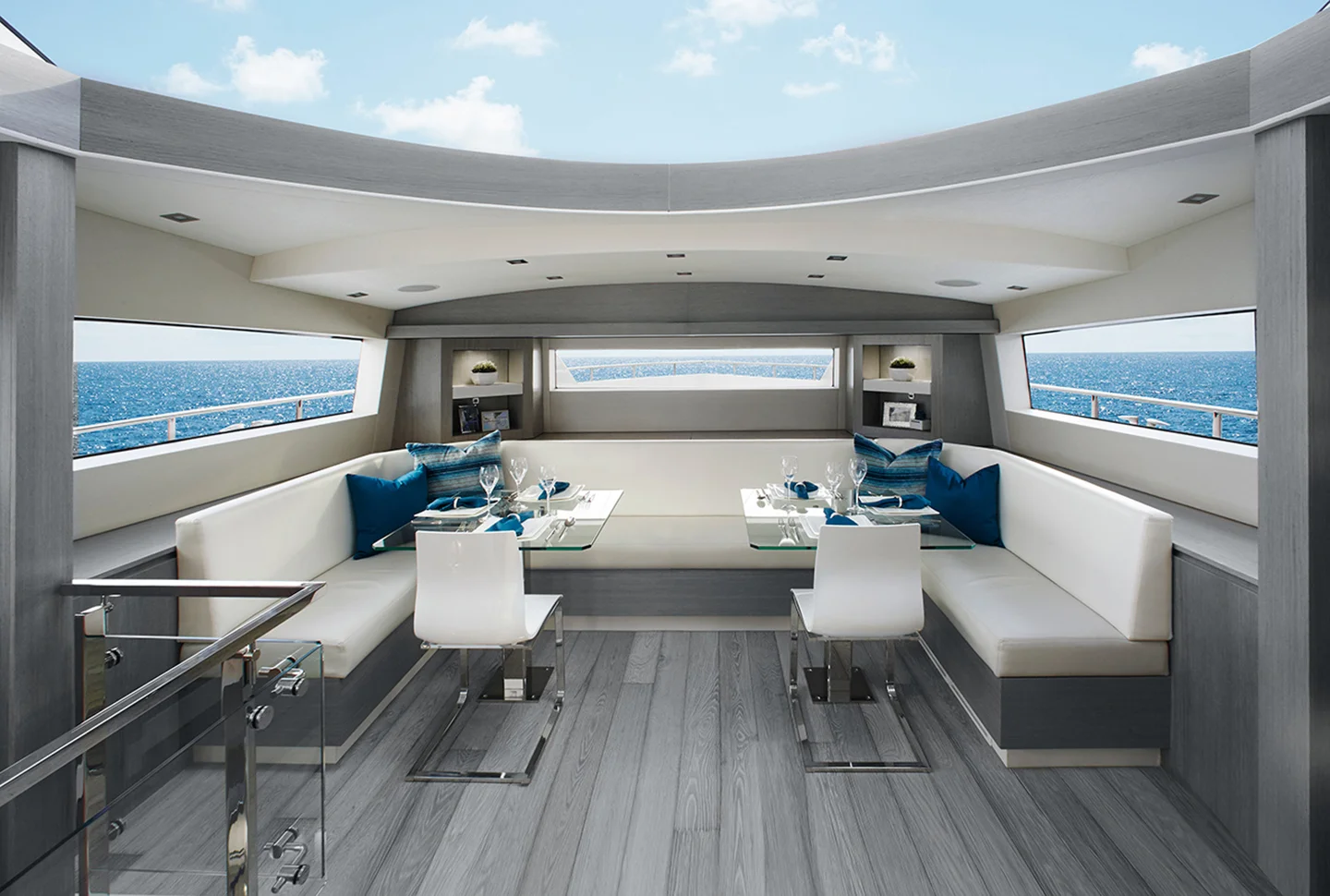
How do luxury yacht wood panels balance weight and structural stability?
Luxury yacht wood panels must contribute minimal mass to protect the vessel's vertical center of gravity and overall fuel efficiency. Naval architects assign precise weight budgets to interior outfit packages, often restricting floor build-ups to tight dimensional thicknesses. High-density engineered profiles maximize wear depth while eliminating the dead weight of uncalibrated solid sub-structures.
An engineered construction combining a 4 mm to 8 mm top wear layer over a calibrated 10 mm to 12 mm birch plywood core delivers the structural stiffness needed across marine floor plates without excess bulk. This calibrated build-up allows flush transitions to perimeter stone, metal inlay thresholds, and deck access hatches without requiring heavy leveling screeds.
What should an engineered timber marine spec include?
An engineered timber marine spec must evaluate fiber cut, core construction, fire behavior, and adhesive flexibility. Standard terrestrial installation methods fail in maritime environments if hull deflection and acoustic vibrations transfer directly into the wood. Subfloors aboard yachts flex during ocean transits, requiring permanently elastic silane-based adhesives that decouple the timber surface from the steel or aluminum deck substrate.
Fire performance is equally critical. Specifiers must look for timber with proven reaction-to-fire classifications such as European Cfl-s1, ensuring low flame spread and limited smoke production inside enclosed marine accommodations.
tbody| Material Specification | Cut & Construction | Janka Hardness | Fire Rating | Primary Marine Advantage |
|---|---|---|---|---|
| Zambezi Teak (Réserve) | Endgrain block, fallen timber | Approx. 2,990 lbf | Dense grain performance | Extreme impact resistance and zero virgin logging |
| Woven Smoked Teak (Tweed) | Hand-woven teak strips | Teak offcut core | Cfl-s1 | Textile-like grain texture and heavy commercial wear class 33 |
| Engineered French Oak (Droit) | 12 mm oak core + 4 mm top layer | Approx. 1,300 lbf | Cfl-s1 | Calibrated low-profile thickness and classic long plank visual |
| Endgrain Oak (Forêt / Opus) | 12 mm birch ply + 8 mm oak | Endgrain compressive face | Cfl-s1 | Heavy traffic usage class 34 with high acoustic damping |
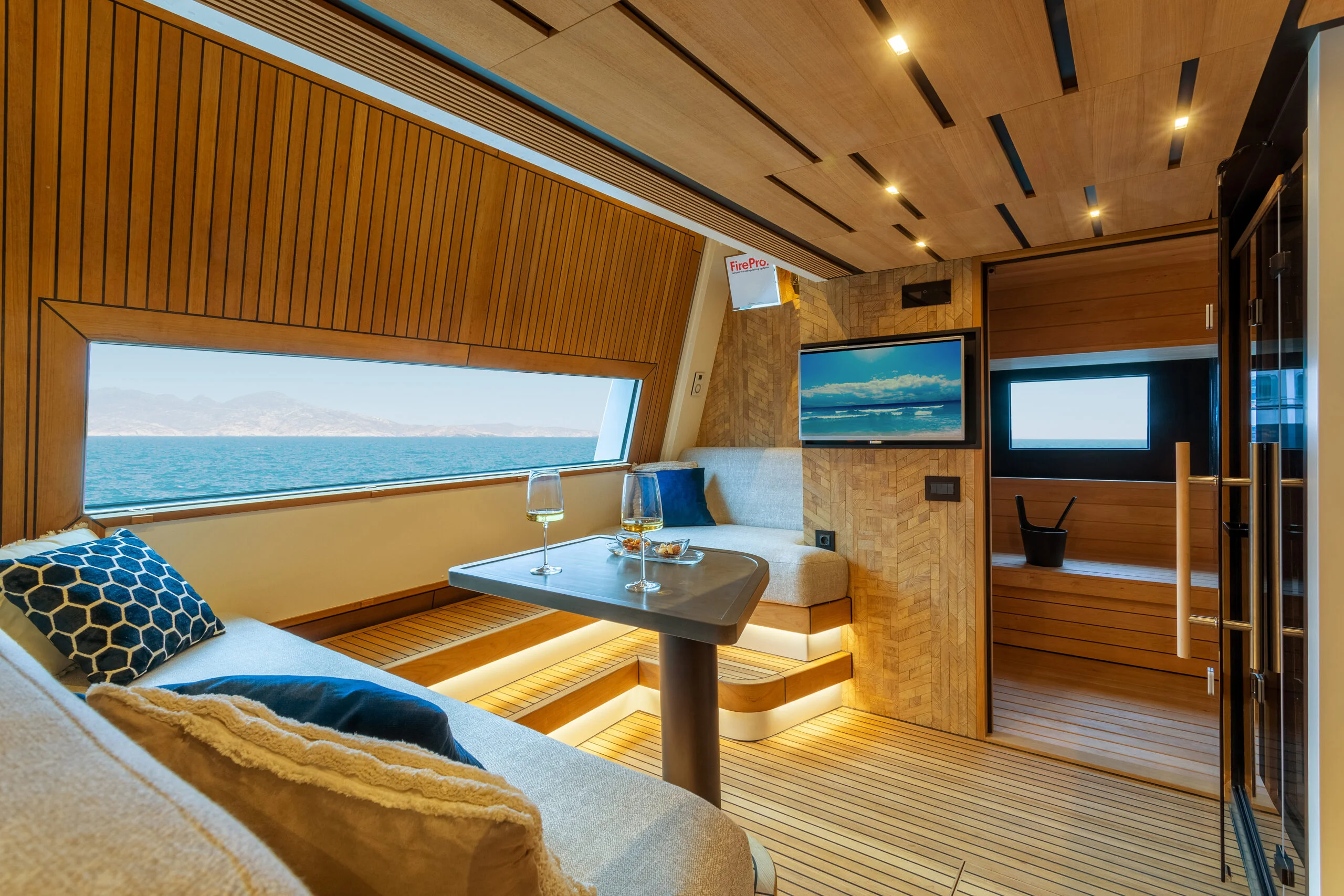
Specifying marine wood surfaces with OscarOno Paris
OscarOno Paris manufactures architectural wood surfaces engineered to meet exacting marine interior criteria. For naval designers seeking resilient teak alternatives, the Réserve collection offers our Opus endgrain pattern cut into fallen Zambezi teak (Baikiaea plurijuga), delivering an exceptionally dense Janka rating of approximately 2,990 lbf in a deep Smoke finish. Where woven texture is required, the Tweed collection brings hand-assembled strips of smoked teak into a certified Cfl-s1 surface graded for usage class 33 commercial traffic.
For yacht interiors centered on European oak, OscarOno Paris produces both classical linear planks and organic endgrain patterns. The Droit collection offers select grade French oak with a 4 mm top layer on a 12 mm base in eleven lacquered colors, as seen in the custom Rocher Bleu Gris palette aboard the Private Yacht M75 Panacera. In high-traffic main salons, endgrain collections such as Forêt combine an 8 mm oak wear layer with a 12 mm birch plywood backing to achieve usage class 34 durability, featured on luxury vessels like Yacht Sd118. Explore our full portfolio of completed marine and terrestrial projects in our realisations.
To evaluate finishes, weight samples, and technical tolerances for your next yacht interior, order samples or consult technical spec sheets, CAD files, and 3D assets in our Library.
Frequently asked questions
Can solid teak flooring be installed inside modern superyachts?
Solid teak can be installed, but it requires wide expansion joints and perimeter margins to manage severe marine humidity swings. Most naval architects prefer engineered constructions, which significantly reduce lateral expansion and prevent seam separation between air-conditioned interiors and open decks.
What is the difference between exterior marine teak and interior teak surfaces?
Exterior yacht decking relies on thick, unfinished solid teak planks bedded in flexible polyurethane with visible black caulking joints designed to shed standing saltwater. Interior teak surfaces utilize fine calibrated cuts, furniture-grade finishes, and tight joint tolerances under 1 mm to integrate cleanly with luxury joinery and stone transitions.
How does Zambezi teak compare to traditional Asian teak?
Zambezi teak (Baikiaea plurijuga) is substantially harder than traditional plantation teak, with a Janka rating of approximately 2,990 lbf compared to oak at approximately 1,300 lbf. Sourced entirely from fallen trees in southern Africa, it offers superior compressive strength and rich natural coloration without the deforestation concerns associated with virgin tropical teak.
What fire rating is required for interior superyacht timber flooring?
Interior marine joinery and flooring must minimize flame propagation and toxic smoke production. Engineered surfaces meeting European classification Cfl-s1 provide the flame retardance and low smoke development required by naval outfitting engineers.
More from the Atelier
Acoustic Parquet Underlay: Detailing Penthouse Floors
An acoustic parquet underlay stops footsteps reaching the flat below. How to choose one, keep the floor from sounding hollow, and hold flush thresholds.
Monotile Parquet Pattern: Non-Repeating Geometric Wood Floors
Explore the mathematics of aperiodic wood flooring. Discover how modular endgrain oak shapes non-repeating architectural parquet compositions.
Fire Rated Wood Flooring Commercial: The Cfl-s1 Guide
A technical specification guide for architects detailing how engineered endgrain oak meets Euroclass Cfl-s1 and Class 34 durability in high-traffic commercial spaces.