
Wabi-Sabi Interiors: Choosing Imperfect Wood That Ages Well
Natural materials left visible, a narrow palette, and a floor that is allowed to change.
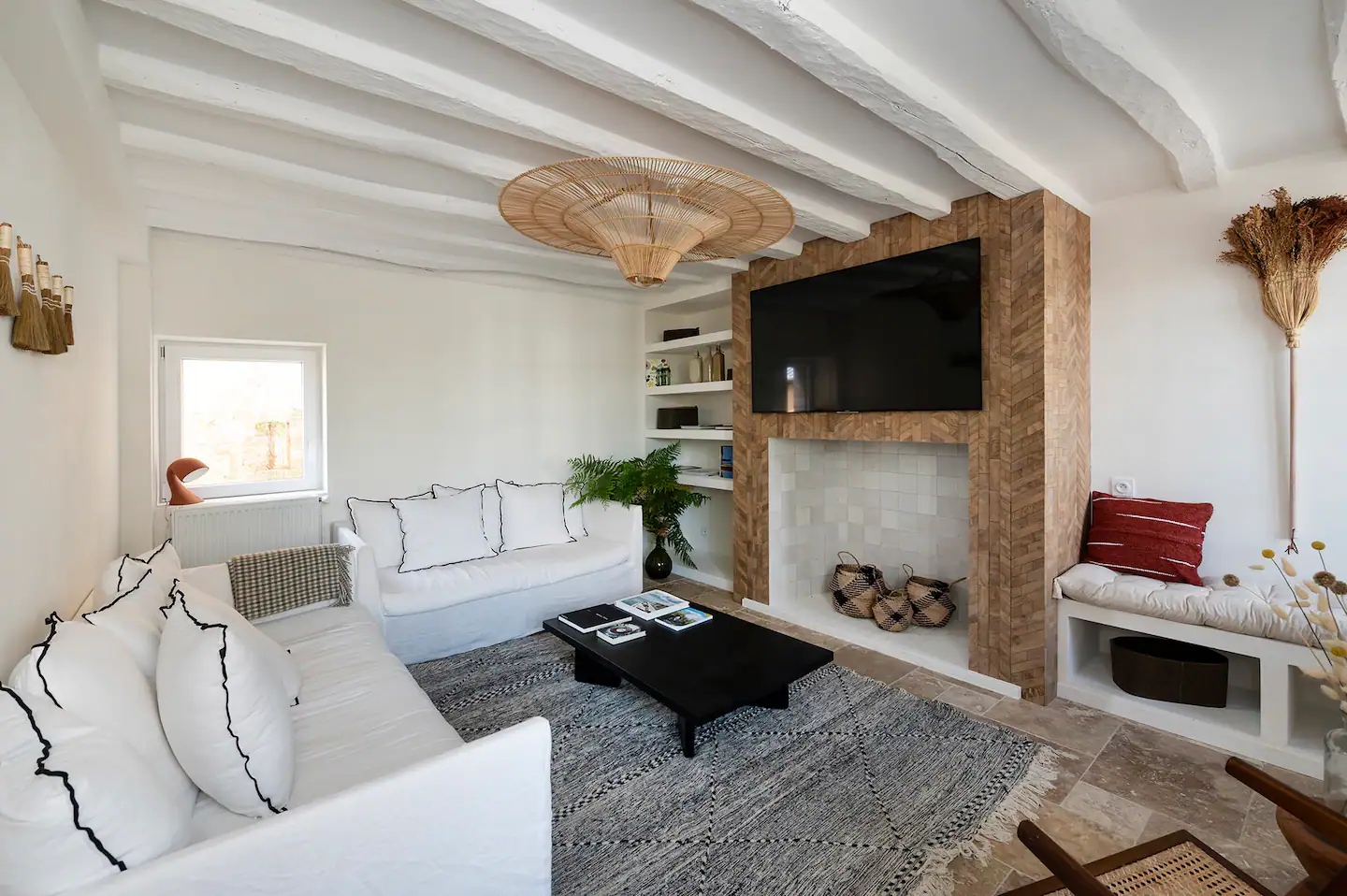
A wabi-sabi interior is built on the Japanese idea that beauty lies in things that are imperfect, impermanent and modest. In a room, that means natural materials left visible, an earthy palette, few objects, soft light, and surfaces that are allowed to age. Wood is central to it because a wood floor shows how the tree grew, in its grain, knots and rings, and then records how the room is lived in.
What does wabi-sabi mean?
The two words are often explained together. Wabi points to quiet, rustic simplicity, the beauty of things that are humble and spare. Sabi points to the beauty of age: patina, wear, the way materials change with time. The idea is closely tied to the Japanese tea ceremony, with its rough handmade bowls and plain tea rooms, and to the practice of mending broken ceramics so that the repair shows.
It is less a style than a way of looking. A wabi-sabi room is not decorated to look old or distressed; it is made of honest materials and then left to change.
Wabi-sabi, Japandi and minimalism
The three are often confused. Minimalism removes things until what is left looks perfect. Japandi, a more recent interior style, combines Japanese restraint with Scandinavian practicality, usually with pale woods and clean lines. Wabi-sabi shares their restraint but not their wish for perfection: it keeps the irregular edge, the visible knot, the patch of wear by the door.
Choosing a wood floor for a wabi-sabi interior
The floor is the largest natural surface in the room, so it sets the tone. Three things matter:
- A matte surface. Gloss turns wood into a reflection; a matte finish lets you see and feel the grain.
- Visible texture. Grain, knots and growth rings should read, not be printed over or sanded into uniformity.
- An earthy tone. Natural oak, smoked oak and charred black oak all sit comfortably with plaster, stone and linen.
Irregularity can also be designed into the floor itself. Forêt is built from six planks and six patterns in endgrain oak, combined freely by the architect, so the surface holds together like a forest without ever repeating. It comes in Natural, Smoke, smoked through the full depth of the oak, and Black, charred in the shou sugi ban tradition, a Japanese technique, and is never stained.
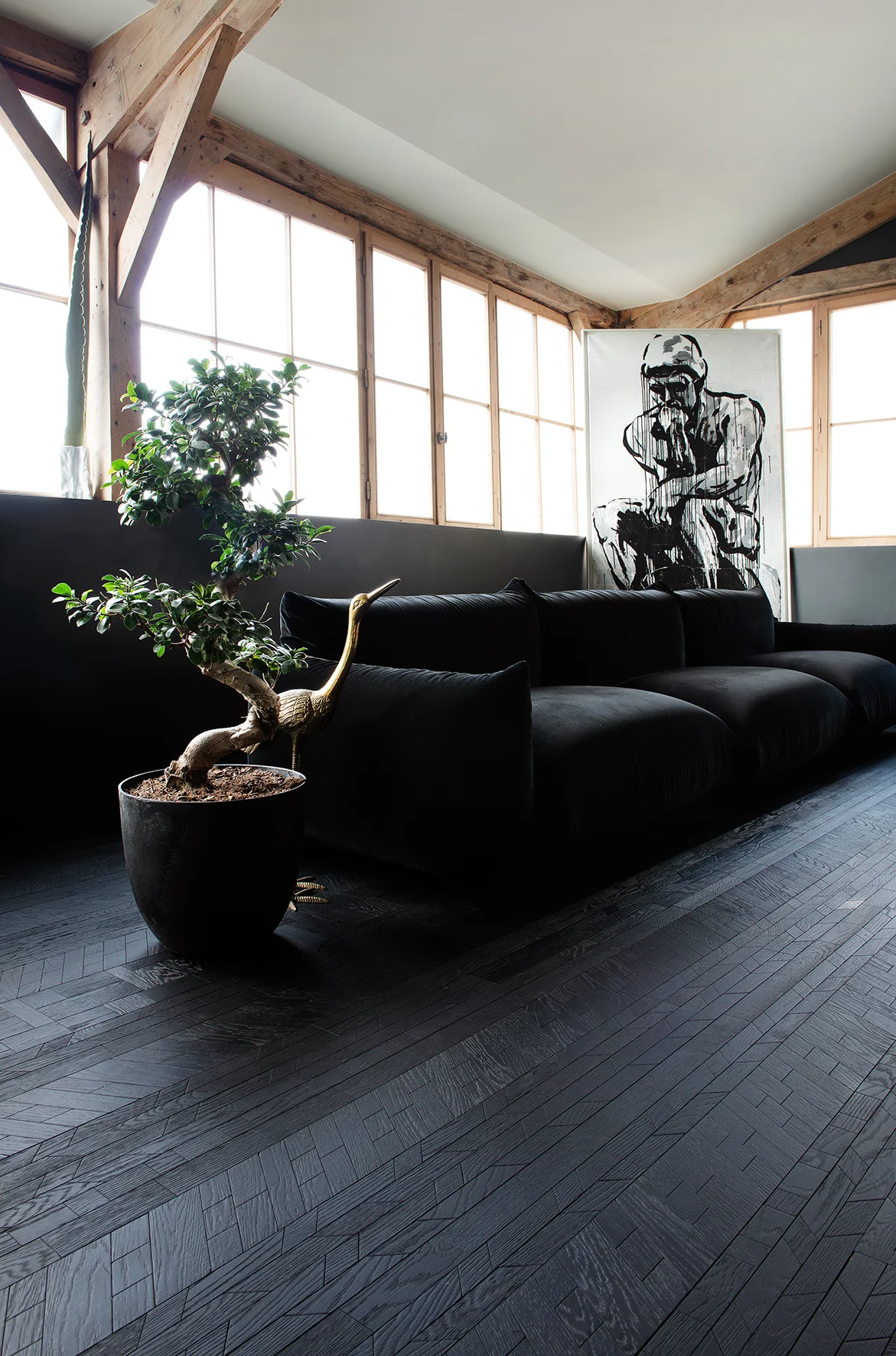
In the Cerede project in Paris, Forêt in Black runs under a room of dark upholstery, raw timber window frames and a single bonsai: very few things, all of them natural, all of them allowed to show their texture.
Why endgrain suits wabi-sabi
Most wood floors are flatgrain: the board is sawn along the trunk and shows the long grain. Endgrain is cut across the trunk, so every block shows its growth rings in cross-section, a record of each year the tree grew. No two blocks are alike, and the floor reads as many small pieces of one forest rather than one manufactured surface. Endgrain is also the hardest face of the wood.
The idea goes furthest in Terra, a wood terrazzo composed entirely by hand from endgrain oak fragments, the offcuts of Opus and Forêt production. Each fragment is placed, turned and separated by a clean line, so the floor is made from wood that would otherwise have been set aside. Terra comes in Sable, with Noir coming soon, and is rated usage class 33 for heavy commercial traffic.
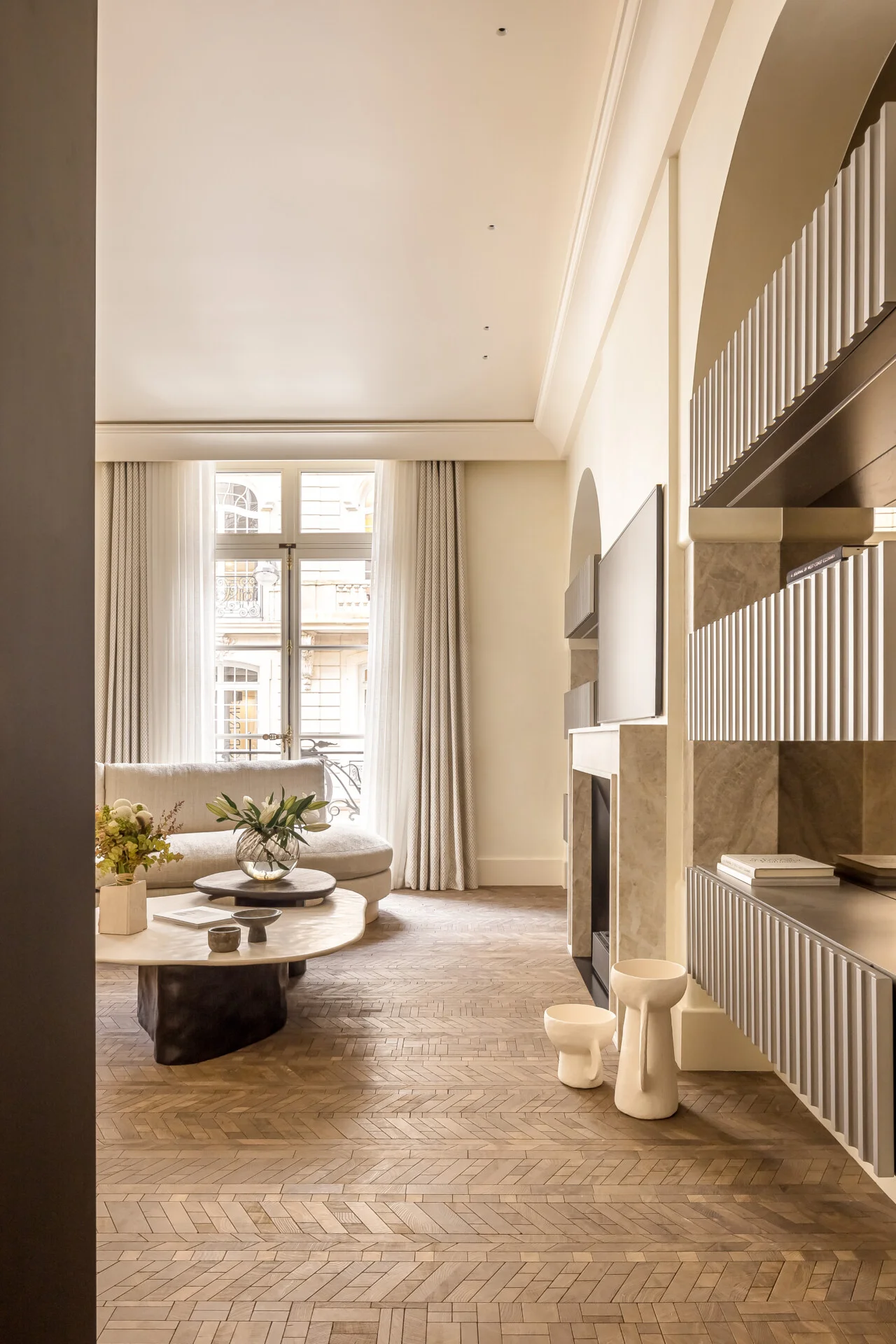
In Project Galilée in Paris, Forêt in Smoke gives a warm, uneven brown that sits easily with plaster arches, stone and pale ceramics.
Materials that belong with wood
Wabi-sabi rooms combine materials that share the same quality: a surface that is not uniform and that changes with time.
- Lime plaster and clay on the walls, with the movement of the hand left in them.
- Stone, honed or rough, for weight and coolness against the warmth of wood.
- Linen and wool, undyed or in earth tones, to soften sound and light.
- Handmade ceramics, with uneven glazes and visible throwing marks.
- Dried branches and grasses rather than arranged flowers.
Keep the palette narrow: off-whites, sand, clay, moss, charcoal. The richness comes from texture, not color.
How each finish ages
| Floor | Character | How it changes |
|---|---|---|
| Natural oak, matte | Pale to honey, grain clearly visible | Mellows and warms with light; wear shows as soft paths |
| Smoked oak | Warm brown to deep brown, uneven | When smoked through the full depth, wear does not expose a lighter wood underneath |
| Charred black oak | Deep black, grain still legible | Shows dust and grit more than mid tones, so it wants regular sweeping |
| Endgrain fragments (Terra) | Many tones of oak, set by hand | Already irregular, so marks of use blend into it |
Letting the floor age
A wabi-sabi floor is not one that never changes; it is one that changes well. Small dents, worn paths and the slow shift of color in the light are part of it. Care is simple: dry sweeping, a damp mop with a cleaner suited to the finish, and felt pads under furniture that moves. Follow the maintenance advice for the finish on your floor, because oiled, lacquered and smoked surfaces are each cared for differently.
Frequently asked questions
What is a wabi-sabi interior?
A room shaped by the Japanese idea that beauty lies in things that are imperfect, impermanent and modest. In practice that means natural materials left visible, a muted, earthy palette, few and often handmade objects, soft light, and surfaces that are allowed to show age and use.
What is the difference between wabi-sabi and Japandi?
Wabi-sabi is a Japanese way of seeing, centered on imperfection and the marks of time. Japandi is a recent interior style that blends Japanese restraint with Scandinavian function. Japandi rooms are usually cleaner and more even; a wabi-sabi room accepts more irregularity, texture and wear.
What wood floor suits a wabi-sabi interior?
A matte floor whose grain, knots and texture stay visible, in an earthy tone: natural, smoked or charred oak all work. Endgrain floors suit the idea especially well, because every block shows the growth rings of the tree. Avoid glossy finishes and printed or perfectly uniform surfaces.
Are knots in a wood floor a defect?
No. Knots are where branches grew from the trunk, and in a properly graded floor they are a matter of appearance, not strength. Grades with more knots look livelier and more rustic; select grades keep them small and few. A wabi-sabi room usually welcomes them.
Wabi-sabi floors by OscarOno Paris
Forêt is endgrain oak, an 8 mm top layer on 12 mm birch plywood, in Natural, Smoke or Black, rated usage class 34 for very heavy commercial traffic. Terra is endgrain oak fragments set by hand, in Sable. Both carry a Cfl-s1 fire rating and are FSC and PEFC certified. Texture only makes sense in your own light and next to your own plaster and fabric, so order samples, and find spec sheets, CAD and 3D files in the library.
More from the Atelier
Wood Floors in the Bedroom: How to Choose a Calm, Quiet Floor
Wood is warm underfoot, easy to keep dust-free and lasts for decades in a low-traffic room. How to choose the color, finish, layout and acoustics of a bedroom floor.
Light Oak Flooring for Bright, Sunlit and Coastal Rooms
Pale oak suits sunlit and seaside rooms, if you get the finish right. How light oak changes in the sun, and what sand, humidity and glare mean for it.
Wide Plank Oak Flooring for a Minimalist Interior
Fewer joints, a clean grade, a low sheen and one direction through the house: how to choose wide plank oak for a minimalist interior, and when an end grain grid does the job better.