
What Makes Luxury Wood Flooring Different?
Four things separate a luxury wood floor from an ordinary one, and each can be checked on a spec sheet.
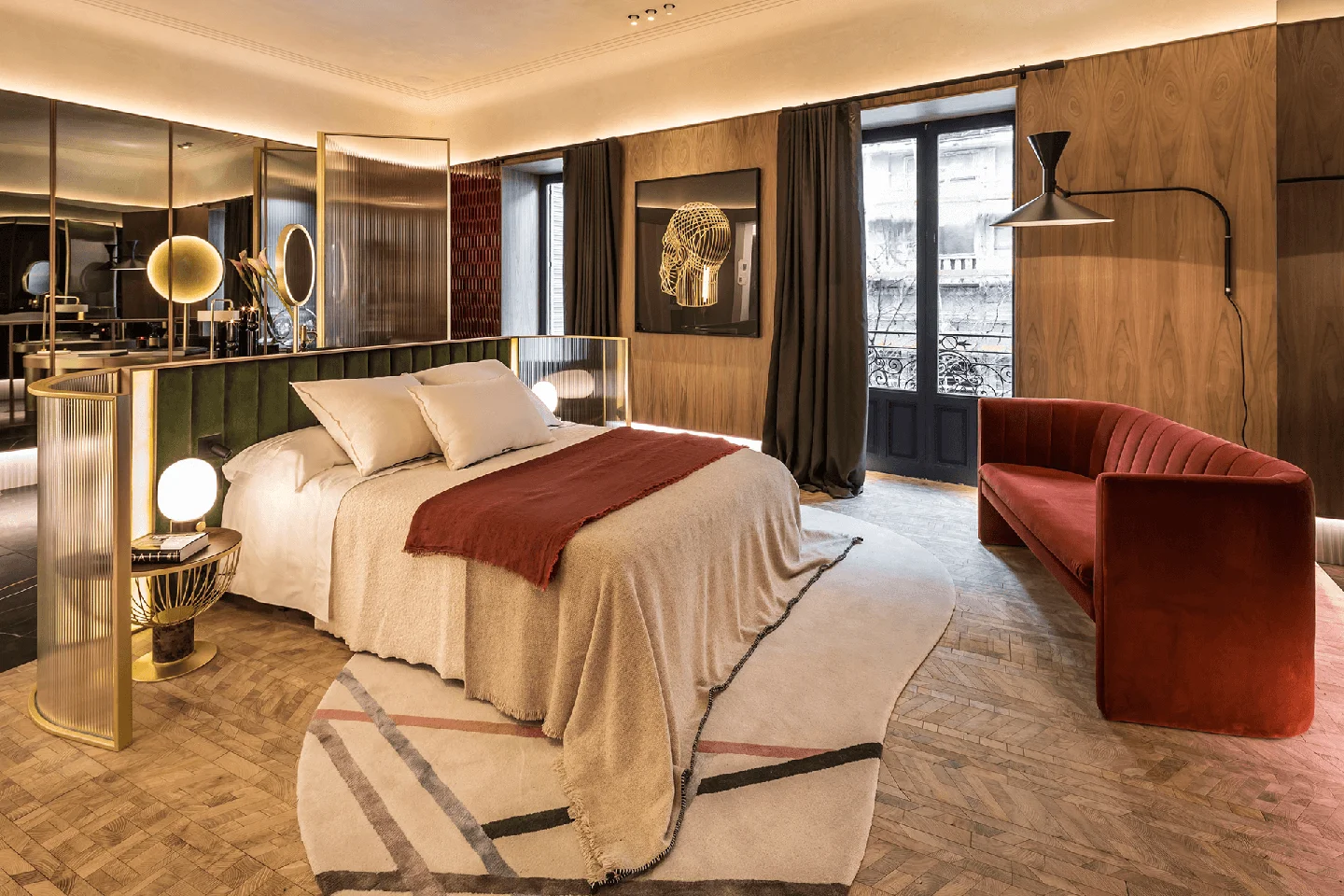
Luxury wood flooring differs from an ordinary wood floor in four places: the wood and how it is cut, the way the floor is built, where its color comes from, and the design it is laid in. Price follows from those choices, not the other way round. At OscarOno Paris that means endgrain oak floors that revive nineteenth-century Parisian wood paving, color that goes through the wood rather than sitting on it, and classic Paris patterns made in select oak, all rated for commercial traffic.
What makes a wood floor luxury?
Ignore the adjectives in the brochure and check five things:
- Grade. Select grade oak has few knots and an even look. Rustic grades are cheaper and busier.
- Cut. Flatgrain boards show long grain; endgrain blocks show the growth rings and wear far more slowly.
- Construction. How thick the oak top layer is, and what it sits on, decides stability and how long the floor lasts.
- Finish. Color that goes through the wood ages well; a surface stain shows paler wood where it wears.
- Proof. A usage class, a fire rating and FSC or PEFC certification on the spec sheet.
End grain: the hardest face of the oak
Most wood floors show the side of the grain. An endgrain floor is cut across the trunk, so you walk on the ends of the fibers. That is the face Paris used to pave its streets in the nineteenth century, because it carries load along the fiber and wears slowly and evenly.
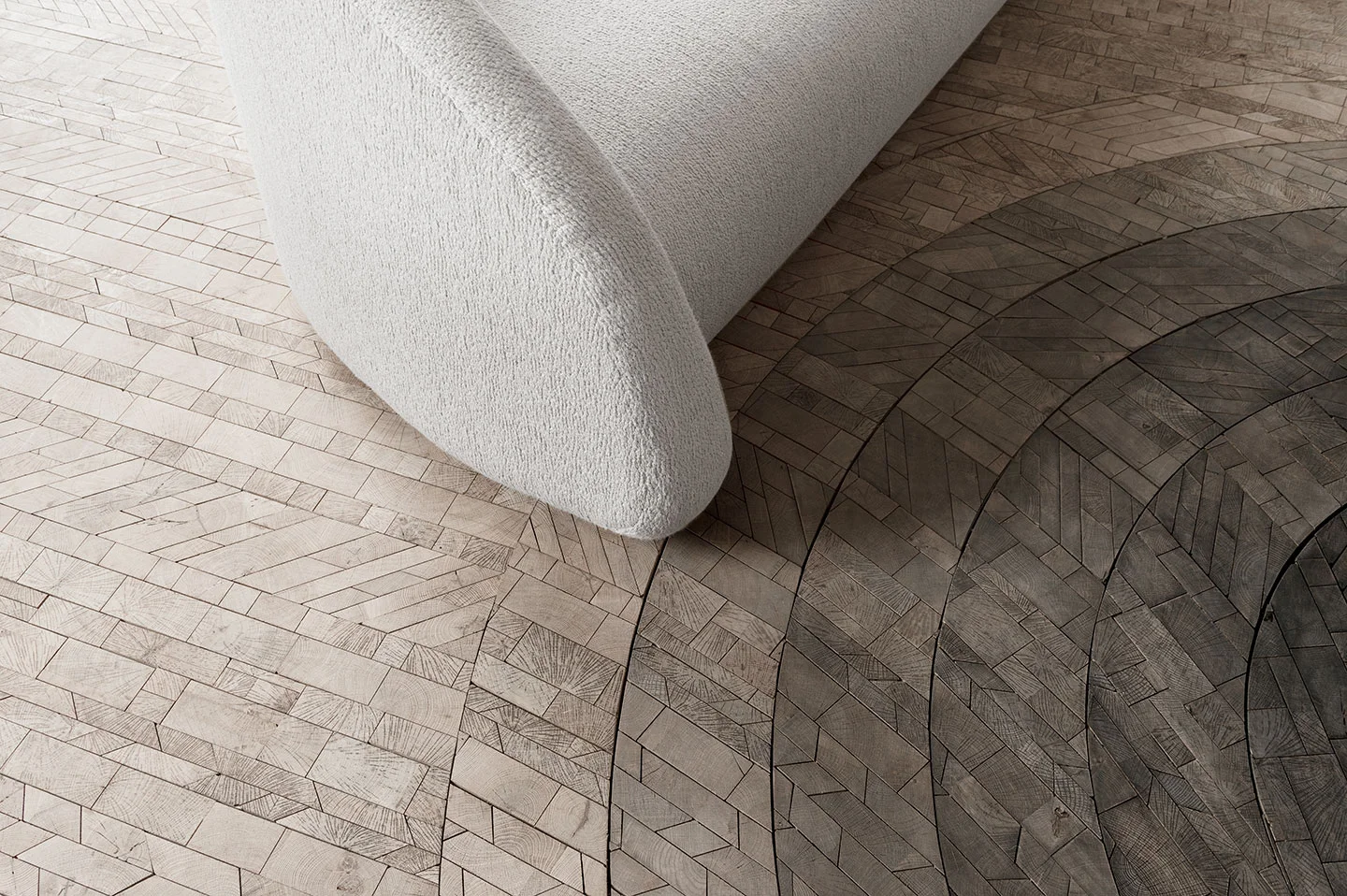
Opus revives that craft: oak cut on its endgrain face into an organic pattern whose joins disappear into one continuous surface. It is built as an 8 mm endgrain oak top layer on 12 mm birch plywood and rated usage class 34, very heavy commercial traffic. The joints are under 1 mm, with optional filling in brown or black LignoFusion.
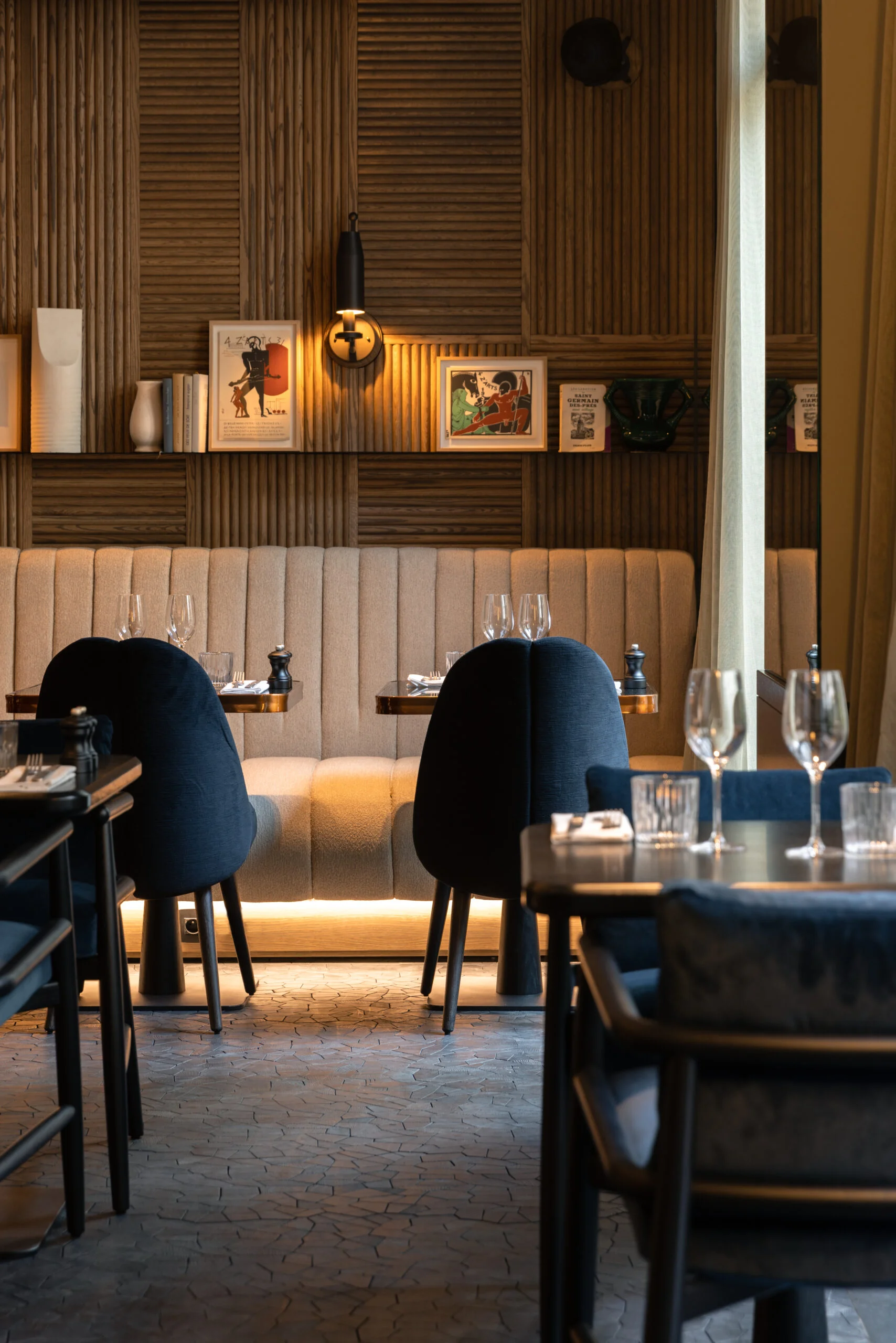
At Hotel Dame des Arts in Paris, Opus in Black runs through the restaurant and lounge, the kind of traffic class 34 is meant for.
Floors that are composed, not repeated
A standard floor repeats one board. Forêt is built from six planks and six patterns in endgrain oak, which the architect combines freely, so the surface holds together like a forest without ever repeating. It shares Opus's construction and class 34 rating. For a single centerpiece, Rosace bends straight planks into a spiral four meters across.
Color that goes all the way through
A stain colors the top of the wood, and a worn path eventually shows the paler wood underneath. OscarOno Paris's endgrain and Atelier floors use no stain. They come in three finishes: Natural, the oak as it is; Smoke, smoked through the full depth of the oak; and Black, charred in the shou sugi ban tradition. Wear reveals the same color, so the floor ages evenly.
The Essentiel collections take a different route: twelve lacquered colors on select flatgrain oak, for floors that are easy to keep and consistent from room to room.
Classic Paris patterns, made in select oak
Herringbone is the floor of the Paris apartment. Rompu is OscarOno Paris's herringbone, the bâtons rompus pattern Paris has laid for three hundred years, in flatgrain select oak, 12 mm with a 4 mm oak top layer, 150 mm or 190 mm wide, in the twelve Essentiel colors. Like the other Essentiel patterns (Droit, Hongrie and Dalle), it is rated usage class 33.
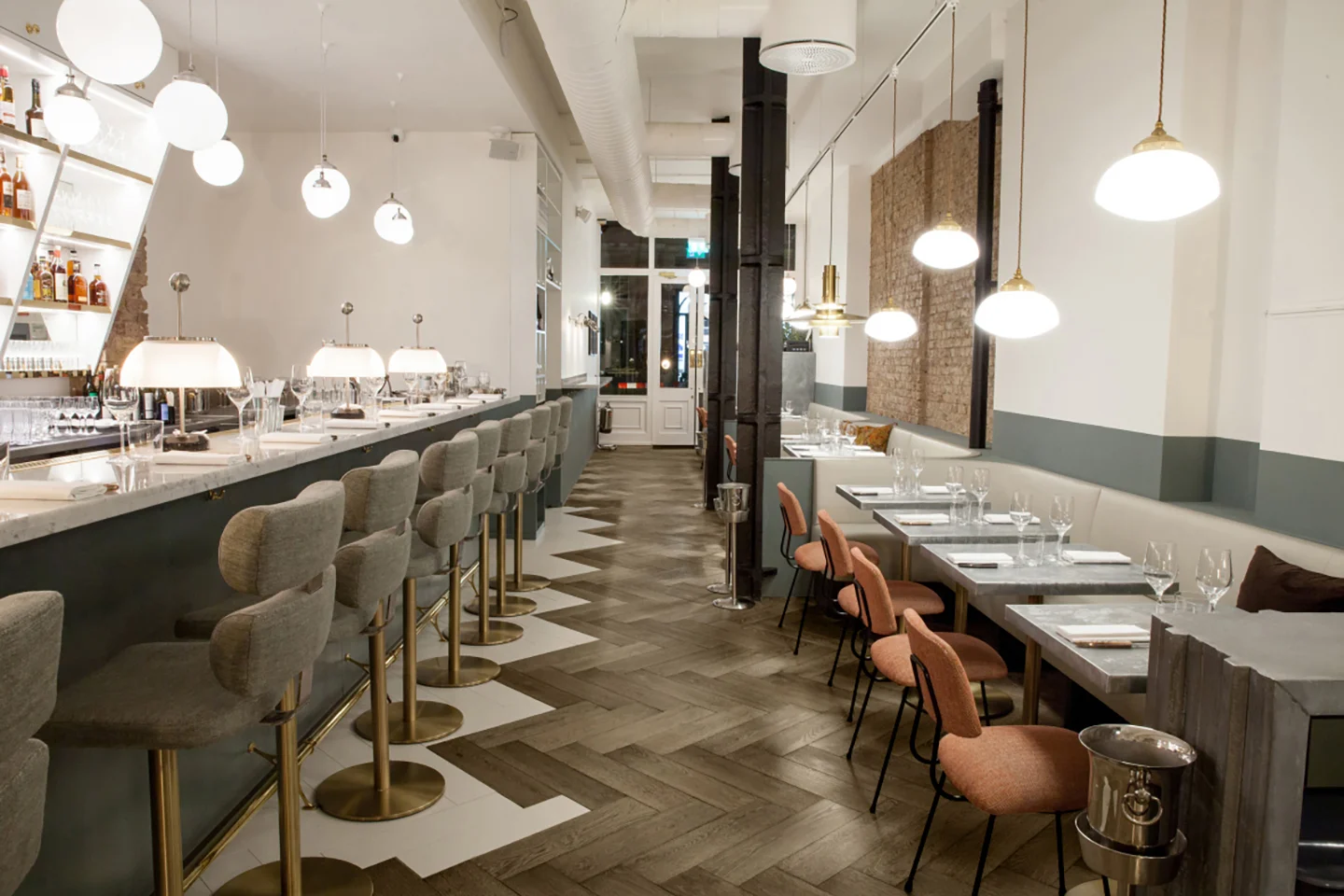
At Frenchie in London, Rompu in a brown finish runs the full length of the restaurant, from the bar to the tables.
Nothing wasted
Several collections exist because the atelier refuses to throw good wood away. Cube is built entirely from solid endgrain offcuts set in an even grid. Terra is a wood terrazzo set by hand from the endgrain fragments left over from Opus and Forêt. Réserve cuts the Opus pattern in Zambezi teak recovered only from trees that have fallen, and Tweed weaves its offcuts into a floor of their own.
The specifications side by side
| Opus | Forêt | Cube | Rompu | |
|---|---|---|---|---|
| Cut | Endgrain oak | Endgrain oak | Endgrain oak, solid offcuts | Flatgrain oak, select grade |
| Construction | 12 mm birch plywood, 8 mm oak top layer | 12 mm birch plywood, 8 mm oak top layer | 10 mm birch plywood, 6 mm oak top layer | 12 mm oak, 4 mm top layer |
| Finishes | Natural, Smoke, Black | Natural, Smoke, Black | Natural, Smoke, Black | Twelve colors, lacquered |
| Usage class | 34 | 34 | 34 | 33 |
| Fire rating | Cfl-s1 | Cfl-s1 | Cfl-s1 | Cfl-s1 |
| Certification | FSC and PEFC | FSC and PEFC | FSC and PEFC | FSC and PEFC |
For the rooms next to a patterned floor, the endgrain collections have Tandem: plain boards in the same finish, so a hallway or a bedroom can carry on in the same color.
Frequently asked questions
What is luxury wood flooring?
A floor where the material, construction and finish are chosen for how they look and last over decades, not for the lowest cost: select-grade wood, a stable construction, color that does not wear off, and a design that suits the room. The spec sheet should back it up with a usage class, fire rating and certification.
Is end grain flooring better than plank flooring?
It is harder-wearing, because you walk on the ends of the fibers rather than their sides, and it has a deeper, more textured look. Plank floors are simpler to lay and suit long, quiet rooms. OscarOno Paris rates its endgrain floors usage class 34 and its plank and pattern floors class 33.
Does OscarOno Paris stain its floors?
No. The endgrain and Atelier collections come in Natural, Smoke and Black: Smoke is smoked through the full depth of the oak and Black is charred in the shou sugi ban tradition. The Essentiel collections, such as Droit, Rompu, Hongrie and Dalle, are lacquered in twelve colors.
Can OscarOno Paris floors be used in commercial spaces?
Yes. Every collection is rated for commercial traffic: usage class 34 for the endgrain floors and class 33 for the others, with a Cfl-s1 fire rating. That is why the same floors appear in hotels, restaurants and shops as well as homes.
See the difference in person
A spec sheet tells you what a floor is rated for; a sample tells you how it looks in your light and feels underfoot. Order samples of Opus, Forêt or Rompu, and find spec sheets, CAD and 3D files in the library.
More from the Atelier
Bespoke Parquet Flooring: What It Means and What to Expect
Bespoke parquet is a floor composed for one room: its pattern, layout and finish decided by the designer. How a project runs, step by step, and what to check.
How Bespoke Parquet Flooring Is Made: From Endgrain Cut to Joint
From oak cut on its endgrain to a spiral bent four meters across: how a bespoke parquet floor is made, finished and laid, and what you decide along the way.
How Parquet Flooring Is Made: From Tree to Floor
From log to finished floor in seven steps: sawing, drying, grading, building the board, cutting the pattern and finishing, and what each step changes in the floor you walk on.