
Wood Floor in Kitchen and Bathroom Spaces: The Technical Guide
How engineered stability, end-grain resilience, and advanced finishes make timber safe for wet areas.
Is a wood floor in kitchen or bathroom spaces highly viable? Yes, but only when specified with engineered construction or end-grain blocks, sealed with penetrating finishes, and detailed with proper expansion joints. While no natural wood floor is entirely waterproof, modern material science minimizes wood movement to prevent warping, cupping, and structural failure in wet-prone environments.
- Multi-ply engineered parquet and end-grain blocks offer superior dimensional stability over solid wood in wet environments.
- No natural timber is 100% waterproof; rather, advanced coatings and wood species selection provide high water resistance.
- Penetrating hardwax oils or matte UV-lacquers protect wood fibers internally without cracking like traditional high-gloss polyurethane.
- Careful boundary detailing and perimeter expansion joints are critical to prevent moisture-induced buckling or cupping.
- Relative humidity in bathrooms and kitchens must be maintained between 45% and 65% through proper mechanical ventilation.
Why is solid wood flooring highly risky in full bathrooms?
Solid wood flooring is highly risky in full bathrooms because solid planks react aggressively to the extreme humidity fluctuations typical of bathing environments. Unlike engineered structures, solid timber lacks internal layers to restrict natural expansion, leading to irreversible structural issues like cupping, crowning, and buckling when exposed to high moisture.
Natural wood is an inherently hygroscopic material. This means it absorbs and releases water vapor to maintain equilibrium with its surrounding environment. In a typical bathroom, relative humidity can surge from 40% to over 90% during a single hot shower. Without a stabilizing system, solid wood boards expand tangentially and radially, pushing against each other with enough force to lift the floor from its subfloor.
Furthermore, when the bathroom dries out, the timber contracts rapidly. This cycle of sudden expansion and contraction results in structural gaps, splintering, and adhesive failure. Therefore, architectural specifications for wet-prone residential or hospitality environments explicitly reject solid planks in favor of highly engineered alternatives.
Solid vs engineered parquet vs end-grain — which is best for wet zones?
Engineered parquet and end-grain wood blocks are the best options for wet zones, vastly outperforming traditional solid wood planks in dimensional stability. Engineered wood uses a multi-ply, cross-laminated structure that minimizes natural movement, while end-grain blocks expose the wood’s hardest face, offering exceptional shock absorption and natural resistance to compression.
To understand why engineered parquet and end-grain thrive where solid wood fails, one must look at wood anatomy. Multi-ply engineered parquet is composed of a wear layer of hardwood bonded to multiple layers of birch plywood or high-density fiberboard running in perpendicular directions. This cross-laminated core counteracts the natural force of timber expansion, reducing dimensional movement by up to 70% compared to solid planks, according to industry-standard dimensional stability studies.
End-grain blocks, cut crosswise to expose the annual growth rings to the sky, present an entirely different structural advantage. In this orientation, the wood fibers act like vertical straws. Rather than warping laterally when exposed to surface moisture, end-grain tiles naturally compress and breathe vertically, absorbing impact and resisting deep lateral cupping. When properly sealed with modern elastomeric binders, end-grain offers an incredibly stable, quiet, and warm surface for wet environments.
| Flooring Type | Dimensional Stability | Moisture Resistance | Shock & Wear Resistance | Underfoot Tactility |
|---|---|---|---|---|
| Solid Wood Planks | Poor | Low (Highly prone to cupping) | Moderate | Warm & Natural |
| Engineered Parquet | Excellent | High (When sealed properly) | Moderate to High | Warm & Natural |
| End-Grain Blocks | Excellent | High (Compresses vertically) | Extreme (Self-healing) | Velvety & Exceptionally Warm |
Can you install a truly waterproof wood floor?
You cannot install a truly waterproof wood floor made of 100% natural timber, as all real wood remains inherently hygroscopic. However, you can achieve a highly water-resistant wood floor by selecting engineered formats, applying advanced penetrating finishes, and sealing all joints and edges hermetically during installation to block moisture ingress.
The term "waterproof wood floor" is frequently used in commercial marketing to describe luxury vinyl planks (LVP) or laminate products with synthetic plastic wear layers. For authentic, high-end timber, water resistance is a factor of the installation and finish. Specifying a full glue-down method with a premium polyurethane or silane-based moisture barrier adhesive is a vital first step. This prevents water from traveling underneath the boards if a spill occurs.
Once laid, the timber must be sealed. Rather than a brittle, film-forming lacquer that can crack under impact and let water slip beneath the coating, designers specify high-performance finishes. These sealants bond directly with the wood fibers, creating a hydrophobic barrier that repels water at the surface while allowing the timber to breathe.
What are the best wood species and finishes for kitchen parquet?
The best wood species for kitchen parquet are dense hardwoods like European oak and teak, protected by matte penetrating hardwax oils or matte UV-lacquers. Oak features natural tyloses that plug its vascular structure, while teak possesses high natural oil content; both characteristics significantly slow water absorption compared to softer timbers.
When selecting a wood floor in kitchen applications, durability and ease of local repair are paramount. European oak remains the benchmark. Its dense cellular structure withstands the dropped utensils, heavy foot traffic, and occasional spills typical of culinary spaces. For wet-prone bathrooms, marine-grade timbers like teak or fumed oak are highly prized, as the fuming process naturally darkens the timber while increasing its biological resistance to decay.
For the surface coating, matte UV-lacquers and natural hardwax oils are preferred over high-gloss polyurethanes. Glossy surfaces highlight water spots, scratches, and micro-abrasions. A matte, textured, or brushed surface diffuses light, effectively hiding minor water stains. Furthermore, hardwax oils allow for spot-repairability; if a small area near the sink suffers wear, it can be sanded and re-oiled locally without refinishing the entire kitchen floor.
How do you design transitions and expansion joints in high-splash zones?
Designing transitions in high-splash zones requires a combination of precise perimeter expansion gaps and flexible elastomeric sealants or metal profiles. Rather than relying on simple wooden thresholds, modern installations integrate stone or porcelain tile directly against engineered wood, sealing the boundary with a flexible, moisture-impervious joint to accommodate natural movement.
In high-splash zones—such as the immediate perimeter of a bathtub, a shower entry, or directly beneath a kitchen sink—designers often use a hybrid zoning layout. Placing a durable slab of marble, terrazzo, or porcelain tile in the splash zone, and transitioning to engineered timber for the rest of the room, offers the best of both worlds. The key to this detailing is the joint. A rigid grout will crack as the timber moves, so installers use a flexible, color-matched polyurethane or silicone sealant along the metal transition profile.
Equally critical is the perimeter expansion gap. A professional installer must leave a 10mm to 15mm gap around the entire perimeter of the kitchen or bathroom. This gap, concealed beneath baseboards or neatly detailed with a flexible cork strip, gives the floor room to expand during seasonal humidity rises, preventing the planks from lifting or buckling.
What maintenance and ventilation rules prevent wood floor damage?
Preventing wood floor damage in kitchens and bathrooms requires keeping standing liquids on the surface to a minimum and maintaining relative humidity between 45% and 65%. Active mechanical ventilation, the immediate cleanup of kitchen spills, and using breathable, non-rubber-backed mats near sinks are essential to preserve the timber's integrity.
No matter how advanced the finish, standing water will eventually penetrate wood. Spills from the dishwasher, splashes from the tub, or condensation must be wiped up within 15 to 30 minutes. To protect the wood flooring bathroom installations, homeowners should place breathable, high-quality bath mats near wet zones, ensuring they do not have rubber or vinyl backings, which trap moisture underneath and cause the timber to discolor.
Finally, climate control is the ultimate safeguard. According to the National Wood Flooring Association, maintaining relative humidity thresholds between 30% and 50% is standard, but in bathroom environments, keeping the space ventilated to prevent prolonged humidity spikes above 65% is vital. Specifying a quiet, continuous-run mechanical ventilation system with a humidity sensor ensures moisture is extracted quickly before it can affect the timber.
Frequently Asked Questions
Can I install a wood floor in kitchen spaces with underfloor heating?
Yes, engineered wood flooring is highly compatible with underfloor heating systems because its multi-ply construction distributes heat evenly and resists dimensional movement. However, the system's surface temperature must never exceed 27°C (80°F) to prevent drying out the timber excessively.
Is solid wood or engineered wood better for a bathroom?
Engineered wood is far superior to solid wood for bathrooms because its cross-laminated design significantly reduces expansion and contraction. Solid wood planks will inevitably cup, warp, or buckle when exposed to the high humidity levels typical of full bathrooms.
How do I clean a wood floor in kitchen and bathroom areas?
Clean the floor using a damp—never wet—microfiber mop and a pH-neutral wood cleaner specifically formulated for oiled or lacquered finishes. Avoid steam mops, harsh detergents, or abrasive scrubbing pads, which can strip away the protective finish and allow water to penetrate the grain.
More from the Atelier
Restoring an Old Parquet Floor: Is It Worth Saving?
Discover how to assess, repair, and preserve historical parquet floors. Learn the difference between aggressive modern sanding and furniture-grade conservation.
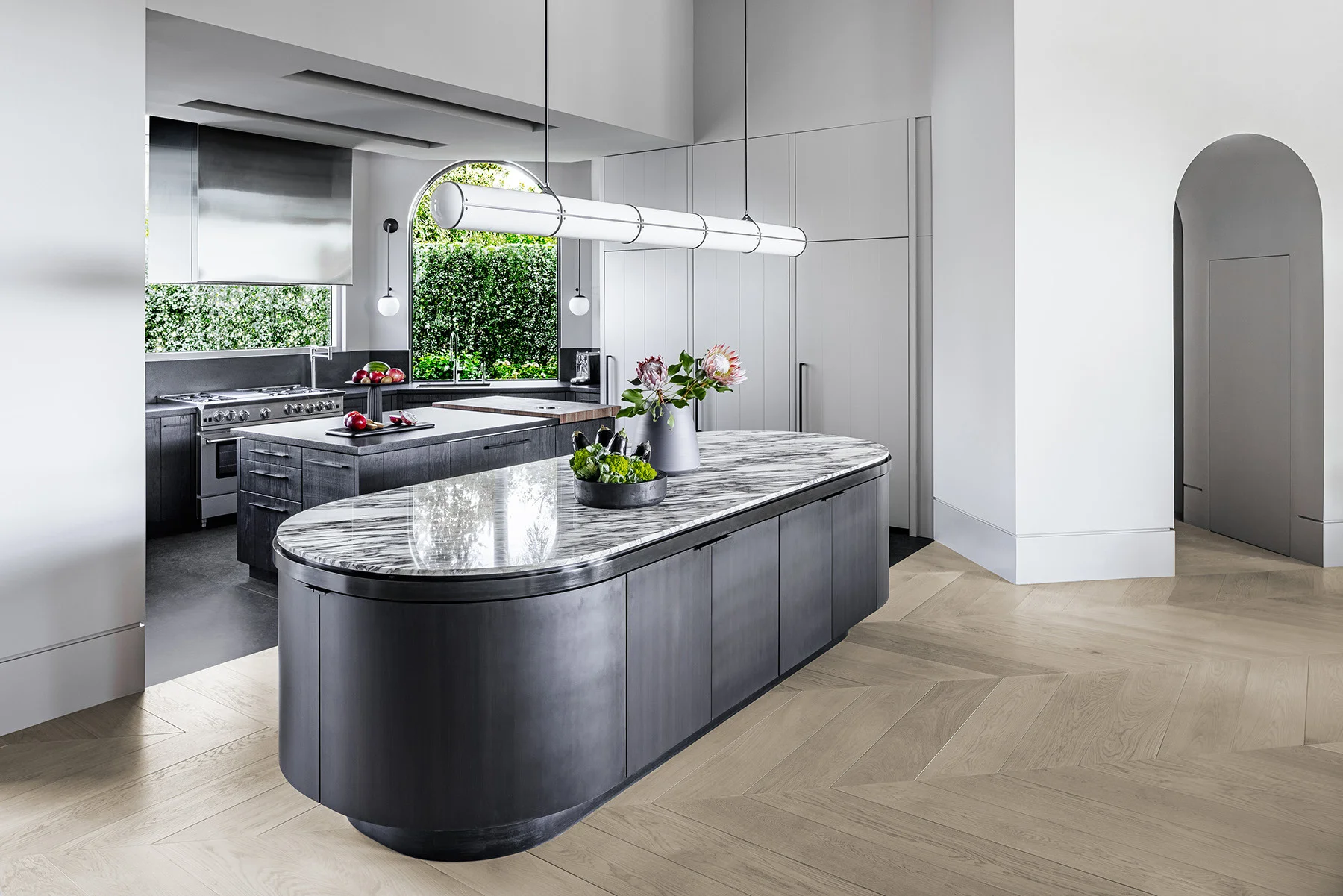
Why Does a Squeaky Wood Floor Happen, and How Do You Fix It?
A deep dive into why wood floors squeak, exploring the physics of timber friction, seasonal humidity, and the structural remedies that restore quiet luxury.
How Is Parquet Installed? Glue-Down vs Floating Floors
Demystify the choice between glue-down and floating parquet installations. Explore how these fitting methods impact acoustics, thermal efficiency, and longevity.