
Quarter Sawn vs Plain Sawn Oak Flooring: What's the Difference
Same tree, same oak: the angle of the saw decides the grain you walk on.

Plain sawn and quarter sawn oak come from the same tree; the difference is the angle at which the saw meets the growth rings. Plain sawn boards are cut roughly along the rings, which shows broad, arched grain. Quarter sawn boards are cut across the rings, which gives straight, tight grain flecked with the silvery ribbons of the medullary rays, and a board that moves less across its width.
Quarter sawn costs more because it gets less wood out of each log. Whether it is worth it for a floor depends on the look you want and on how the board is built.
What is the difference between plain sawn and quarter sawn oak?
Look at the end of a board and you can see the growth rings as curved lines. Their angle to the face of the board defines the cut:
- Plain sawn (also flat sawn or flatgrain): rings at roughly 0 to 30 degrees to the face. The log is sliced straight through, so most boards come out this way.
- Rift sawn: rings at roughly 30 to 60 degrees. The straightest, most even grain.
- Quarter sawn: rings at roughly 60 to 90 degrees. The log is first cut into quarters, then each quarter is sawn toward its center.
A fourth term, live sawn, means the log was sliced straight through and all three cuts were kept together, so a single floor, or even a single wide board, shows all three kinds of grain.
What does each cut look like on a floor?
Plain sawn oak shows the growth rings as wide arches and flames, often called cathedrals, running down the board. It is the most figured, lively grain and the one most people picture when they think of an oak floor.
Quarter sawn oak shows the rings as fine, straight, parallel lines. Oak has another feature that only this cut reveals: the medullary rays, thin sheets of cells that run from the center of the tree outward. Cut across, they appear as silvery flecks and ribbons that catch the light as you move. That ray fleck is the signature of quarter sawn oak and the main reason people ask for it.
Rift sawn oak sits between the two: straight, quiet grain with little or no fleck, the most uniform look of the three.

In the Beaumarchais 108 project in Paris, laid in Droit, the flatgrain boards show the arched figure of plain sawn oak under a warm honey tone.
Why does quarter sawn oak move less?
Wood swells and shrinks with humidity, and not equally in every direction. Movement along the growth rings is roughly twice the movement across them. In a plain sawn board the rings run across its width, so the board widens and narrows more with the seasons and can cup if one face gets wetter than the other. In a quarter sawn board the rings run through the thickness, so most of the movement goes into the thickness, where it matters less.
That matters most for solid boards, wide boards and rooms with big swings in humidity. It matters much less in a layered board, where a thin oak top layer is bonded to a stable backing: the backing controls most of the movement, and the cut of the top layer becomes mainly a question of appearance. Glued down and acclimatized properly, a well-made plain sawn layered board is a stable floor.
Why does quarter sawn oak cost more?
Yield. Plain sawing slices straight through the log and turns most of it into boards. Quartering means more cuts, more handling and more offcuts, and because each quarter is narrower than the log, the boards come out narrower too. Rift sawing wastes the most of all. You pay for the wood that did not become floor.
| Cut | Ring angle to the face | Grain | Movement across the width | Relative cost |
|---|---|---|---|---|
| Plain sawn | About 0 to 30 degrees | Arches and flames (cathedrals) | Most | Lowest |
| Rift sawn | About 30 to 60 degrees | Straight, uniform, little fleck | Least | Highest |
| Quarter sawn | About 60 to 90 degrees | Straight, with ray fleck | Less | Higher |
Which oak cut should you choose for a floor?
Choose quarter sawn if you want straight grain with ray fleck, or if you are laying wide solid boards in a room with large humidity swings. Choose rift sawn for the calmest, most uniform floor. Choose plain sawn for the warmth and movement of classic oak figure, and for the best use of the tree.
The cut also changes how a finish reads. Plain sawn figure shows strongly under a natural or light finish and softens under a dark one; on a patterned floor, such as herringbone or chevron, the arches of flatgrain oak add a second layer of movement to the geometry.
OscarOno Paris's straight boards are flatgrain. Droit, the straight oak board, is flatgrain oak in select grade, 12 mm thick with a 4 mm oak top layer, 150 mm or 190 mm wide, in twelve lacquered colors. Canopée, slim lines of flatgrain oak broken by a fine diagonal cut, uses the same oak in Natural, Smoke (smoked through the full depth of the wood) and Black (charred, in the shou sugi ban tradition).
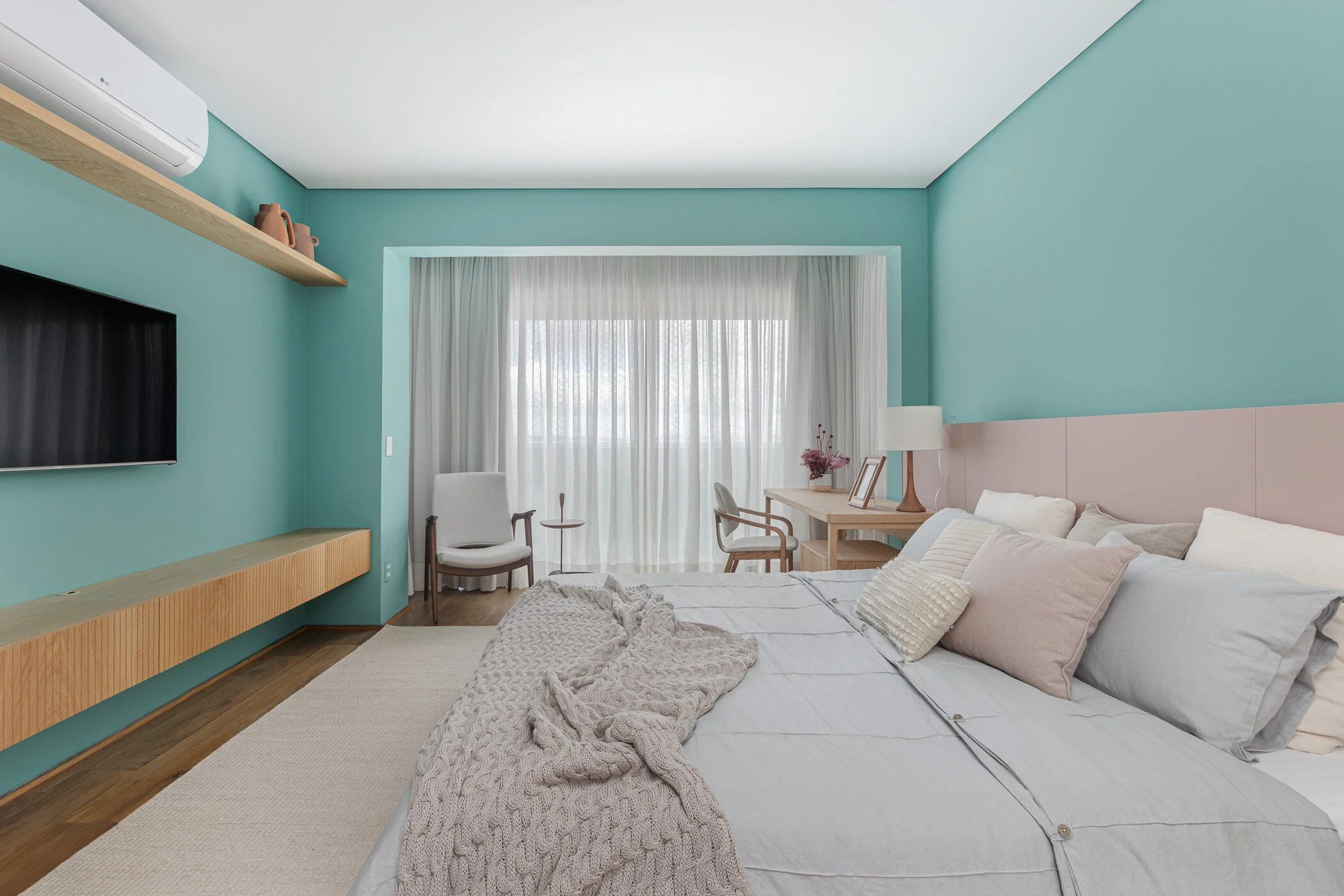
In this private apartment in São Paulo laid in Droit, flatgrain oak in a natural finish keeps the grain visible without dominating the room.
There is also a third way to cut oak, across the trunk rather than along it. End grain shows the growth rings themselves as the surface of the floor; see what is end grain wood flooring and Opus.
Frequently asked questions
Is quarter sawn oak better for flooring?
It is more stable across the width of the board and has straight grain with the silvery flecks of the medullary rays. Plain sawn oak has bolder, arched grain and costs less. Which is better depends on the look you want and on how the board is built: in a layered board the backing controls most of the movement, so the cut of the top layer is mainly a question of appearance.
Why is quarter sawn oak more expensive?
The log has to be quartered and each quarter sawn separately, which takes more handling, yields fewer and narrower boards per log, and leaves more offcuts. Plain sawing slices straight through the log and gets the most usable wood from it.
What is the difference between quarter sawn and rift sawn oak?
The angle of the growth rings to the face of the board. Quarter sawn boards have rings at roughly 60 to 90 degrees and show ray fleck. Rift sawn boards are cut at roughly 30 to 60 degrees, which gives the straightest, most uniform grain with little or no fleck, and the most waste.
What does flatgrain oak mean?
Flatgrain is another name for plain sawn or flat sawn: the face of the board is cut roughly along the growth rings, which shows the arched, flame-like grain often called cathedrals. OscarOno Paris’s Droit and Canopée are flatgrain oak in select grade.
Flatgrain oak by OscarOno Paris
Droit and Canopée are both cut from flatgrain oak in select grade, 12 mm with a 4 mm top layer, rated usage class 33 for heavy commercial traffic, Cfl-s1, and FSC and PEFC certified. Grain is hard to judge from a photo, because ray fleck and cathedrals both change with the light and the angle you look from. Order samples to see the grain in your own room, and find spec sheets, CAD and 3D files in the library.
More from the Atelier
Protecting End Grain Wood Block Flooring from UV Fading
Discover the science of oak photodegradation and how to protect end-grain wood floors from UV fading using advanced varnishes and architectural design.
Parquet Floor Restoration: Is an Old Parquet Floor Worth Saving?
Loose blocks, gaps, stains and a worn finish can all be put right. How to tell whether an old parquet floor is worth restoring, what the work involves, and when it is not.
Squeaky Wood Floors: Why They Squeak and How to Fix Them
A squeak is friction: wood on wood, wood on a nail, or a subfloor moving on its joists. Find which one it is and the fix follows.