
The History of Parquet Flooring: From Versailles to Today
Three centuries of patterned oak, from the royal apartments to the modern home.
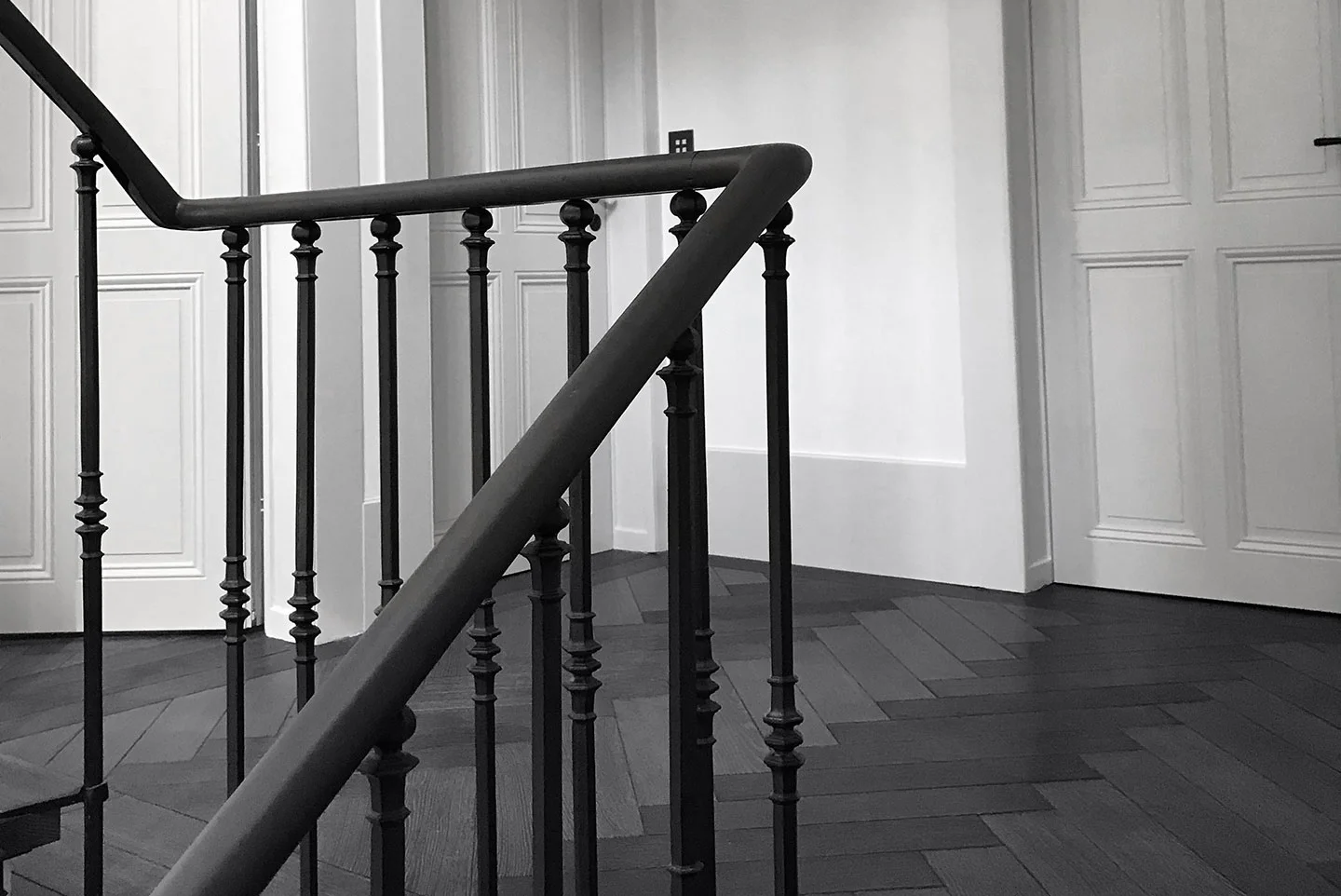
The history of parquet flooring runs from the great houses of seventeenth-century France to today's engineered patterned floors. French joiners began assembling oak into panels and repeating patterns to replace stone and marble, most famously at Versailles, where oak panels replaced marble floors in the late seventeenth century. Herringbone and chevron then spread through Paris apartments in the eighteenth and nineteenth centuries, and the twentieth century turned parquet from a craft into an industry.
Where does the word parquet come from?
Parquet is a French word, a diminutive of parc, an enclosed area. It first meant a small marked-off space, and the patterned wooden floor laid inside it borrowed the name. In French, parquet now covers almost any wooden floor; in English it usually means wood laid in a geometric pattern.
Before parquet: stone, brick and plain boards
The herringbone layout is older than wood floors. Roman builders set bricks and stones in a zigzag known as opus spicatum, both for strength and for looks. For centuries afterward, the grand rooms of Europe were floored in stone, tile or marble, while ordinary houses had wide plain boards. Patterned wood was the step between the two: the warmth of timber with the order of a stone floor.
Versailles and the parquet panel
The best-known moment in parquet's history came at Versailles in the late seventeenth century, when oak panels replaced the marble floors in the royal apartments. The usual explanation is practical: marble was cold, and the water used to wash it seeped into the timber structure below. Oak was warmer underfoot, quieter and drier.
The panel that resulted is the one still called parquet de Versailles, or Versailles parquet: a square of oak, roughly a meter across, framed on four sides and filled with a diagonal lattice of interlaced strips. The pieces were held together with tongue-and-groove joints and wooden pegs rather than glue, and the panels were laid over timber battens. In the eighteenth century the trade manuals of French joinery, André-Jacob Roubo's L'Art du menuisier among them, set out the geometry of these panels in detail, and the pattern spread to grand houses across Europe.
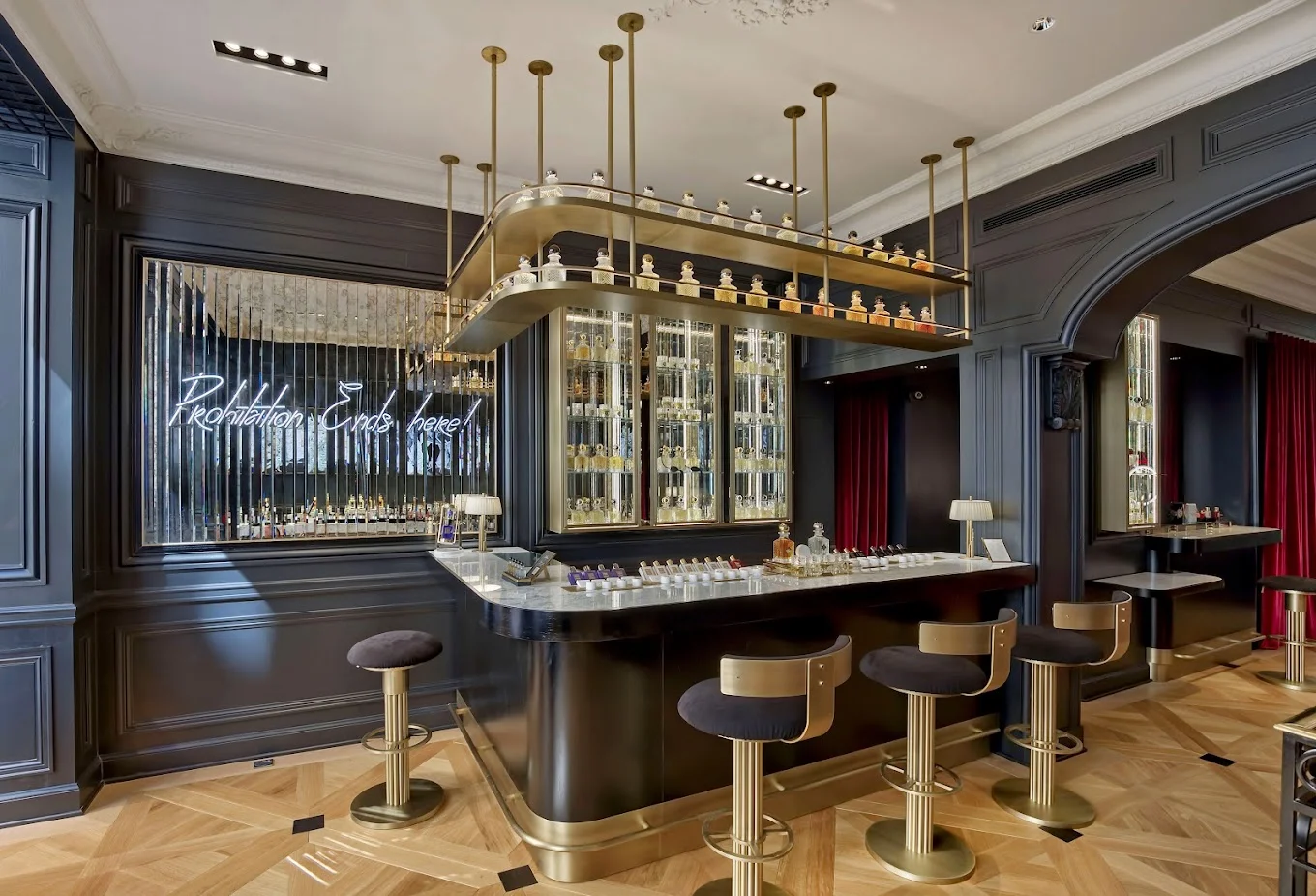
Panel parquet is still made the same way in principle. In the By Kilian boutique in Paris, oak panels with a diagonal lattice set the tone of the room. OscarOno Paris makes panel parquet as Dalle, oak composed into 800 x 800 mm panels.
Herringbone and chevron in Paris apartments
Alongside the panels, two board patterns became the floors of Paris. Herringbone, bâtons rompus or "broken sticks", uses rectangular boards whose square ends butt against the side of the next, in a stepped zigzag. Chevron, point de Hongrie or "Hungarian point", cuts the board ends at an angle so they meet on one straight center line. Where the name point de Hongrie comes from is not known for certain.
Both patterns suited the long enfilades of Parisian apartments, and both became standard in the apartment buildings of Haussmann's rebuilding of Paris in the second half of the nineteenth century. They stayed popular because they play with light: the grain runs one way on one side of each zigzag and the other way on the other, so alternate rows look pale and dark as the light moves. For a closer look at the difference, see herringbone vs chevron.
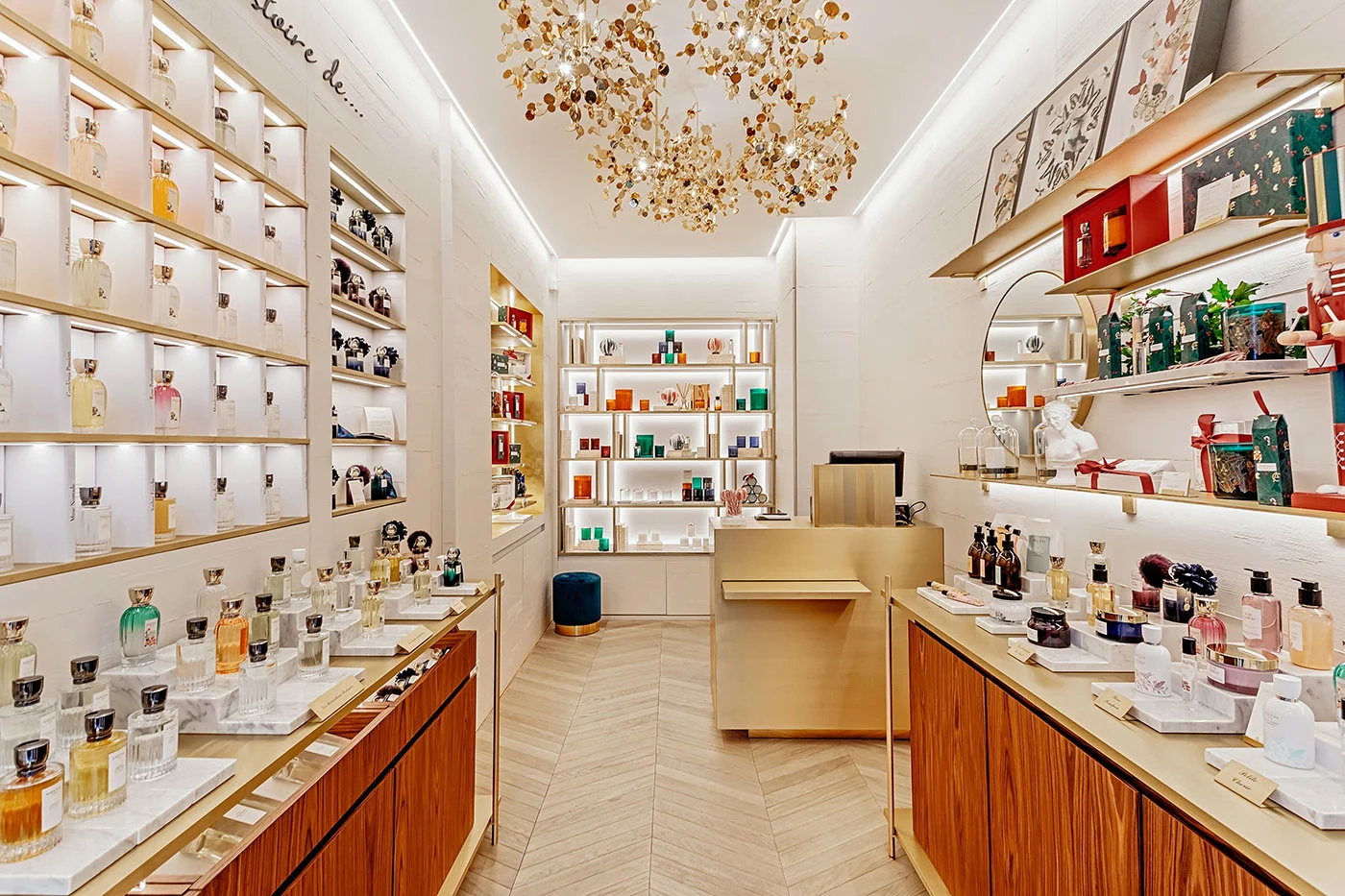
In the Goutal boutique in Paris, a natural oak chevron runs the length of the shop. OscarOno Paris makes the two patterns as Rompu, a herringbone in oak, and Hongrie, a chevron in oak.
Endgrain wood paving in nineteenth-century Paris
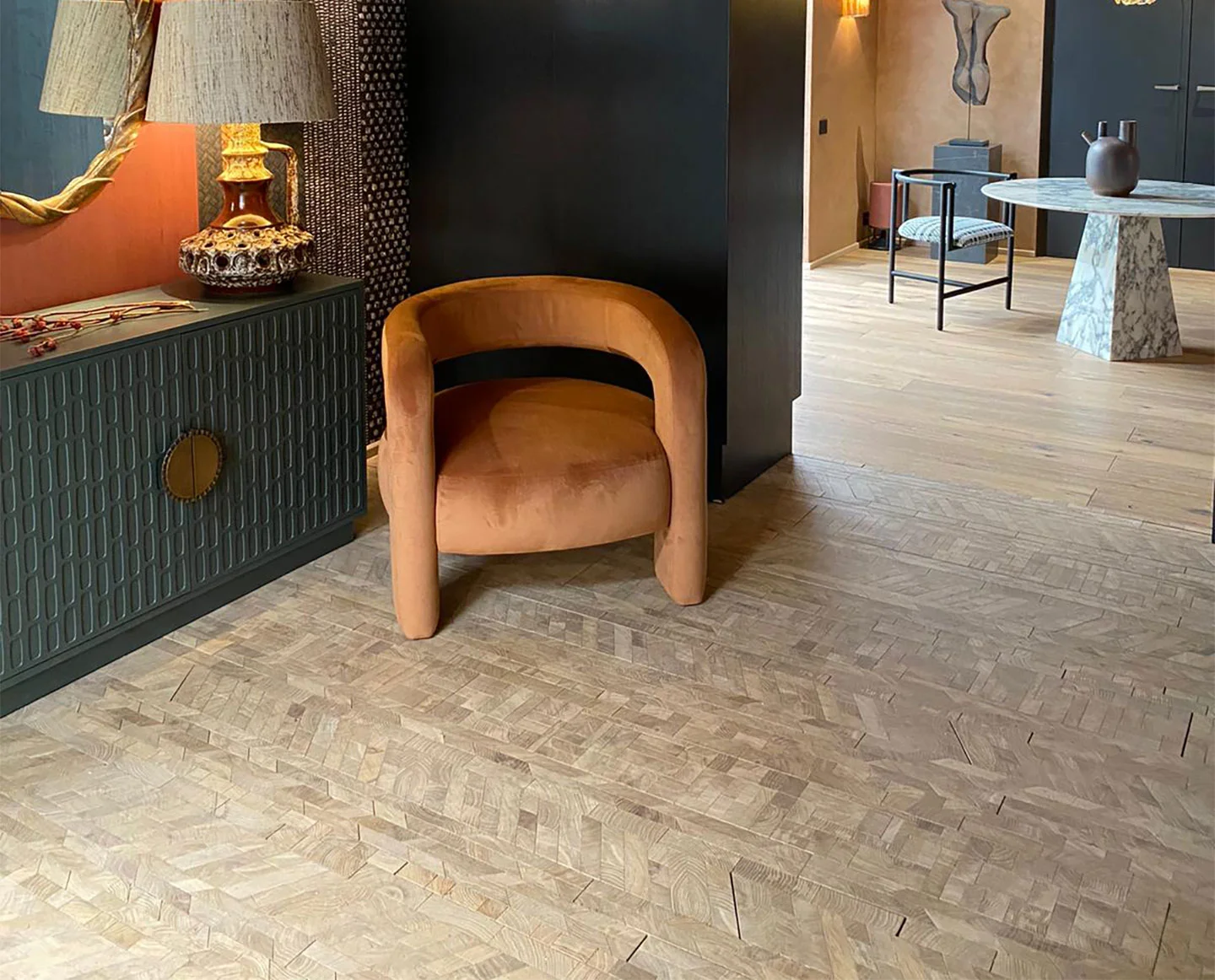
Parquet was not the only way Paris used wood underfoot. In the nineteenth century, blocks of wood set on end, so the growth rings face up, were used as paving: endgrain is the hardest face of the wood, and the blocks were quieter than stone under wheels and hooves. The craft disappeared with asphalt. Opus revives nineteenth-century Parisian oak paving for interiors, cutting the oak on its endgrain face into an organic pattern whose joins disappear into one surface.
How the twentieth century changed parquet
Machines made parquet affordable. Strip and block parquet were produced in volume, mosaic parquet made of small strips glued into squares became common in postwar housing, and parquet moved from the salon into ordinary homes. The finish changed too, from wax to varnish and then to modern lacquers and oils.
The largest change came later, with boards built in layers: a hardwood top layer on a stable base. The layered construction moves less with humidity, makes patterned floors faster to lay, and suits underfloor heating, which is why most new parquet is now made this way.
Parquet today
The patterns are the same ones Paris has laid for centuries, but the way they are used has changed. Boards are often wider and longer, which calms the pattern down; finishes tend toward matte; and color is chosen as freely as the pattern. Panels, herringbone and chevron sit next to new geometries and endgrain floors that would have been impossible to make by hand at scale.
| Pattern | French name | Associated with | OscarOno Paris collection |
|---|---|---|---|
| Panel parquet | parquet de Versailles | Versailles and the grand houses, from the late seventeenth century | Dalle |
| Herringbone | bâtons rompus | Roman brick and stone; French great houses, then Paris apartments | Rompu |
| Chevron | point de Hongrie | Nineteenth-century Paris apartments | Hongrie |
| Endgrain wood paving | pavé de bois | Nineteenth-century Paris streets | Opus |
Frequently asked questions
When was parquet flooring invented?
Patterned wood floors took their recognizable form in France in the seventeenth century, when joiners began assembling oak into panels and repeating patterns instead of laying plain boards. The herringbone layout itself is far older: Roman builders laid brick and stone that way.
Why is it called parquet de Versailles?
The square oak panel with a diagonal lattice is named after the Palace of Versailles, where oak panels replaced marble floors in the late seventeenth century. The design was copied in grand houses across Europe, and the name stuck to the pattern.
Where does the word parquet come from?
It is French, a diminutive of parc, an enclosed area. It first meant a small marked-off space and only later the patterned wooden floor laid in one.
What is the difference between parquet and hardwood flooring?
Parquet describes a pattern: wood laid in a geometric arrangement such as herringbone, chevron or panels. Hardwood flooring describes the material, and often means straight boards. A parquet floor is a hardwood floor, but a hardwood floor is not necessarily parquet.
Historic patterns by OscarOno Paris
Dalle, Rompu and Hongrie share one specification: flatgrain select oak, 12 mm with a 4 mm oak top layer, in twelve lacquered colors, rated usage class 33 for heavy commercial traffic, Cfl-s1, FSC and PEFC certified. Rompu and Hongrie come in 150 mm or 190 mm widths; Dalle comes as 800 x 800 mm panels. Opus is endgrain oak in Natural, Smoke or Black, rated usage class 34. To see how a pattern behaves in your own light, order samples, and find spec sheets, CAD and 3D files in the library.
More from the Atelier
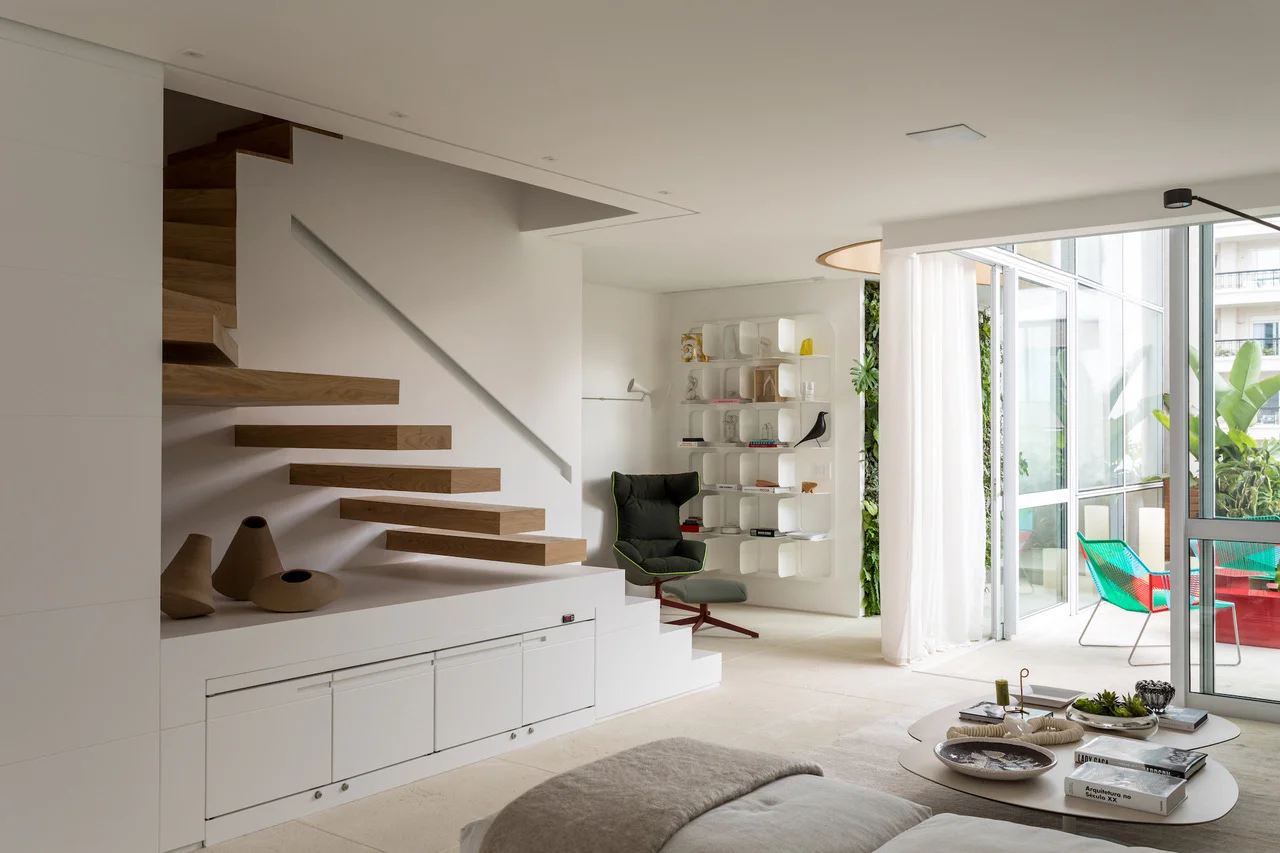
Wood Floors in the Bedroom: How to Choose a Calm, Quiet Floor
Wood is warm underfoot, easy to keep dust-free and lasts for decades in a low-traffic room. How to choose the color, finish, layout and acoustics of a bedroom floor.
Light Oak Flooring for Bright, Sunlit and Coastal Rooms
Pale oak suits sunlit and seaside rooms, if you get the finish right. How light oak changes in the sun, and what sand, humidity and glare mean for it.
Wide Plank Oak Flooring for a Minimalist Interior
Fewer joints, a clean grade, a low sheen and one direction through the house: how to choose wide plank oak for a minimalist interior, and when an end grain grid does the job better.