
Herringbone Flooring: Why the Pattern Never Goes Out of Style
Where the pattern comes from, why it plays with light, and how width and color change it.
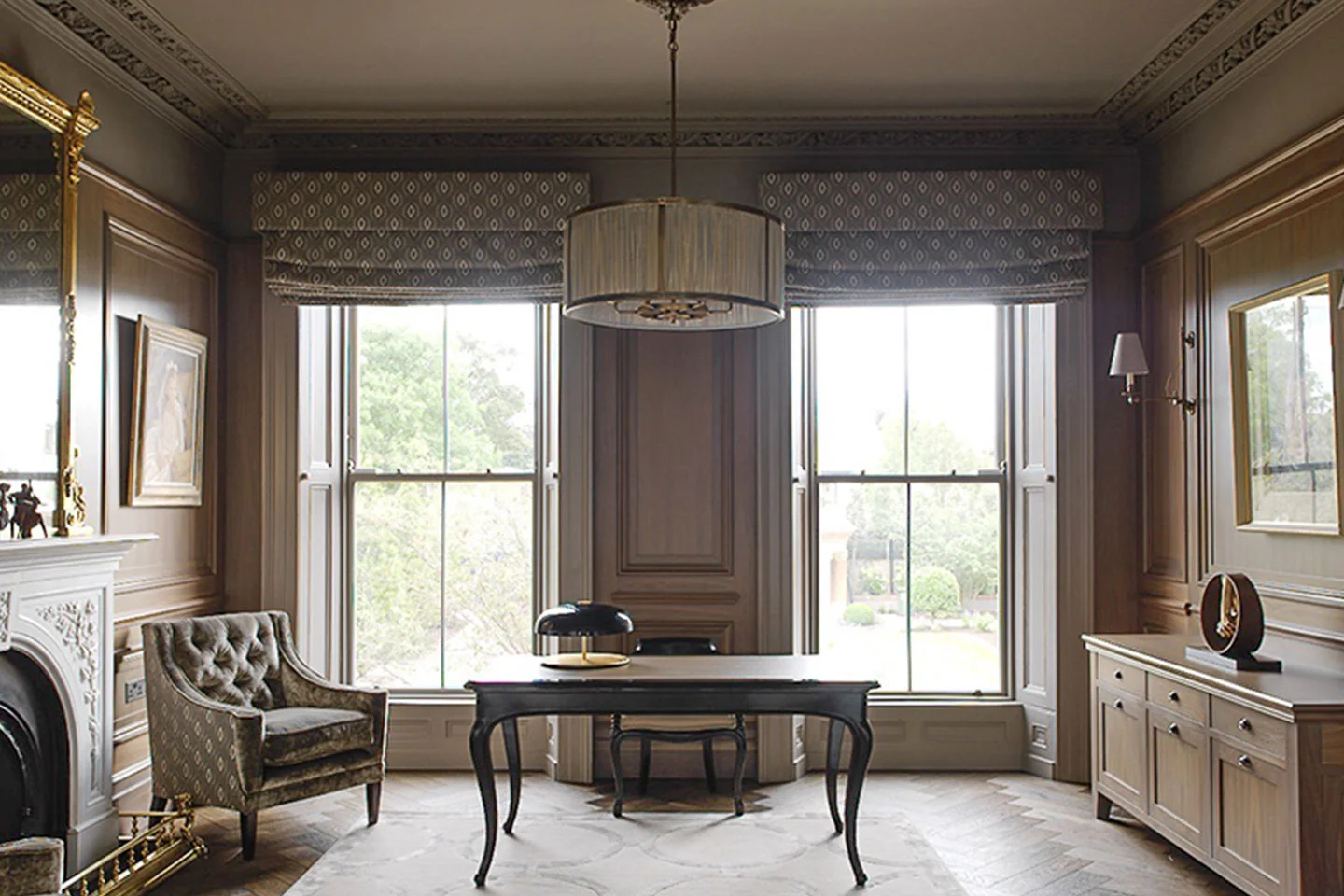
Herringbone flooring stays in style because it is pure geometry: rectangular boards laid at right angles in a stepped zigzag, with no ornament to date it. The pattern catches light differently on each side of the zigzag, works in a period apartment as easily as in a concrete loft, and changes character with the width of the board and the color of the wood.
It is also one of the most searched floors there is, and interest has kept growing. Here is what makes it last, and how to choose one that will still look right in twenty years.
Where does herringbone flooring come from?
The layout is older than wood floors. Roman builders laid bricks and stones in the same zigzag, a technique called opus spicatum. The pattern later moved into wood, and in France it took the name bâtons rompus, "broken sticks", after the way each board seems to stop short against its neighbor.
Paris has laid it for around three hundred years. It runs through countless apartments there, from grand reception rooms to small upper-floor flats, which is one reason it reads as classic rather than fashionable: people have lived on it for generations without tiring of it. OscarOno Paris makes it as Rompu, a herringbone in oak.
Why does herringbone never look dated?
- It is structure, not decoration. The pattern comes from how the boards are laid, not from inlays or borders, so it sits comfortably with any style of furniture.
- It plays with light. The grain runs one way on one side of each zigzag and the other way on the other side. In raking light one set of boards looks pale and the other darker, and the floor shimmers as the light moves through the day.
- It has direction without insisting. The staggered joints soften the lines, so herringbone suits square rooms and open plans where furniture faces several ways.
- It adapts. The same pattern can look traditional, minimal or graphic depending on board size and finish.
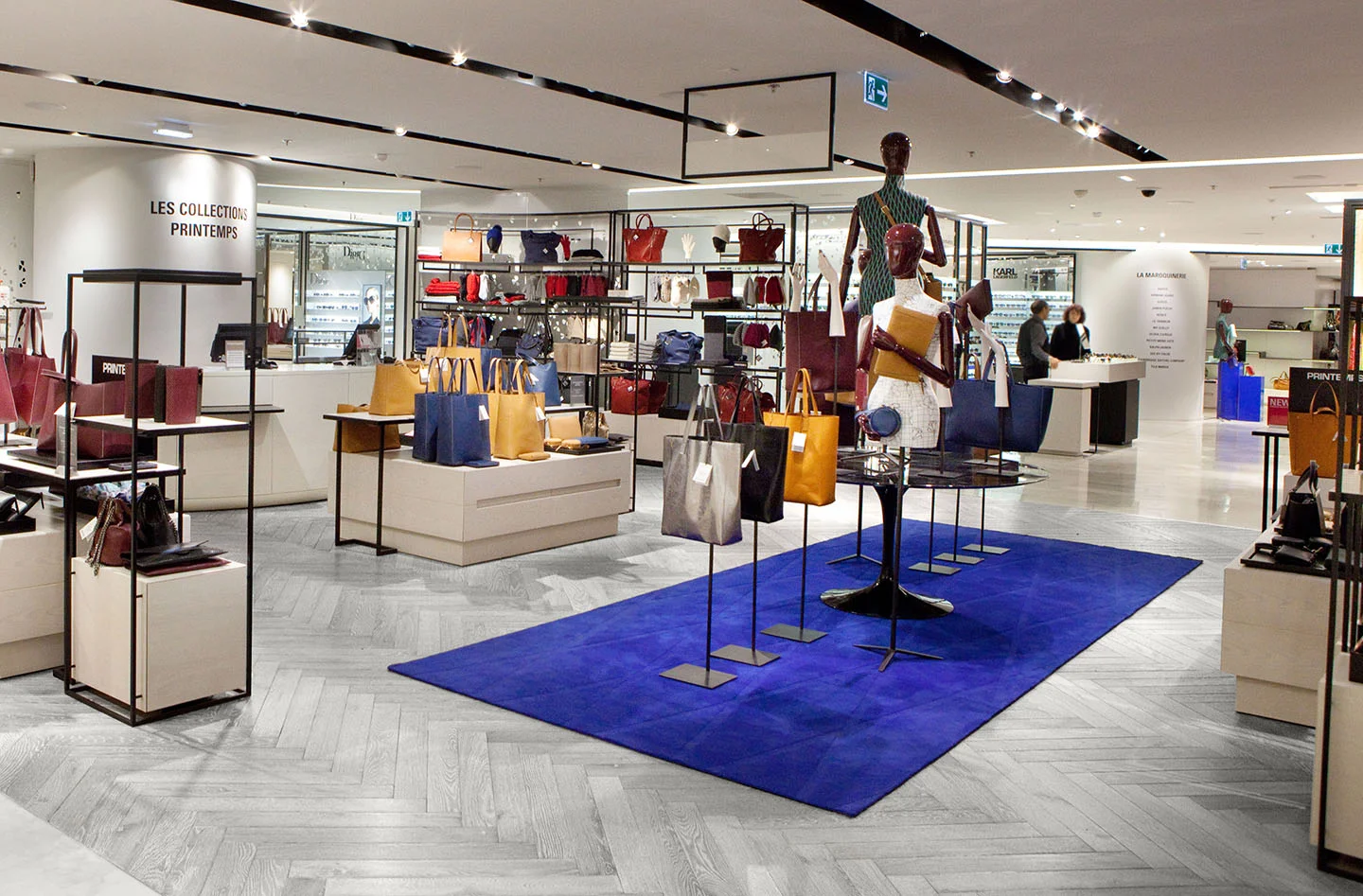
At Le Printemps in Paris, laid in Rompu in a pale finish, the pattern gives a large retail floor texture without competing with what is on display.
Herringbone vs chevron: which one is it?
The two are often confused. Herringbone boards have square ends and meet end against side, so the zigzag steps along. Chevron boards have their ends cut at an angle and meet point to point on one straight line. Chevron points like an arrow; herringbone has a softer, woven look. OscarOno Paris makes chevron as Hongrie. For a full comparison, see herringbone vs chevron: how to tell them apart.
How does board size change a herringbone floor?
Board size sets the mood. Short, narrow boards make a busy, detailed floor that recalls old Paris. Wider boards slow the rhythm of the zigzag, show more of the grain and suit larger rooms and open-plan spaces, where a fine pattern can look fussy.
Rompu comes in two widths, 150 mm or 190 mm. The narrower board keeps the classic rhythm; the wider one gives a bolder, calmer pattern. Both are flatgrain oak in select grade, 12 mm thick with a 4 mm oak top layer.
Which colors suit herringbone today?
Light, natural oak is the strongest trend in wood floors, and it suits herringbone well: the pattern stays quiet and the grain does the work. Mid browns keep the warmth of a traditional parquet. At the other end, dark and black herringbone is growing fast, because a deep color turns the zigzag into a graphic, almost tailored surface.
Rompu is offered in twelve lacquered colors, from pale to near black, so the pattern and the tone can be chosen separately.
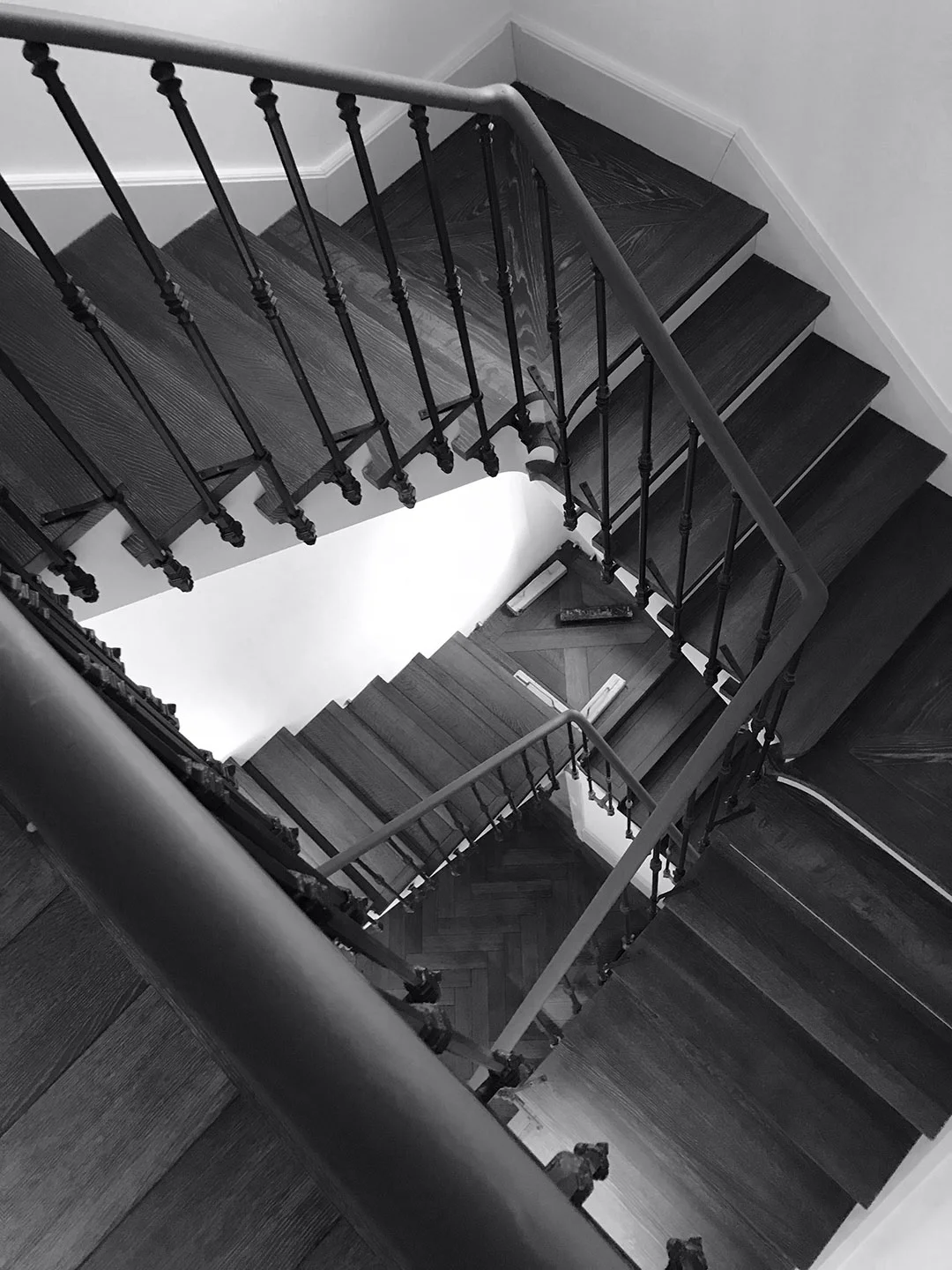
In this private residence in Geneva, laid in Rompu in a near-black finish, the herringbone reads as a fine texture rather than a pattern.
How do you make herringbone feel modern?
Keep the rest of the room simple and let the floor bring the texture: plain plaster walls, a restrained palette and furniture with clean lines. Run the pattern continuously through connected rooms instead of changing floor at every door, and decide the direction of the zigzag before anything else, usually along the main axis of the room or toward the light.
Frequently asked questions
Is herringbone flooring still in style?
Yes. Herringbone has been laid in Paris apartments for around three hundred years and is still one of the most searched floor patterns. What changes is the board size and the color: wider boards and light natural oak feel current, and dark and black herringbone is gaining ground.
Does herringbone flooring make a room look bigger?
It can. The zigzag carries the eye across the floor and gives a room movement without the strong single direction of chevron. Lighter colors and wider boards make the pattern calmer, which helps a small room feel more open.
What is the difference between herringbone and chevron?
Herringbone uses rectangular boards with square ends, laid so the end of one board butts against the side of the next, which gives a stepped zigzag. Chevron boards have their ends cut at an angle and meet point to point on a straight center line, forming clean V shapes.
Does herringbone cost more than straight boards?
Usually, yes. Every board has to be placed at an angle to its neighbors, the layout has to be set out carefully from the center of the room, and more wood is cut away at the walls. It is still less exacting than chevron.
Can herringbone flooring go over underfloor heating?
The pattern itself makes no difference. What matters is the construction of the boards and the installation: patterned floors over underfloor heating are normally engineered boards glued to the screed. Check the product's spec sheet for its heating compatibility before you commit.
Herringbone flooring by OscarOno Paris
OscarOno Paris makes herringbone as Rompu: flatgrain select oak, 12 mm with a 4 mm top layer, 150 mm or 190 mm wide, in twelve lacquered colors. It is rated usage class 33 for heavy commercial traffic, carries a Cfl-s1 fire rating and is FSC and PEFC certified, so the same floor can run from an apartment into a shop or a hotel.
Color and board width are easiest to judge in your own light. Order samples, and find spec sheets, CAD and 3D files in the library.
More from the Atelier
What Is Wood Terrazzo Flooring? An Architectural Guide
Wood terrazzo flooring unites reclaimed endgrain oak offcuts and mineral ground, creating continuous, tactile surfaces designed for circular luxury interiors.
Modern Versailles Parquet: The Classic Panel in Today's Interiors
The woven oak panel first laid in a palace still works in a contemporary room. What changes is the color, the construction and how freely the weave is drawn.
Wood Floor Interior Design: Pairing Oak with Linen, Stone and Brass
Start with the floor, then balance it: stone for weight, linen for softness, brass for light. A practical guide to designing a room around wood.