
Chevron Flooring: What Point de Hongrie Is and How to Use It
The French chevron is the simplest pattern to recognize and the hardest to lay well.
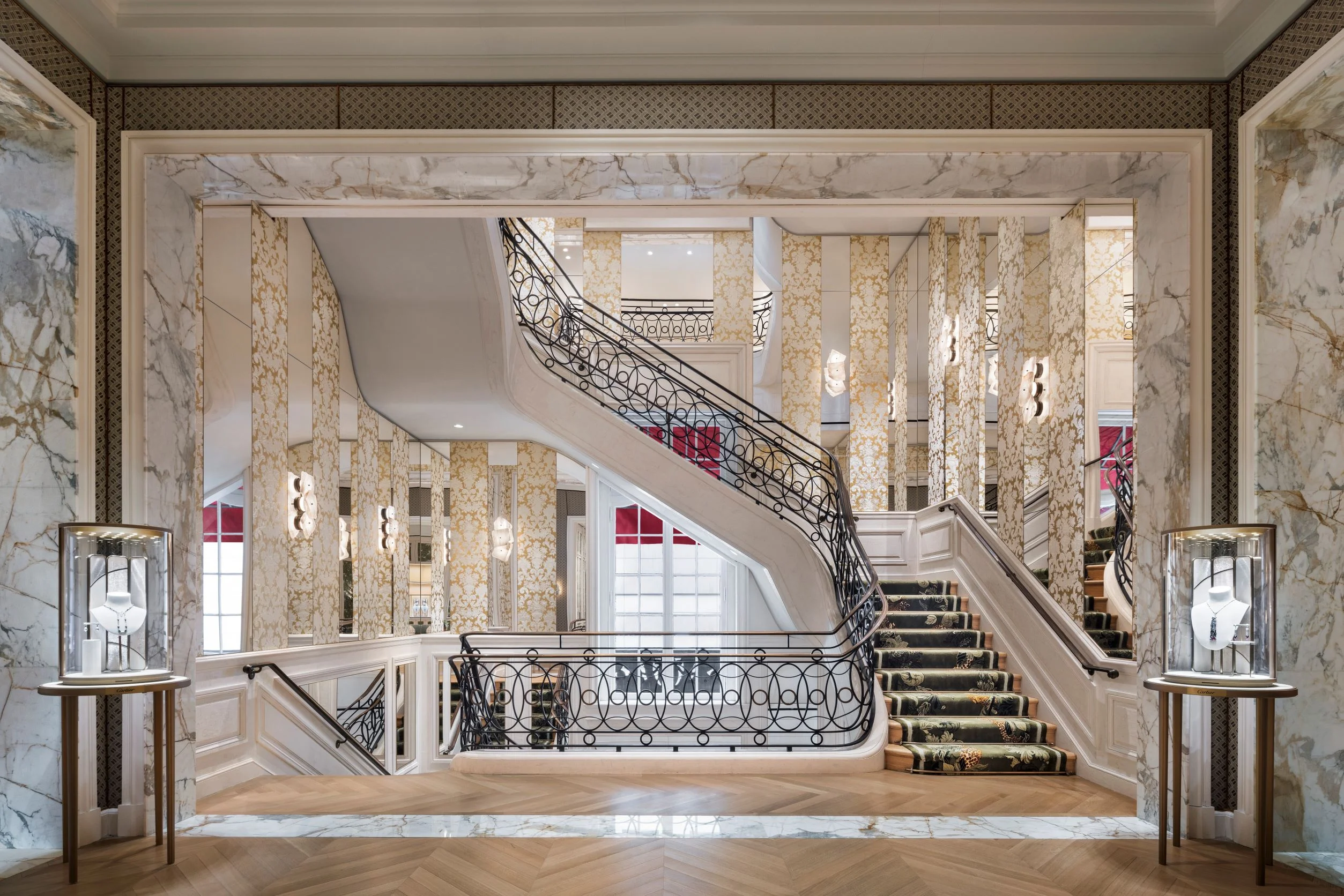
Chevron flooring is a parquet pattern made of boards whose ends are cut at an angle, so they meet point to point along a straight center line and form a column of V shapes. In French it is called point de Hongrie, and it is the floor most people picture in a nineteenth-century Paris apartment.
It looks simple, and that is the difficulty: one straight seam runs the length of every row, so every error in cutting or laying shows.
What is chevron flooring?
Each chevron board is a parallelogram rather than a rectangle: both ends are cut at the same angle, usually 45 degrees and sometimes steeper or shallower. Boards come in two hands, a left and a right, and are laid in pairs so the angled ends meet tip to tip. The joints line up into one continuous straight line, and the rows step down the room as a series of arrows.
That straight seam is what separates chevron from herringbone, whose square-ended boards stop against the side of the next board and leave a stepped, broken joint. If you are unsure which one you are looking at, see herringbone vs chevron: how to tell them apart.
OscarOno Paris makes chevron as Hongrie, point de Hongrie in oak, the chevron running sharp and unbroken down the room.
Why is it called point de Hongrie?
The French name point de Hongrie means "Hungarian point". Nobody knows for certain where the name comes from. The same name is used in needlework for a zigzag stitch, and the floor most likely borrowed it from there. What is certain is that the pattern was developed in French parquet and became the defining floor of Paris apartments in the nineteenth century, laid in long straight lines through the connecting reception rooms.
Where does chevron flooring work best?
Wherever a space has a clear direction. Chevron points, so it reads best when it points somewhere:
- Long rooms and hallways. Run the points down the length of the room and it reads longer. Run them across and it reads shorter.
- A sequence of rooms. Carried through the doorways on one axis, a chevron ties several rooms into one long perspective, which is exactly how Paris apartments use it.
- Toward a focal point. Aim the V at a window, a fireplace or an entrance and the floor frames it.
- Shops and hotels. The strong line leads visitors through the space, which is why chevron is common in retail.
In a square room with no obvious axis, chevron can feel insistent. There, herringbone, which has a softer direction, is often the easier choice.
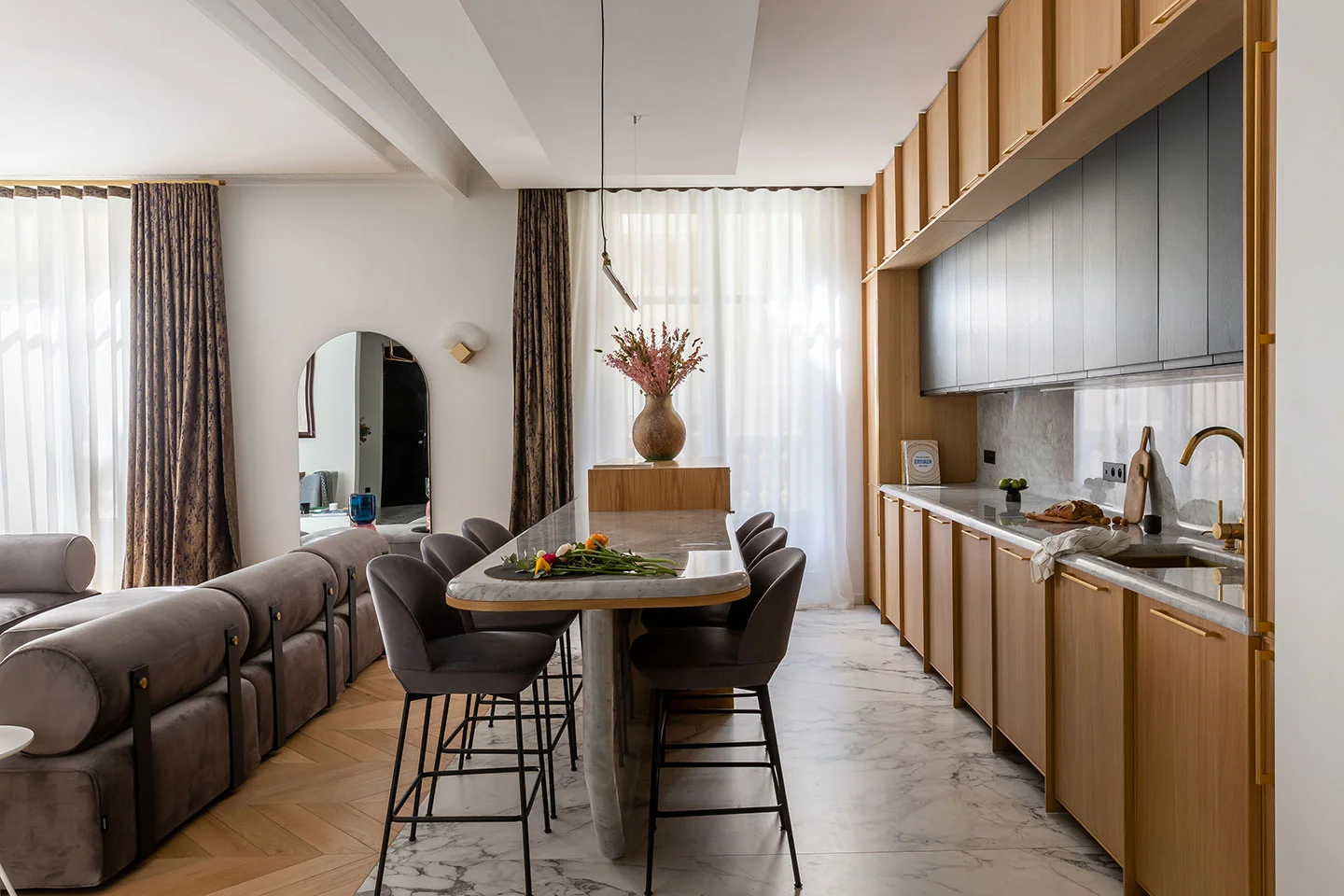
In this private apartment in Paris laid in Hongrie, a honey-toned chevron follows the classic Paris use of the pattern.
How do light and color change a chevron floor?
The grain runs one way on the left side of each V and the other way on the right. In raking light, one side reflects more than the other, so a chevron floor shows alternating pale and darker bands that shift through the day and as you walk across it. Natural and light tones make that play of light the main effect; darker colors make the geometry itself more graphic.
Board width changes the rhythm. A narrower board gives more, smaller V shapes and a more traditional floor; a wider board gives fewer, bolder ones and a calmer room. Hongrie comes in 150 mm or 190 mm widths and in twelve lacquered colors, so width and tone can be chosen separately.
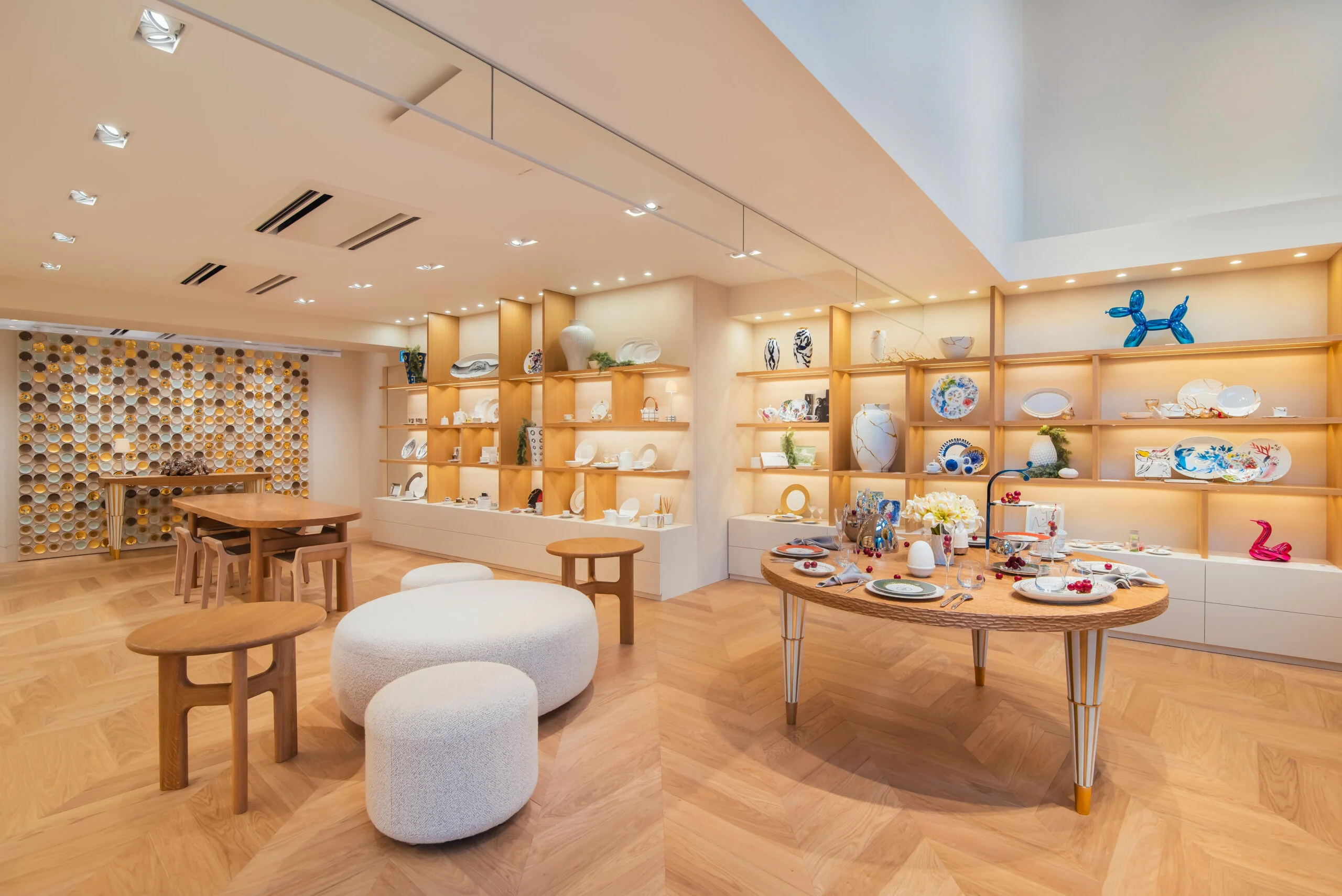
At Bernardaud in Tokyo, laid in Hongrie, a natural chevron leads through a retail space.
How is chevron flooring laid?
From the center line out. The fitter first fixes the axis the points will follow, usually the center of the room or of its main view, and sets out the rows from it so that the cut pieces at the two walls are equal and not thin slivers. Dry-laying a few rows before gluing confirms the line and the layout.
The subfloor has to be flat and sound. Any dip or error in the first rows is carried along the whole floor, and on chevron it shows as a center line that wanders. This is why chevron is usually glued down and laid by fitters who do patterned floors regularly.
Why does chevron cost more than other patterns?
Three reasons: each board needs an accurate angled cut at both ends, the straight center line leaves no room for error in fitting, and the angled rows leave more offcuts where they meet the walls. Herringbone costs more to lay than straight boards, and chevron usually costs more again.
Frequently asked questions
What is chevron flooring?
A parquet pattern made of boards whose ends are cut at an angle, so that they meet point to point along a straight center line. Row after row, the floor forms a column of V shapes. In French it is called point de Hongrie.
Why is chevron called point de Hongrie?
The French name point de Hongrie means Hungarian point. The origin of the name is uncertain: the same name is used in needlework for a zigzag stitch, and the floor probably borrowed it. The pattern itself was developed and made famous in French parquet.
Is chevron flooring more expensive than herringbone?
Usually, yes. Every board needs an accurate angled cut at both ends, the fitter has to keep the center line straight across the whole room, and more wood is cut away where the rows meet the walls.
Which direction should chevron flooring run?
Along the main axis of the space, with the V shapes pointing down the length of the room or toward the feature you want to frame, such as a window, a fireplace or the next room. Laid across a narrow room, chevron makes it feel shorter.
Chevron flooring by OscarOno Paris
Hongrie is OscarOno Paris's chevron: flatgrain select oak, 12 mm with a 4 mm top layer, 150 mm or 190 mm wide, in twelve lacquered colors. It is rated usage class 33 for heavy commercial traffic, carries a Cfl-s1 fire rating and is FSC and PEFC certified, so the same chevron can run through an apartment, a shop or a hotel.
A chevron is easiest to judge with two boards side by side in your own light. Order samples, and find spec sheets, CAD and 3D files in the library.
More from the Atelier
Reclaimed Teak Flooring: End-Grain Strength and Resilience
Explore how reclaimed teak flooring and end-grain timber provide extraordinary durability, natural silica protection, and stability for demanding spaces.
How to Prevent Fading on Hardwood Floors: Design Guide
An architectural approach to managing sun exposure on wood floors, from spectrally selective glazing to finish choices and uniform patina development.
The Craft of Marquetry Parquet Flooring and Panels
Marquetry parquet flooring bridges historical French palace geometry with contemporary minimalism, bringing architectural structure to luxury interiors.